
Barberry
 2
2 6
6 6
6Will it grow where I live?
Barberry is hardy to zone 3 – that covers all of Central Europe and the British Isles, and every USDA zone from 3 upwards.
Or check it for your location right here:
Profile
- Family
- Berberidaceae
- Habit
- Shrub
- Height
- 3 m
- Spread
- 2 m
- Growth
- medium
- Lifespan
- 70 years
- First yield
- after 3 years
- Yield per plant
- up to 0.4 kg a year
- Yield in cultivation
- up to 1 t/ha
- Energy yield
- 320 kcal per m² a year
- Hardiness
- zone 3–7
- Shade tolerance
- partial shade
- Soil
- Sand, Silt, Loam, Clay
- Soil moisture
- dry – very moist
- pH
- 4 – 7
- Synonyms
- Berberitze
Flowering & harvest
| J | F | M | A | M | J | J | A | S | O | N | D | |
|---|---|---|---|---|---|---|---|---|---|---|---|---|
| Flowering | ||||||||||||
| Fruit harvest | ||||||||||||
| Leaf harvest |
Varieties (8)
8 varieties of Barberry are listed in the Permaplans variety finder — each with its own page: taste, ripening time, disease resistance, parentage and use.
Uses
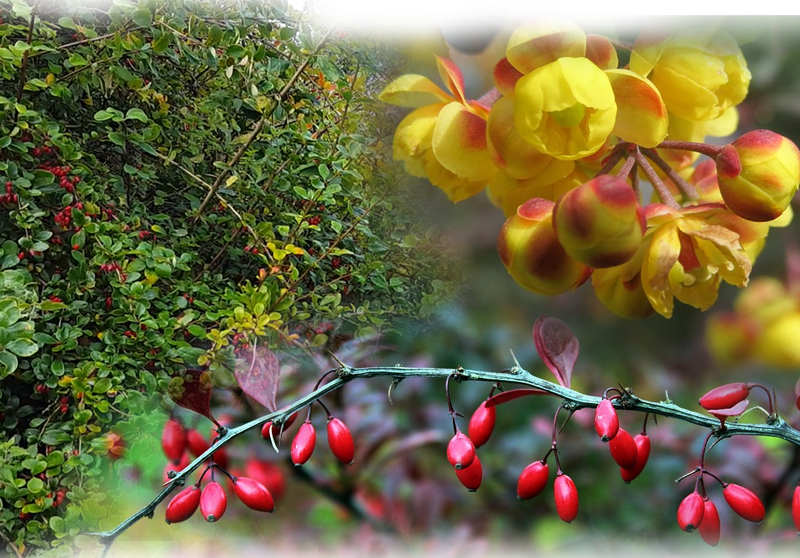
Edible: The fruits are oblong-oval, cylindrical berries eight to twelve millimetres long and bright red, with two or three seeds. They ripen from September and are edible, though the flesh is decidedly sour: it holds around 3.1 grams of fruit acids per hundred grams — citric, tartaric and malic — alongside 5.5 grams of sugar and 20 milligrams of vitamin C. Frost softens the acidity somewhat, after which the berries are also eaten raw with sugar. Usually, though, they serve as an acid and aroma carrier in jellies, mixed-fruit jams and sweet musts of pear or apple; the neat juice replaces lemon in salads and with meat. Mead, vinegar and spirits can also be made from them. One caution: the seeds should not be eaten, so the fruit is sieved when processed. In Persia and India lightly dried, all but seedless barberries are an everyday ingredient known as zereshk, served over rice.
Medicinal: The roots of Berberis species are utilized for treating ulcers, urinary tract discharges, eye inflammations, jaundice, and fever. They contain 2.1% berberine, while the stems contain 1.3%. In Nepal, the bark and wood are crushed, boiled, strained, and evaporated to form a viscous mass with antibacterial, laxative, and tonic properties. This mass is ingested for fever and applied externally for eye inflammations like conjunctivitis. Tender leaf buds can be chewed and held against aching teeth to treat dental caries. The fruit has cooling and laxative effects. Berberine found in the rhizomes of Berberis species exhibits potent antibacterial effects and is orally administered for treating intestinal infections, especially bacterial dysentery. It should not be used in conjunction with Glycyrrhiza species (licorice) as it may diminish the efficacy of berberine. Berberine has also demonstrated antitumor activities.
Other uses: The wood and roots of barberry are bright yellow, and that pigment is the alkaloid berberine. Roots, bark and stems once yielded a high-grade yellow dye for leather, wool, silk and wood — a use that vanished with synthetic dyes. The wood itself is hard, fine-grained and yellow and was used for carving, toothpicks, mosaics and inlay, but its small dimensions leave it without practical role today. In the landscape, by contrast, barberry is as sought after as ever: as a dense, thorny hedging shrub for boundaries, banks and difficult sites, as a windbreak and as a component of field hedges. In autumn its foliage turns yellowish orange-red, which together with the red fruit makes it an ornamental shrub as well.
Growing
Site: Two things decide the position. First, wheat stem rust: the fungus alternates between barberry and cereals, so the shrub does not belong right next to cereal fields — in gardens far from arable land this is irrelevant, at the edge of a wheat field it is not. Second, the thorns: the leaf spines, up to two centimetres long and usually three-parted, sit densely and make the shrub a nuisance beside paths, seating and play areas, while making it the best argument there is for an impenetrable boundary. That is precisely where its ecological value lies: it is a first-rate shelter and nesting shrub in which no cat hunts. Plan for the root suckers by which it slowly spreads, and for a harvest that stays awkward because of the spines. Care: A shrub is hardly less demanding. Do not feed — barberry comes from nitrogen-poor ground and repays fertiliser with soft growth prone to mildew. It takes cutting very well, reshoots reliably from old wood and can be kept as a clipped hedge or grown freely; to rejuvenate it, cut it back to the stool in winter. Gloves and long-handled loppers are essential for that. In dry years mildew appears, avoidable by thinning and an airy position. Harvest from September, best after the first frosts, which soften the acidity a little; to work faster, cut off whole trusses of fruit. Suckers that wander too far are severed with a spade.
Propagation
The simplest route is by root suckers: barberry produces them freely, and a rooted sucker is severed with a spade in autumn or early spring and moved. For larger numbers, sow. Wash the seed out of fully ripe berries in autumn — all the flesh must come off — then stratify it cold over winter, or sow it straight into a sheltered outdoor seedbed where it gets the cold naturally; germination follows in spring, often unevenly and spread over two years. Semi-ripe cuttings in July and August root well under cover, and spring layering nearly always works. In every operation the three-parted spines are the main problem: allow for stout gloves and long sleeves. Seedlings flower from their third or fourth year.
Value for wildlife
Barberry is one of the most valuable hedging shrubs Central Europe has to offer, and on three levels. The bright yellow, strongly scented flowers stand in hanging racemes in May and June and yield nectar freely — its nectar value is rated three out of four — to flies, hymenopterans and beetles; the irritable stamens snap towards the stigma within a tenth of a second when touched and dust the visitor, a pollination mechanism you can trigger with a blade of grass in calm weather. As a caterpillar food plant its leaves support 18 moth and butterfly species, four of them confined to barberries. The red berries ripen from September and hang on into winter; 19 bird species eat them and distribute the seed. Heaviest of all, though, is the structure: the dense tangle of shoots bristling with spines up to two centimetres long is a shelter and nesting shrub of the first order, in which red-backed shrikes, warblers and dunnocks breed beyond the reach of cat or marten.
Notable
Specialties: drought and wind tolerant, commercially grown in Iran in Khorosan at temperatures ranging from -38° to +44°C and annual rainfall of only ~180mm; varieties include 'Apserma' (seedless), 'Dulcis', or large-fruited: B. koreana 'Rubin'; intermediate host of cereal fungal pest.
Origin & habitat
Europe and western Asia: from southern, western and central Europe east to Asia Minor and the Caucasus. Barberry climbs from the lowlands to 2,500 metres in the Alps, making it one of the highest-ascending shrubs of Central Europe. Across much of Germany it is scarcer today than it once was, and for a historical reason: because it is the alternate host of wheat stem rust, it was systematically eradicated in cereal-growing regions during the 19th and early 20th centuries. In North America, where European settlers brought it as a useful and hedging plant, it has by contrast spread widely and is classed as invasive in several states.
Barberry is a half-light plant of sunny, warm and calcareous places. It occupies woodland edges, hedges, open floodplain woods and free-standing groups of scrub, and is a character species of warmth-loving barberry thickets. It takes dry to moderately moist soils that are markedly low in nitrogen — on fed garden soil it loses out to stronger neighbours, on lean calcareous ground it prevails. It grows into a densely branched shrub two and a half to three metres tall with arching shoots, and forms root suckers with which it merges into impenetrable thickets with age. Drought, heat and wind suit it well; waterlogging does not.
⚠️ Hazards
Poisonous apart from the fruit, injury risk from spines With the exception of the berries the whole plant is poisonous, the root especially. The principal compound is the alkaloid berberine at around one to three per cent, which colours the wood and roots yellow. Taken internally it causes nausea, vomiting, diarrhoea and kidney irritation. The fruits themselves are edible and rich in vitamins, but the seeds should not be eaten with them — which is why the fruit is sieved when processed. Added to this is the armament: the leaf spines, up to two centimetres long and usually three-parted, sit densely, and both harvesting and pruning call for stout gloves.
Frequently asked questions
Barberry: how big does it get?
Barberry (Berberis vulgaris) grows as a Shrub and reaches roughly 3 m in height when mature, with a spread of about 2 m. Growth is medium.
Barberry: what site does it need?
Barberry tolerates partial shade. Suitable soils are Sand, Silt, Loam, Clay. Soil moisture should be in the range dry – very moist. The pH may lie between 4 and 7.
Barberry: is it hardy?
Barberry is listed as hardy in zone 3–7 and survives normal winters outdoors there.
Barberry: will it grow in Central Europe?
Barberry is hardy to zone 3 – that covers all of Central Europe and the British Isles, and every USDA zone from 3 upwards.
Barberry: when does it flower?
In a temperate northern-hemisphere climate it flowers in May.
Barberry: when is it harvested?
In a temperate northern-hemisphere climate the fruit ripens from September to October.
Barberry: when does it start cropping, and how much?
Barberry first crops after 3 years. A mature plant gives up to 0.4 kg a year, in cultivation up to 1 t per hectare. Figures assume a good site; variety, soil and climate shift them considerably.
Barberry: is it poisonous?
Individual parts of Barberry are noted as mildly problematic — the plant does not count as poisonous. With wild plants, never rely on a database alone, only on a confident identification.
Barberry: what is it used for?
Rated on a scale up to 10: Edible 2/10, Medicinal 6/10, Other uses 6/10.
Which Barberry varieties are there?
The Permaplans variety finder lists 8 varieties of Barberry, including Asperma, Beznassinevyj Chervonyj, Beznassinevyj Zhovtyj, Bidaneh, Cervonyj Veleten, Dulcis, Lichtaryk, Tzukerka. Each variety has its own page with taste, ripening time, disease resistance and parentage.
Plan this plant into your own garden
Permaplans plans your garden to scale on the map — with a site check, harvest calendar and over 1,000 plants. Free for iPhone, Android, Mac, Windows & Linux.
Will this plant grow where you live? → Check your site
Community experience
No first-hand reports for this plant yet.
Growing it? Write in the app what works for you – your post will show up here.
💬 Get the app and join in