
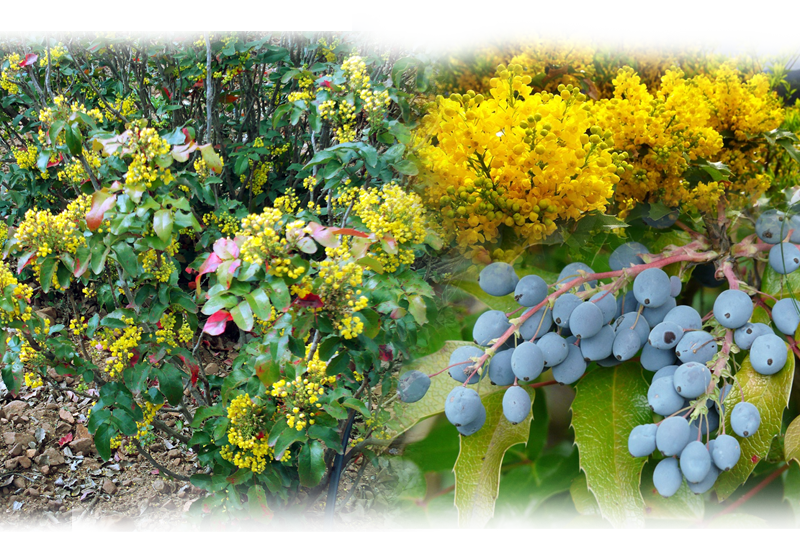
Mahonia
 6
6 6
6 4
4Will it grow where I live?
Mahonia is hardy to zone 4 – that covers all of Central Europe and the British Isles, and every USDA zone from 4 upwards.
Or check it for your location right here:
Profile
- Family
- Berberidaceae
- Habit
- Shrub
- Height
- 1.9 m
- Spread
- 1.5 m
- Growth
- slow
- Lifespan
- 30 years
- First yield
- after 3 years
- Yield per plant
- up to 1 kg a year
- Yield in cultivation
- up to 5 t/ha
- Energy yield
- 250 kcal per m² a year
- Hardiness
- zone 4–8
- Shade tolerance
- full shade
- Soil
- Sand, Silt, Loam, Clay
- Soil moisture
- dry – very wet
- pH
- 5 – 8
- Planned in gardens
- 6×
Flowering & harvest
| J | F | M | A | M | J | J | A | S | O | N | D | |
|---|---|---|---|---|---|---|---|---|---|---|---|---|
| Flowering | ||||||||||||
| Fruit harvest |
Uses
Edible: Fruit - raw or cooked. The fruit, almost the size of a blackcurrant, grows in large clusters, making it easy to harvest. It has a tart taste but is particularly delicious when added to a puree or cereal. Unfortunately, there is relatively little flesh and many seeds, although some plants produce larger and juicier fruits. Cooked fruits taste somewhat like blackcurrants. The fruits can also be dried and stored for later use. Flowers - raw. They can also be used to make a lemonade-like drink.
Medicinal: The roots are crushed and applied to eruptions.
Other uses: A yellow dye is extracted from the inner bark of the stem and roots, while another source mentions it being green. Dark green, violet, and dark blue-violet dyes are obtained from the fruit. A green dye is extracted from the leaves. This variety can be cultivated as a low hedge and does not require pruning. Due to its spreading habit, it also serves as an effective dense ground cover plant, although it may establish slowly.
Growing
Site: Oregon grape is one of the few fruiting shrubs that will still crop beneath trees and against shaded walls, though full yields need part shade or sun. Winter sun on frozen ground scorches the evergreen foliage, so a position shaded in the morning or sheltered by taller woody plants is safer. It suckers and closes into dense stands over the years; where that is unwelcome, choose non-suckering cultivars such as 'Mirena' or 'Jupiter'. The spine-tipped leaves make it excellent cover for birds but unpleasant beside paths and seating. Berry juice stains deep purple and should not drip onto terraces or pale paving. In eastern Germany it escapes readily — keep a distance from semi-natural pine woodland. Care: An annual mulch largely replaces feeding; drought and high lime content do not suit it, so water through the first summer and in long dry spells. It tolerates cutting back into old wood and recovers reliably from frost damage; the best time is early spring straight after flowering, since fruit ripens on the previous year's shoots. Mildew, and rust on some cultivars, appear occasionally and rarely matter; airy spacing is the best prevention. Berries ripen from August and often hang into winter — anyone wanting a harvest must get there before the birds. Sieve out the numerous seeds when processing.
Propagation
The species is readily raised from seed: take ripe berries in late summer, wash off the pulp and sow the cleaned seed in autumn into pots or an outdoor seedbed. Winter cold breaks dormancy and seedlings emerge in spring; seed stored dry germinates far less reliably and often only in the second year. Named cultivars come true only from vegetative propagation — semi-ripe cuttings in late summer under film or in a closed case are usual, or rooted suckers detached in spring. Suckering forms are easiest to increase this way, while stiffly upright cultivars such as 'Mirena' produce none and depend on cuttings.
Value for wildlife
The golden flower clusters open in April and May and are a generous early nectar source: honeybees, bumblebees and solitary bees take both nectar and pollen at a time when the garden offers little else. The species has no specialised pollinators in Central Europe, as is to be expected of a North American newcomer. Its greater value lies in structure: as an evergreen with dense, spiny foliage it provides cover and secure nest sites all year, when deciduous shrubs stand bare. The blue-bloomed berries ripen from August and often persist into winter — blackbirds, thrushes and warblers use them as late food and carry the seed onward. That is precisely the route by which it has naturalised in eastern German pine woods.
Notable
Special features: Urban climate resistant; spreads by runners; suitable for borders, rooftop gardens, containers, and underplanting trees; Medicinal plant of North American indigenous people; Interesting varieties include: 'Mirena' (no runners, very productive, powdery mildew and rust resistant); 'Pamina' (cross with M. repens, good winter hardiness, high resistance to powdery mildew).
Origin & habitat
Western North America: British Columbia south to northern California, east to Idaho and Montana. Oregon grape is most abundant in the coastal ranges and on the western slopes of the Cascades, from the lowlands up to about 2,000 metres. It reached Europe in 1822 as an ornamental and was grown here during the nineteenth century for fruit and wine. Today it has escaped from gardens across much of Central Europe and appears on Germany's watch list of potentially invasive species; in the open pine woods of Brandenburg and eastern Germany it locally forms extensive stands.
The understorey of open conifer and mixed woodland — beneath Douglas fir, ponderosa pine and oaks — along with woodland edges, rocky slopes and scrub margins. It grows on fresh to moderately dry, nutrient-rich soils that are usually acid to neutral, and is one of the few evergreen shrubs of its range able to endure deep shade. In Central Europe it finds comparable conditions in warm, dry pine plantations, on railway embankments and in park underplantings. Its competitive edge comes from being evergreen: it photosynthesises through the winter half-year, when the herb layer of deciduous woodland lies dormant.
Frequently asked questions
Mahonia: how big does it get?
Mahonia (Mahonia aquifolium) grows as a Shrub and reaches roughly 1.9 m in height when mature, with a spread of about 1.5 m. Growth is slow.
Mahonia: what site does it need?
Mahonia tolerates full shade. Suitable soils are Sand, Silt, Loam, Clay. Soil moisture should be in the range dry – very wet. The pH may lie between 5 and 8.
Mahonia: is it hardy?
Mahonia is listed as hardy in zone 4–8 and survives normal winters outdoors there.
Mahonia: will it grow in Central Europe?
Mahonia is hardy to zone 4 – that covers all of Central Europe and the British Isles, and every USDA zone from 4 upwards.
Mahonia: when does it flower?
In a temperate northern-hemisphere climate it flowers in May.
Mahonia: when is it harvested?
In a temperate northern-hemisphere climate the fruit ripens from August to November.
Mahonia: when does it start cropping, and how much?
Mahonia first crops after 3 years. A mature plant gives up to 1 kg a year, in cultivation up to 5 t per hectare. Figures assume a good site; variety, soil and climate shift them considerably.
Mahonia: is it poisonous?
No toxicity is recorded for Mahonia. With wild plants, never rely on a database alone — only on a confident identification.
Mahonia: what is it used for?
Rated on a scale up to 10: Edible 6/10, Medicinal 6/10, Other uses 4/10.
Which Mahonia varieties are there?
The Permaplans variety finder lists 3 varieties of Mahonia, including Jupiter, Mirena, Pamina. Each variety has its own page with taste, ripening time, disease resistance and parentage.
Plan this plant into your own garden
Permaplans plans your garden to scale on the map — with a site check, harvest calendar and over 1,000 plants. Free for iPhone, Android, Mac, Windows & Linux.
Will this plant grow where you live? → Check your site
Community experience
No first-hand reports for this plant yet.
Growing it? Write in the app what works for you – your post will show up here.
💬 Get the app and join in