
Pawpaw
 9
9 5
5 5
5Will it grow where I live?
Pawpaw is hardy to zone 6, which covers nearly all of Central Europe and the British Isles; only harsh upland sites (Alps, high ridges) call for winter protection.
Or check it for your location right here:
Profile
- Family
- Annonaceae
- Habit
- Shrub
- Height
- 4.8 m
- Spread
- 4 m
- Growth
- very slow
- Lifespan
- 50 years
- First yield
- after 5 years
- Yield per plant
- up to 30 kg a year
- Yield in cultivation
- up to 20 t/ha
- Energy yield
- 1600 kcal per m² a year
- Hardiness
- zone 6–9
- Shade tolerance
- partial shade
- Soil
- Silt
- Soil moisture
- semi-dry – very wet
- pH
- 5.5 – 7.5
- Synonyms
- Indianer-banane, Paw-paw, Pawpaw
Flowering & harvest
| J | F | M | A | M | J | J | A | S | O | N | D | |
|---|---|---|---|---|---|---|---|---|---|---|---|---|
| Flowering | ||||||||||||
| Fruit harvest |
Varieties (25)
25 varieties of Pawpaw are listed in the Permaplans variety finder — each with its own page: taste, ripening time, disease resistance, parentage and use.
- Allegheny Smaller, highly aromatic Peterson fruit with intense, complex flavour.
- Davis
- Ithaca
- KSU-Atwood The first official KSU cultivar: productive, aromatic and with few seeds.
- KSU-Benson Productive KSU cultivar with large, sweet fruit and low seed content.
- Mango Large, mild-sweet fruit with a tropical, mango-like aroma and creamy flesh.
- Marion Reliable cultivar with yellow flesh, mild flavour and good fruit size.
- Mitchell
- NC-1 Large-fruited, cold-hardy pawpaw from Canada.
- Overleese Classic benchmark cultivar with large, aromatic fruit and few, large seeds.
- Pennsylvania Golden Early-ripening cultivar with golden flesh – ideal for cooler regions and short summers.
- Potomac Large, uniform Peterson fruit with sweet, balanced flavour and few seeds.
- Prima 1216European pawpaw selection.
- Prolific Heavy-bearing, cold-hardy cultivar with sweet, yellow flesh.
- Rappahannock
- Rebecca's Gold Sweet cultivar with yellow flesh and a mild, custard-like flavour.
- Shenandoah Mild-sweet pawpaw with creamy flesh.
- Sunflower Large-fruited, late-ripening pawpaw from Kansas.
- Susquehanna Premium Peterson cultivar: very large fruit, firm buttery flesh and unusually few, small seeds.
- Sweet Alice
- Taylor
- Taytwo Old, hardy cultivar with yellow flesh and a mild, sweet flavour.
- Wabash Large Peterson fruit with firm, caramel-sweet flesh and good keeping quality.
- Wells Very large fruit with orange flesh and a bold, sweet flavour.
- Wilson
Uses
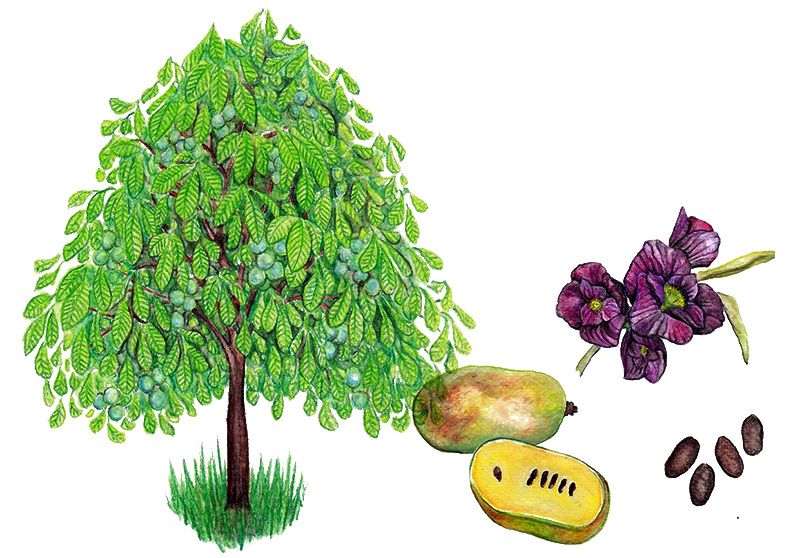
Edible: Edible fruits can be consumed raw or cooked, varying in quality with flavors ranging from exquisite banana pudding to unpleasant. White fruits are said to have a mild taste and ripen later than the orange ones. They are commonly used in various sweet dishes like preserves, pies, and ice cream. The fruit drops from the tree in autumn and is stored until fully ripe, although some individuals may have digestive issues after consuming it.
Other uses: A fiber from the inner bark is utilized for creating durable ropes and cords. The seed possesses insecticidal qualities, while a yellow dye is derived from the ripe pulp. The wood is light, soft, weak, spongy, and coarse-grained, weighing 24 pounds per cubic foot, but it is not utilized for commercial purposes.
Growing
The pawpaw wants a moderately moist, fertile, free-draining soil and will not tolerate waterlogging. Slightly acid soils are considered ideal, but trial plantings at Schönbrunn and Veitshöchheim show that it also does well at pH 7.2 to 7.3 on calcareous ground. A wine-growing climate helps the fruit ripen before the first frosts; at least 160 frost-free days and around 400 hours of winter chilling are needed. The wood is very hardy at minus 25 degrees, but the plant is sensitive to dry winds, low air humidity and cool wet summers — drip irrigation helps on summer-dry sites. Young plants need shade at first, then as much warmth and sun as possible. Allow four by two to three metres per tree. Cropping begins after five to six years.
Propagation
The seed must never dry out once removed from the fruit. It needs three months of cold stratification at zero to four degrees and then germinates in warmth with bottom heat, often only in summer when sown in spring; autumn sowing in boxes works too. Seedlings are unreliable, however — some produce fruit with an unpleasant aftertaste — so named cultivars are the better choice. These are grafted; chip budding at the start of growth in early spring is considered the most dependable method, while T-budding succeeds poorly. Own-rooted selections can be increased from root cuttings. One point matters: the plant forms a taproot and reacts badly to any damage to it, so only container-grown stock from deep pots should be planted out.
Value for wildlife
The pawpaw does not fit the usual pattern. Its chestnut-brown flowers give off a faint carrion smell and attract flies and beetles rather than bees. Those pollinators are largely absent in Central Europe, so fruit set is often poor without hand pollination with a brush; planting several clones together helps as well, since the flowers are self-sterile and protogynous. As a food plant the species is worthless to native insects: leaves and young shoots contain acetogenins that deter herbivores. In its home range only the zebra swallowtail feeds on it, its caterpillars sequestering the toxins and becoming unpalatable themselves. In a Central European garden the contribution therefore lies less with insects than with the large leaves, which provide shade and structure, and with windfall fruit taken by mammals.
Notable
Special features: forms root runners (+for propagation); sensitive to dry winds and cool and humid summers; when young, place in a shady and protected location, then place in a warm and sunny location if possible. Seed-grown plants may have unpleasant-tasting fruits; grafted varieties are sometimes self-fertile, e.g., 'Sunflower'; hand pollination (brush) helpful; max. 40 kg/shrub.
Origin & habitat
Eastern North America: from northern Florida to southern Ontario, west to Nebraska and eastern Kansas. The pawpaw is concentrated in the humid continental climate of the mixed deciduous forests of the Ohio and Mississippi basins, where it grows as an understorey shrub along river bottoms on fertile, moist, acid to neutral soils. Fossil finds confirm that it is long native there; its present northern and western range is partly the result of dispersal by Indigenous communities. Numerous American towns, rivers and lakes carry the name Pawpaw. In Europe it has only been cultivated for a few decades and has nowhere become naturalised.
Thickets and sparse woodlands in the low-lying areas and elevated terrain.
⚠️ Hazards
The seeds have a toxic alkaloid and are poisonous. Some people with sensitive skin may get dermatitis from the leaves or by touching the fruit.
Frequently asked questions
Pawpaw: how big does it get?
Pawpaw (Asimina triloba) grows as a Shrub and reaches roughly 4.8 m in height when mature, with a spread of about 4 m. Growth is very slow.
Pawpaw: what site does it need?
Pawpaw tolerates partial shade. Suitable soils are Silt. Soil moisture should be in the range semi-dry – very wet. The pH may lie between 5.5 and 7.5.
Pawpaw: is it hardy?
Pawpaw is listed as hardy in zone 6–9 and survives normal winters outdoors there.
Pawpaw: will it grow in Central Europe?
Pawpaw is hardy to zone 6, which covers nearly all of Central Europe and the British Isles; only harsh upland sites (Alps, high ridges) call for winter protection.
Pawpaw: when does it flower?
In a temperate northern-hemisphere climate it flowers in May.
Pawpaw: when is it harvested?
In a temperate northern-hemisphere climate the fruit ripens in October.
Pawpaw: when does it start cropping, and how much?
Pawpaw first crops after 5 years. A mature plant gives up to 30 kg a year, in cultivation up to 20 t per hectare. Figures assume a good site; variety, soil and climate shift them considerably.
Pawpaw: is it poisonous?
Individual parts of Pawpaw are noted as mildly problematic — the plant does not count as poisonous. With wild plants, never rely on a database alone, only on a confident identification.
Pawpaw: what is it used for?
Rated on a scale up to 10: Edible 9/10, Medicinal 5/10, Other uses 5/10.
Which Pawpaw varieties are there?
The Permaplans variety finder lists 25 varieties of Pawpaw, including Allegheny, Davis, Ithaca, KSU-Atwood, KSU-Benson, Mango, Marion, Mitchell, NC-1, Overleese, Pennsylvania Golden, Potomac and 13 more. Each variety has its own page with taste, ripening time, disease resistance and parentage.
Plan this plant into your own garden
Permaplans plans your garden to scale on the map — with a site check, harvest calendar and over 1,000 plants. Free for iPhone, Android, Mac, Windows & Linux.
Will this plant grow where you live? → Check your site
Community experience
No first-hand reports for this plant yet.
Growing it? Write in the app what works for you – your post will show up here.
💬 Get the app and join in