
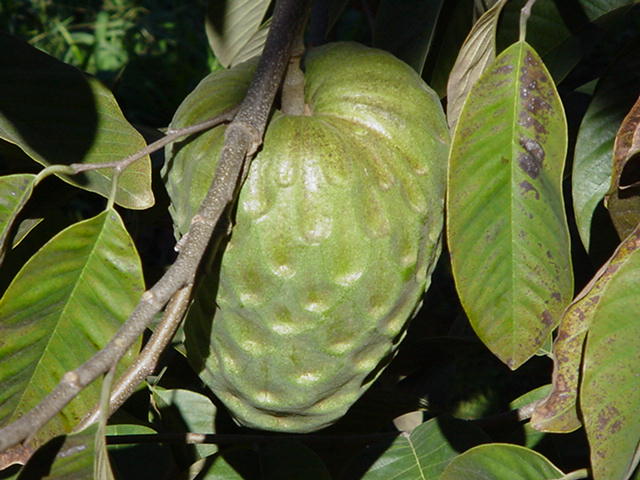
Cherimoya
 9
9 4
4 3
3Will it grow where I live?
Cherimoya is not winter-hardy in Central Europe (zone 10): outdoors from spring to autumn only, otherwise a container plant overwintered frost-free. The summer heat it needs to ripen is out of reach outdoors in Central Europe – greenhouse or conservatory.
Or check it for your location right here:
Profile
- Family
- Annonaceae
- Habit
- Tree
- Height
- 9 m
- Spread
- 9 m
- Growth
- fast
- Lifespan
- 50 years
- First yield
- after 5 years
- Yield in cultivation
- up to 15 t/ha
- Energy yield
- 1125 kcal per m² a year
- Hardiness
- zone 10–12
- Shade tolerance
- full sun
- Soil
- Sand, Silt
- Soil moisture
- dry – very moist
- pH
- 5.5 – 7.5
Flowering & harvest
| J | F | M | A | M | J | J | A | S | O | N | D | |
|---|---|---|---|---|---|---|---|---|---|---|---|---|
| Flowering | ||||||||||||
| Fruit harvest |
Varieties (12)
12 varieties of Cherimoya are listed in the Permaplans variety finder — each with its own page: taste, ripening time, disease resistance, parentage and use.
- Bays Californian variety with round, fingerprint-marked fruit and a refreshing lemony flavour.
- Booth Hardy, widely adaptable variety with conical fruit and a papaya-like flavour.
- Bronceada Chilean lead variety with large, bronze-toned fruit and excellent flavour quality.
- Campas Early-ripening Spanish variety with rounded-conical, smooth fruit and juicy, aromatic flesh.
- Chaffey Old Californian variety with evenly conical fruit and mild, sweet flesh.
- Concha Lisa Early Chilean variety with smooth skin, less bruise-sensitive and well storable.
- El Bumpo Californian variety with strikingly large, round fruit and a pronounced knobbly skin.
- Fino de Jete The world-leading commercial cherimoya with smooth fingerprint-marked skin and intensely sweet aroma.
- Honeyhart Very sweet, juicy Californian variety with smooth skin and a honeyed flavour.
- Libby Californian variety prized for sweet flesh and comparatively few seeds.
- Pierce Californian quality variety with rounded fruit and a well-balanced, aromatic flavour.
- White Californian variety with large, sweet fruit and mild, creamy flesh.
Uses
Edible: Frucht (roh) (aus der Hand oder gelöffelt, am besten wenn weich) (Eiscreme, Pudding, Kuchen), ~15t/ha = 1125kcal/m²; Samen giftig!
Medicinal: Rural residents roast, peel, and grind one or two seeds, taking the powder with water or milk as an effective emetic and laxative. The powder, when mixed with fat, is applied to parasitic skin conditions. A decoction made from the fruit peel is consumed to alleviate pneumonia.
Other uses: Evaluation of other uses: Low (3/5). Cherimoya can be utilized as a fruit tree in agroforestry systems, providing shade and integrating well into various cultivation systems. Its seeds are crushed and used as insecticides. Seeds mixed with fat and powdered are employed to kill lice. 1. Nectar sources - Flowers rich in nectar and pollen: Yes - Many Annona species (such as Cherimoya, Atemoya, and Sugar Apple) have flowers that attract pollinators, especially beetles, due to their pollen. 2. Wildlife - Food (fruits, seeds, leaf litter, shelter, nesting site, roosting site): Yes, the fruits of Annona species are edible and can feed wildlife, while their leaves can provide shelter and nesting sites for birds and other small animals. 3. Protection for invertebrates (overwintering sites, leaf litter, ground cover): Yes - The leaf litter from Annona trees can offer protection to invertebrates, and their bark can provide overwintering sites for certain insects. 4. Pest confusers (odor): No - Annona species do not produce strong, aromatic scents known to confuse or deter pests.
Growing
The Cherimoya thrives best in tropical lowland areas, preferring elevations above 700 meters but can grow up to 2,400 meters. It can also be cultivated in subtropical and warm-temperate regions that are practically frost-free. The ideal soil for Cherimoya is moist, sandy loam with a pH around 6. It shows good growth in a wide range of soil types, from light to heavy, but seems to perform best in moderately fertile soils of medium weight. The tree requires protection from strong winds that can affect pollination and fruit set. Cherimoya cultivation has declined in some areas but has become established in subtropical to tropical climates. The fruit-bearing typically starts between 3 to 5 years of age, increasing steadily from the 5th to the 10th year. Hand pollination is highly recommended due to inadequate natural pollination, with male and female flower structures not maturing simultaneously. Cherimoya fruits are usually harvested from late autumn to early winter, while flowering occurs from late spring to early summer. Cherimoyas grow moderately fast, taking 3 to 4 years after planting to bear fruit.
Propagation
Seed – usually pure [200]. Sow in individual, shallow pots (maximum 2 cm) at 21°C [200]. Cherimoya seeds remain viable for 2-3 years if stored dry and protected from weevils and fungi. Seeds germinate at around 21 days with soil warmth at 20°C, or about 40 days under normal growth conditions [303]. Many species in this genus have hard seed coats that can be scarified before sowing to hasten germination. Typically, this is done by pouring some boiling water over the seeds (be cautious not to boil!) and then soaking them in warm water for 12-24 hours. By this time, they should have absorbed moisture and swelled. If not, gently scarify the coat (taking care not to damage the embryo) and soak the seeds for another 12 hours before sowing. Semi-ripe cuttings [200]. Cuttings from mature wood will root in coral sand with soil warmth within 28 days [303].
Notable
Besonderheiten: aus dem subtropischen Hochland der Anden 1500-2000m, mag sie kein tropisches immerfeuchtes Klima, optimaler Jahresmittel ~ 19°C und 800-1000mm Jahresniederschlag auf gut durchlässigem sandigen Lehm; Seit Mitte 18.Jh auch im südlichsten Spanien/Italien an der Küste bei ausreichend Bewässerung in Blüte- und Fruchtbildungs-zeit;
Origin & habitat
Peru, Ecuador, Colombia
Stable sand dunes, coastal shrubland, and pine forests near the coast.
⚠️ Hazards
The seeds are toxic, and the skin slightly: Blindness can be caused by eye contact with the juice of crushed seeds. The seeds and branches contain various alkaloids, including (+)-reticulin, (-)-anonain, liriodenin, and lanuginosin. Ingesting 0.15 g of the dark yellow resin from the seeds leads to symptoms resembling those of atropine.
Frequently asked questions
Cherimoya: how big does it get?
Cherimoya (Annona cherimola) grows as a Tree and reaches roughly 9 m in height when mature, with a spread of about 9 m. Growth is fast.
Cherimoya: what site does it need?
Cherimoya tolerates full sun. Suitable soils are Sand, Silt. Soil moisture should be in the range dry – very moist. The pH may lie between 5.5 and 7.5.
Cherimoya: is it hardy?
Cherimoya is listed as hardy in zone 10–12 and survives normal winters outdoors there.
Cherimoya: will it grow in Central Europe?
Cherimoya is not winter-hardy in Central Europe (zone 10): outdoors from spring to autumn only, otherwise a container plant overwintered frost-free. The summer heat it needs to ripen is out of reach outdoors in Central Europe – greenhouse or conservatory.
Cherimoya: when does it flower?
In a temperate northern-hemisphere climate it flowers from May to June.
Cherimoya: when is it harvested?
In a temperate northern-hemisphere climate the fruit ripens from October to March.
Cherimoya: when does it start cropping, and how much?
Cherimoya first crops after 5 years. In cultivation, up to 15 t per hectare is typical. Figures assume a good site; variety, soil and climate shift them considerably.
Cherimoya: is it poisonous?
Individual parts of Cherimoya are noted as mildly problematic — the plant does not count as poisonous. With wild plants, never rely on a database alone, only on a confident identification.
Cherimoya: what is it used for?
Rated on a scale up to 10: Edible 9/10, Medicinal 4/10, Other uses 3/10.
Which Cherimoya varieties are there?
The Permaplans variety finder lists 12 varieties of Cherimoya, including Bays, Booth, Bronceada, Campas, Chaffey, Concha Lisa, El Bumpo, Fino de Jete, Honeyhart, Libby, Pierce, White. Each variety has its own page with taste, ripening time, disease resistance and parentage.
Plan this plant into your own garden
Permaplans plans your garden to scale on the map — with a site check, harvest calendar and over 1,000 plants. Free for iPhone, Android, Mac, Windows & Linux.
Will this plant grow where you live? → Check your site
Community experience
No first-hand reports for this plant yet.
Growing it? Write in the app what works for you – your post will show up here.
💬 Get the app and join in