
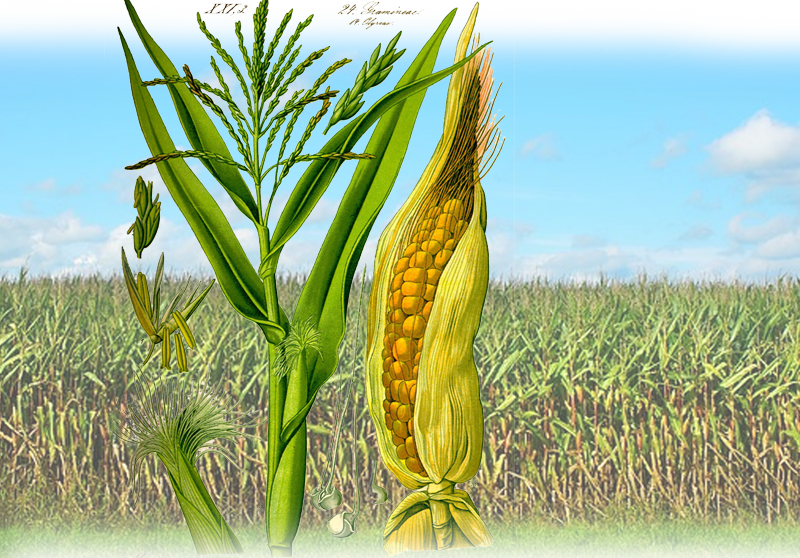
Corn
 9
9 5
5 9
9Will it grow where I live?
Corn is an annual and grows outdoors across Central Europe – one season from spring sowing to autumn harvest.
Or check it for your location right here:
Profile
- Family
- Poaceae
- Habit
- annual
- Height
- 2.5 m
- Spread
- 0.6 m
- Growth
- very fast
- Lifespan
- 1 year
- First yield
- after 1 year
- Yield per plant
- up to 0.1 kg
- Yield in cultivation
- up to 10 t/ha
- Energy yield
- 3300 kcal per m² a year
- Hardiness
- zone 6–10
- Shade tolerance
- full sun
- Soil
- Sand, Silt, Loam
- Soil moisture
- semi-dry – very moist
- pH
- 5.5 – 7
- Synonyms
- Mais
Flowering & harvest
| J | F | M | A | M | J | J | A | S | O | N | D | |
|---|---|---|---|---|---|---|---|---|---|---|---|---|
| Flowering | ||||||||||||
| Fruit harvest |
Uses
Edible: Corn is a widely grown crop globally, with seeds that can be consumed raw or cooked before full ripening. Varieties like sweet corn have exceptionally sweet and delicious seeds. The mature seeds are dried for use whole or ground into flour. Cornstarch, derived from corn, is a common ingredient in confectionery and noodles. Popcorn is made by heating dried corn seeds in the oven. Sprouted corn is used in making uncooked bread and cereals. Edible oil is extracted from the seeds for cooking and salad dressings. Corn pollen is utilized in soups, while the protein-rich roasted seeds can be a coffee alternative. The stalk's pith is chewed or turned into syrup.
Medicinal: A mixture made from the leaves and roots is utilized for treating urinary issues and kidney stones. Corn silks have various medicinal properties such as promoting bile production, soothing, increasing urine production, preventing kidney stones, providing mild stimulation, and widening blood vessels. They are beneficial in reducing blood sugar levels and are commonly used in managing diabetes, bladder inflammation, sexually transmitted infections, arthritis, and similar conditions. The silks should be collected before the plant pollinates and are most effective when used fresh since their diuretic effect diminishes with storage, and they can also act as a laxative. A preparation from the corn cob is employed to stop nosebleeds and excessive menstrual bleeding. The seeds act as a diuretic and mild stimulant. They are effective as a soft poultice for treating sores, inflammation, and joint pains and are frequently applied in cancer, tumor, and wart treatments. The seeds contain allantoin, a substance that promotes cell growth and wound healing, commonly used in herbal medicine to speed up recovery. The plant is believed to possess anti-cancer properties and has demonstrated effects in lowering blood sugar and blood pressure.
Other uses: The seed's starch is utilized for making adhesive and cosmetics, as well as for glucose production. A semi-drying oil extracted from the seed finds application in industries like linoleum, paints, varnishes, and soaps. Corn spades are repurposed for crafting paper, straw hats, and small items like baskets. Fiber from the stalks and seed coats is employed in paper-making. These fibers are collected post-seed harvest in late summer, processed by cutting, soaking, boiling, and ball-milling to create cream-colored paper. Dried cobs serve as fuel, while the stalks' pith is used for packaging. Care must be taken not to overcook the fibers to prevent the formation of sticky pulp, which hinders paper formation.
Growing
Site: Warmth and shelter from wind matter more for maize than the soil; tall plants snap in a storm. It must stand in a block of at least four by four plants rather than in a row, or the cobs stay gappy, because the pollen only carries a few metres. Different maize types within a few hundred metres cross and spoil each other's quality: sweetcorn next to popcorn or fodder maize turns starchy. As the middle storey of the milpa it carries climbing beans, which supply it with nitrogen, while squash shades the ground below. Being a heavy feeder it exhausts the bed, so something else belongs there the following year. Care: Work in plenty of compost or well-rotted manure before planting. Hoe shallowly until knee height, then stop disturbing the prop roots and earth up instead; that replaces any staking. No pruning. Water thoroughly from flowering to grain fill in July and August, as drought in that phase costs yield directly. Crows and jackdaws pull freshly sown kernels back out, so a fleece over the seed row helps, and birds take their share of ripening cobs. The European corn borer overwinters in stubble left standing, so chop and compost crop residues. Harvest sweetcorn while the kernels still run milky.
Propagation
Maize is raised afresh from seed every year; vegetative propagation plays no part. The kernels only germinate from about 8 to 10 degrees soil temperature, which puts direct sowing in Central Europe between mid-April and mid-May; seed sown earlier rots instead of germinating. Sow three to five centimetres deep and in a block rather than in long single rows, so that the pollen actually reaches the silks. For an earlier harvest, start in pots from mid-April and plant out after the middle of May while the plants are still small, since maize resents root disturbance. Seed stays viable for three to five years. Saving your own seed is only worthwhile with open-pollinated varieties and with plenty of distance from other maize, because cross-pollination shows up immediately in the kernel; hybrid varieties give no usable second generation.
Value for wildlife
Maize is monoecious and wind-pollinated: the male tassels at the top of the stem release large quantities of pollen that reaches the silks of the female cobs — insects are not required, and the plant offers no nectar. The pollen nevertheless matters to bees: in high summer, when other forage runs dry, honey bees collect maize pollen in quantity, albeit as a lower-protein food. As an American crop, maize has attracted almost no caterpillars in Central Europe; only occasional ground beetles are recorded. Large monocultures are considered ecologically poor, while a few rows in a garden give birds cover and small mammals food.
Notable
Special features: in cultivation in Mexico for ~10,000 years, climate-adapted varieties here since 1970; for many people the most important staple food, since as a C4 plant it grows especially fast above all under arid conditions; there are flint/dent/pop/sweet/flour/waxy maize; often lives in symbiosis with N2-fixing bacteria
Origin & habitat
Central America: south-western Mexico, valley of the Río Balsas. Maize was domesticated there from Balsas teosinte around 9000 years ago, and wild populations of that ancestor still grow in Guerrero and Michoacán. From Mexico the crop spread through both Americas, reaching the Andes and eastern North America long before Columbus. After 1493 it came to Spain, and from there via Italy and the Balkans into Central Europe, where it was first a garden plant and only became a field crop in the eighteenth century. Maize is now grown on every continent except Antarctica. In Germany it leads the summer crops by area, though most of it goes into silage for fodder and biogas and only a small share reaches the plate as sweetcorn.
Maize is a crop plant with no wild habitat of its own. The domesticated form occurs nowhere spontaneously and does not survive a second season without being sown, because the kernels stay fixed to the cob and cannot disperse themselves. The habitat of its ancestor, Balsas teosinte, lies in the valley of the Río Balsas in south-western Mexico: seasonally dry thorn scrub, open tropical deciduous forest and savanna between roughly 400 and 1800 metres, with sharply separated wet and dry seasons. In Central Europe maize therefore occupies exactly the site cultivation assigns to it, namely open, fully sunlit, nutrient-rich ground in a warm position. Plants escaping to field margins and waste places remain isolated individuals and never form stands.
⚠️ Hazards
I harvested and juiced twelve corn seedlings (approximately 40cm - 80cm). After consuming the juice, I experienced severe poisoning.
Frequently asked questions
Corn: how big does it get?
Corn (Zea mays) grows as a annual and reaches roughly 2.5 m in height when mature, with a spread of about 0.6 m. Growth is very fast.
Corn: what site does it need?
Corn tolerates full sun. Suitable soils are Sand, Silt, Loam. Soil moisture should be in the range semi-dry – very moist. The pH may lie between 5.5 and 7.
Corn: is it hardy?
Corn is listed as hardy in zone 6–10 and survives normal winters outdoors there.
Corn: will it grow in Central Europe?
Corn is an annual and grows outdoors across Central Europe – one season from spring sowing to autumn harvest.
Corn: when does it flower?
In a temperate northern-hemisphere climate it flowers from May to June.
Corn: when is it harvested?
In a temperate northern-hemisphere climate the fruit ripens in October.
Corn: when does it start cropping, and how much?
Corn crops in its first year. Expect up to 0.1 kg per plant, in cultivation up to 10 t per hectare. Figures assume a good site; variety, soil and climate shift them considerably.
Corn: is it poisonous?
Individual parts of Corn are noted as mildly problematic — the plant does not count as poisonous. With wild plants, never rely on a database alone, only on a confident identification.
Corn: what is it used for?
Rated on a scale up to 10: Edible 9/10, Medicinal 5/10, Other uses 9/10.
Plan this plant into your own garden
Permaplans plans your garden to scale on the map — with a site check, harvest calendar and over 1,000 plants. Free for iPhone, Android, Mac, Windows & Linux.
Will this plant grow where you live? → Check your site
Community experience
No first-hand reports for this plant yet.
Growing it? Write in the app what works for you – your post will show up here.
💬 Get the app and join in