
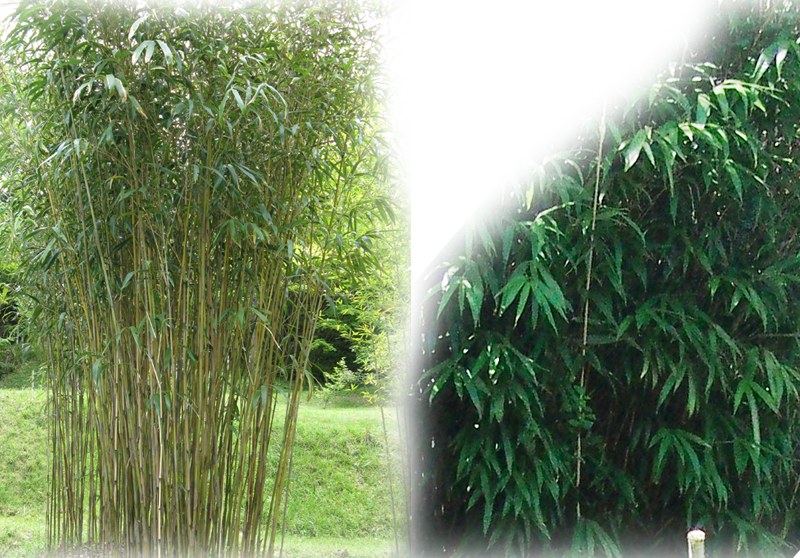
Japanese arrow bamboo
 3
3 4
4 8
8Will it grow where I live?
Japanese arrow bamboo is hardy to zone 5 – that covers all of Central Europe and the British Isles, and every USDA zone from 5 upwards.
Or check it for your location right here:
Profile
- Family
- Poaceae
- Habit
- Shrub
- Height
- 4.8 m
- Spread
- 6 m
- Growth
- very fast
- Lifespan
- 30 years
- Hardiness
- zone 5–9
- Shade tolerance
- full shade
- Soil
- Sand, Silt, Loam, Clay
- Soil moisture
- dry – very wet
- pH
- 5.5 – 7.5
- Synonyms
- Pfeilbambus
Uses
Edible: Young shoots - cooked. Harvested in late spring, about 8 - 10 cm above the ground, cutting the stems 5 cm or more below the ground. They have a rather bitter taste. Seeds - used as a cereal. Small amounts of seeds are produced in many years, but it is rarely viable.
Medicinal: The plant's bark possesses astringent, soothing, and tonic properties. A decoction of the bark was traditionally used to treat digestive disorders, stomach upsets, diarrhea, coughs, colds, and respiratory issues. A decoction of the bark was applied for wound healing, and the dried, powdered bark was used as a dusting powder for wounds. The steam from boiling the bark was used to treat snow blindness. A decoction of the wood waste was employed for intestinal complaints. Compresses with the leaves were applied to abscesses, cuts, wounds, bruises, and black eyes. The ripe fruit has a laxative effect. All plants of this genus contain amygdalin and prunasin, which can break down into hydrocyanic acid in water. In small amounts, hydrocyanic acid can stimulate respiration, improve digestion, and provide a sense of well-being.
Other uses: The culms of arrow bamboo are straight, thin-walled and light, and that governs their use. In Japan they were worked into arrow shafts for centuries — the English and German names both derive from this; two-year-old culms were cut, dried, straightened over a fire and sanded smooth. In the garden the stronger culms make plant stakes and climbing supports, while weaker ones can be woven into mats and fence panels used for screening or for lining walls and ceilings. A second use lies in the root system: the dense mat of rhizomes consolidates banks and water margins and protects them from erosion — the same property that is a nuisance in a border is welcome on a slope. As a hedge the species forms a year-round opaque wind filter that slows the wind without generating eddies on the lee side.
Growing
Site: The decisive point is the rhizome. Arrow bamboo throws long, shallow runners and pushes further into beds, lawn and neighbouring plots year after year; without containment a group becomes a thicket. Plant it from the outset inside a rhizome barrier at least seventy centimetres deep, made of heavy HDPE sheet with its rim standing a few centimetres proud of the soil, or choose a position already enclosed by walls, paths and foundations. Its great strength is shade tolerance: it grows beneath trees where most evergreen hedges fail, and gives year-round screening there. Because it withstands salt air and strong wind without creating turbulence, it serves well as a wind filter near the coast and in draughty positions. It offers insects and birds little food, but dense cover. Care: Keep evenly moist for the first few years; after that it is largely self-sufficient. An annual nitrogen-rich feed in spring encourages strong culms; on poor soil the culms stay thin. Check the rhizome barrier once a year in late summer and cut off escaping runners with a spade — that is the real maintenance work. Remove old yellowed culms at ground level, which keeps the stand open and the new culms strong; as a hedge the species can be cut to height, though it then breaks bushy. At the end of winter the leaves often look tattered, which passes with the spring flush. Culms for craft use are cut in their second year and dried.
Propagation
Arrow bamboo is propagated by division, not by seed. The species flowers only at very long intervals and usually gregariously across whole stands, so usable seed is virtually never available. The standard route is rhizome division in early spring, just before the new shoots break: a section of rootball with several culms and plenty of attached rhizome is cut out with a spade, replanted at once and kept consistently moist for the first weeks, as divisions otherwise dry out. Alternatively, individual rhizome pieces about thirty centimetres long with at least two nodes can be laid horizontally and shallowly in loose substrate and started into growth. Anyone checking the rhizome barrier anyway gains propagation material as a by-product. Culm cuttings, usual with some tropical bamboos, do not work here.
Value for wildlife
For Central European wildlife arrow bamboo is a largely silent plant, and that follows from its biology: it flowers only at very long intervals, often after decades, and for long stretches offers no flowers at all, no nectar, no pollen and no fruit. Native moth and butterfly larvae do not feed on its hard, silica-rich leaves. What it contributes, it contributes through structure, and there it does well: the culm thicket, densely leafed all year, provides cover from raptors, shelter from wind and a roosting place, precisely in the season when deciduous shrubs give nothing; blackbird, wren and dunnock use such stands regularly. The litter layer over the rhizome mat shelters ground beetles, woodlice and spiders. As a food plant it is no use, as a shelter plant it certainly is — anyone wanting both combines it with flowering shrubs.
Notable
Special features: runs on rhizomes - rhizome barrier from 70cm depth essential; very shade tolerant (grows under tree canopies); salt+wind tolerant, culms filter wind without turbulence; hardy to approx. -18°C; flowers only at very long intervals, then gregariously; culms thin-walled+straight (cut in 2nd year, straighten over fire, sand smooth) arrows+plant stakes+weaving;
Origin & habitat
East Asia: Japan and Korea. Arrow bamboo is native to the Japanese main islands from Honshu southwards and to the Korean peninsula, where it forms extensive stands in the lowland and hill zone. It was brought early from there to Europe and North America — it was among the first bamboos to establish themselves in European gardens — and is today one of the most widely planted species in temperate climates worldwide. There is no evidence that it has established itself permanently outside plantings in Central Europe; spread occurs through the rhizomes, not through seed, since the species flowers only at long intervals.
In its homeland arrow bamboo grows in open woodland, along forest edges and in damp hollows, forming dense closed thickets on open ground. What marks it out is the range of conditions it accepts: it endures deep shade beneath tree canopies as readily as full sun, copes with salt-laden coastal air and survives wind that tears other bamboos apart. It prefers fresh to moist, humus-rich soil and avoids both waterlogging and severe drought. Hardiness extends to about minus eighteen degrees, so it can stand outdoors all year in Central Europe. This undemanding nature explains why it is so widespread as an underplanting and hedging bamboo — and equally why it is so hard to remove from a garden again.
⚠️ Hazards
Young shoots should not be consumed raw as they are usually toxic unless they are a specific edible variety.
Frequently asked questions
Japanese arrow bamboo: how big does it get?
Japanese arrow bamboo (Pseudosasa japonica) grows as a Shrub and reaches roughly 4.8 m in height when mature, with a spread of about 6 m. Growth is very fast.
Japanese arrow bamboo: what site does it need?
Japanese arrow bamboo tolerates full shade. Suitable soils are Sand, Silt, Loam, Clay. Soil moisture should be in the range dry – very wet. The pH may lie between 5.5 and 7.5.
Japanese arrow bamboo: is it hardy?
Japanese arrow bamboo is listed as hardy in zone 5–9 and survives normal winters outdoors there.
Japanese arrow bamboo: will it grow in Central Europe?
Japanese arrow bamboo is hardy to zone 5 – that covers all of Central Europe and the British Isles, and every USDA zone from 5 upwards.
Japanese arrow bamboo: is it poisonous?
Individual parts of Japanese arrow bamboo are noted as mildly problematic — the plant does not count as poisonous. With wild plants, never rely on a database alone, only on a confident identification.
Japanese arrow bamboo: what is it used for?
Rated on a scale up to 10: Edible 3/10, Medicinal 4/10, Other uses 8/10.
Plan this plant into your own garden
Permaplans plans your garden to scale on the map — with a site check, harvest calendar and over 1,000 plants. Free for iPhone, Android, Mac, Windows & Linux.
Will this plant grow where you live? → Check your site
Community experience
No first-hand reports for this plant yet.
Growing it? Write in the app what works for you – your post will show up here.
💬 Get the app and join in