
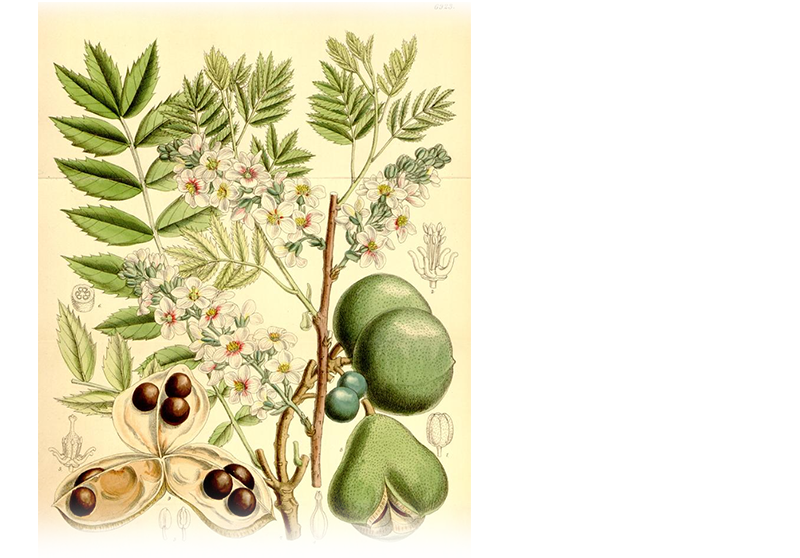
Yellowhorn bush
 6
6 3
3 5
5Will it grow where I live?
Yellowhorn bush is hardy to zone 6, which covers nearly all of Central Europe and the British Isles; only harsh upland sites (Alps, high ridges) call for winter protection.
Or check it for your location right here:
Profile
- Family
- Sapindaceae
- Habit
- Shrub
- Height
- 5.5 m
- Spread
- 3 m
- Growth
- very slow
- Lifespan
- 200 years
- First yield
- after 4 years
- Yield per plant
- up to 7 kg a year
- Yield in cultivation
- up to 3 t/ha
- Energy yield
- 5000 kcal per m² a year
- Hardiness
- zone 6–9
- Shade tolerance
- full sun
- Soil
- Sand, Silt, Loam
- Soil moisture
- very dry – very moist
- pH
- 5.5 – 8.5
- Synonyms
- Gelbhorn
Flowering & harvest
| J | F | M | A | M | J | J | A | S | O | N | D | |
|---|---|---|---|---|---|---|---|---|---|---|---|---|
| Flowering | ||||||||||||
| Fruit harvest |
Uses
Edible: Seeds (raw, dried, baked, cooked similar to chestnuts, roasted like macadamia nuts), nut milk, flour, cooking oil; production of 7 tons per hectare, about 5000 kcal per square meter. Flowers and leaves can be steamed, fried, or boiled.
Medicinal: Leaves (decoction) can assist with rheumatic fever, weakness, and bone pain.
Other uses: Biodiesel can be produced from a lovely ornamental shrub using seeds (70% oil) and wood as fuel. The quantity of wood needed for production is unknown.
Growing
Thrives in rich loamy soil and well-drained, fertile soils in a sunny spot, preferring a warm, dry climate. Needs protection from cold winds. Hardy to about -20°C when dormant. Flourishes in regions with warm summers and frost-free springs, requiring summer heat for wood maturation and flower bud production. Vulnerable to 'coral spot' fungus, especially in immature wood damaged by winter cold. Flowers bloom on last year's wood, typically requiring time to establish.
Propagation
Seeds - Enhancing germination rates, a 3-month cold stratification is recommended before sowing in a cold environment during autumn. An alternative suggestion is to sow seeds in a warm greenhouse in February or March, following the stratification process. Once seedlings are sufficiently grown, transfer them to individual pots. Initially, grow them in a lightly shaded area within a greenhouse during the first winter, then relocate them to their permanent spot in late spring or early summer. It is advisable to provide some protection from cold weather during their first two winters. Root cuttings, 3 cm in length, should be planted horizontally in pots within a frame in December or January, with a high success rate. Divide runners during their dormant phase and plant them directly into their permanent spot.
Notable
Special features: Needs a hot and dry summer for the wood to mature and flowers to appear the following year. Best on a south-facing wall. Drought-resistant. Although self-fertile, the yield and nut size double with cross-pollination. Fully grown after 10-20 years. Propagation: Seeds, root cuttings, cuttings, and slips.
Origin & habitat
East Asia - Northern China.
Swamps and moist areas, typically found on wet heaths and open woodlands, thrive in peaty soil.
Frequently asked questions
Yellowhorn bush: how big does it get?
Yellowhorn bush (Xanthoceras sorbifolium) grows as a Shrub and reaches roughly 5.5 m in height when mature, with a spread of about 3 m. Growth is very slow.
Yellowhorn bush: what site does it need?
Yellowhorn bush tolerates full sun. Suitable soils are Sand, Silt, Loam. Soil moisture should be in the range very dry – very moist. The pH may lie between 5.5 and 8.5.
Yellowhorn bush: is it hardy?
Yellowhorn bush is listed as hardy in zone 6–9 and survives normal winters outdoors there.
Yellowhorn bush: will it grow in Central Europe?
Yellowhorn bush is hardy to zone 6, which covers nearly all of Central Europe and the British Isles; only harsh upland sites (Alps, high ridges) call for winter protection.
Yellowhorn bush: when does it flower?
In a temperate northern-hemisphere climate it flowers in May.
Yellowhorn bush: when is it harvested?
In a temperate northern-hemisphere climate the fruit ripens in October.
Yellowhorn bush: when does it start cropping, and how much?
Yellowhorn bush first crops after 4 years. A mature plant gives up to 7 kg a year, in cultivation up to 3 t per hectare. Figures assume a good site; variety, soil and climate shift them considerably.
Yellowhorn bush: is it poisonous?
No toxicity is recorded for Yellowhorn bush. With wild plants, never rely on a database alone — only on a confident identification.
Yellowhorn bush: what is it used for?
Rated on a scale up to 10: Edible 6/10, Medicinal 3/10, Other uses 5/10.
Plan this plant into your own garden
Permaplans plans your garden to scale on the map — with a site check, harvest calendar and over 1,000 plants. Free for iPhone, Android, Mac, Windows & Linux.
Will this plant grow where you live? → Check your site
Community experience
No first-hand reports for this plant yet.
Growing it? Write in the app what works for you – your post will show up here.
💬 Get the app and join in