
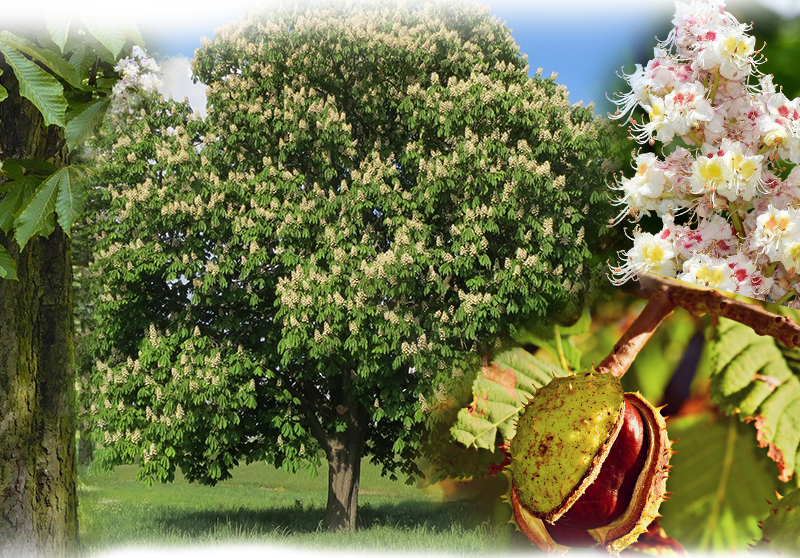
Horse chestnut
 3
3 5
5 7
7Will it grow where I live?
Horse chestnut is hardy to zone 4 – that covers all of Central Europe and the British Isles, and every USDA zone from 4 upwards.
Or check it for your location right here:
Profile
- Family
- Sapindaceae
- Habit
- Tree
- Height
- 30 m
- Spread
- 15 m
- Growth
- fast
- Lifespan
- 300 years
- First yield
- after 13 years
- Yield in cultivation
- up to 1 t/ha
- Hardiness
- zone 4–7
- Shade tolerance
- partial shade
- Soil
- Sand, Silt, Loam
- Soil moisture
- dry – very moist
- pH
- 6 – 8
Flowering & harvest
| J | F | M | A | M | J | J | A | S | O | N | D | |
|---|---|---|---|---|---|---|---|---|---|---|---|---|
| Flowering | ||||||||||||
| Fruit harvest |
Uses
Edible: The roasted seeds can be used as a coffee substitute. They can also be cooked and ground into a porridge. Measuring about 3 cm in diameter, they are easy to harvest. Before being used as food, the saponins must be removed, which also eliminates many minerals and vitamins, leaving mainly starch. The seeds contain up to 40% water, 8 - 11% protein, and 8 - 26% toxic saponins. It is crucial to eliminate the saponins as they are poisonous.
Other uses: Saponins in the seeds are utilized as a substitute for soap. Obtaining them is simple: the seeds are cut into small pieces and steeped in hot water. This water can then be used for washing the body, clothes, etc. A notable drawback is the enduring horse chestnut odor. The seeds contain varying amounts of saponins, up to a maximum of 10%. A starch extracted from the seeds is also used for washing. The bark and other parts of the plant contain tannin, but the exact quantities are unspecified. A yellow dye is derived from the bark. The flowers contain the dye quercetin. The plant's wood is soft, light, and not particularly durable. It is utilized for furniture, crates, and charcoal.
Growing
Site: The horse chestnut is a large tree of 25 to 30 metres with a comparable spread — the commonest planning mistake is to put it in a domestic garden. It needs deep, fresh, base- and nitrogen-rich soil in the neutral to alkaline range, and tolerates air pollution and exposure well, which is what made it the classic town and beer-garden tree. Above paths, terraces and parking spaces it is troublesome: it drops heavy fruit in autumn, its foliage often falls en masse as early as August because of the leaf miner, and older trees shed large limbs without warning. It has no place on pasture or beside small livestock — the seeds and young leaves are toxic to horses, cattle and small animals. Keep at least one crown width away from productive gardens and play areas. Care: Young trees are very hardy when dormant, but the new growth is vulnerable to late frost; a site free of cold-air pooling pays off. Stake for the first years, protect the trunk against browsing and winter sun scald, and water evenly. Prune as little as possible and only while young — the species tolerates hard cutting, but large wounds rot readily and set up later limb failure. The chief pest is the horse chestnut leaf miner, which has advanced across Europe at about a hundred kilometres a year since 1984 and browns the foliage from August; the only effective measure is to collect and dispose of the fallen leaves in which the pupae overwinter. Bleeding canker (Pseudomonas syringae pv. aesculi) adds to this, recognisable by rust-brown weeping cracks in the trunk — no treatment helps, only regular assessment of the tree's stability.
Propagation
Horse chestnut is most easily raised from seed, but only from fresh material: the seeds cannot be stored, lose viability within weeks of drying out, and must not be allowed to dry between falling and sowing. Conkers gathered in September or October should be set about five centimetres deep in open ground or deep pots that same autumn; winter cold breaks dormancy and the seedling pushes through in April. Wire mesh over the seedbed keeps off the mice and squirrels that find the seed unerringly. Double-flowered ornamental forms such as 'Baumannii', which set no fruit, are grafted in winter onto seedling rootstocks of the species. Seedlings flower after about ten to fifteen years but bear regularly only after some twenty.
Value for wildlife
The upright flower candles in May are among the richest forage of early summer: NaturaDB records 18 species of wild bee, one of them specialised, and rates both nectar and pollen value high at three out of four. Bumblebees, honeybees and wasps are the main pollinators. Notable is the nectar guide at the base of each flower, which turns from yellow to red once pollination has occurred — the flower thereby signals that a visit is no longer worthwhile and steers visitors to the unpollinated ones. As a larval food plant the species matters little, with four unspecialised species, and the now abundant horse chestnut leaf miner is itself an introduced pest rather than a gain. Its greatest contribution is one of scale: old horse chestnuts develop cavities, fissures and heart rot early, making them nest trees for starlings, tits, jackdaws and bats and habitat for wood-dwelling beetles. For wildlife the old tree is worth far more than the young one — an argument for leaving it standing rather than replacing it at the first sign of leaf miner.
Notable
Special features: tolerates air pollution; prefers moist and nitrogen-rich mountain forests; Uses: Sapnonine (cosmetics, paints, foams), Starch (alcohol, lactic acid); Good horse feed; Horse chestnut~=female oak; Japanese Horse chestnut (Aesculus turbinata) traditionally used with rice flour as a dessert; Yellow Horse chestnut (Aesculus flava) produces bitter-free seeds.
Origin & habitat
The Balkan Peninsula: northern Greece, Albania and North Macedonia, with small occurrences in Bulgaria. Its natural range is strikingly small — the tree grows there in the uplands between 900 and 1,300 metres, on shaded to half-shaded moist slopes and in ravine woodland. It reached Central Europe only at the end of the sixteenth century, by way of Constantinople and Vienna, and spread from there across the continent as a park, avenue and beer-garden tree. Today it is planted everywhere in Europe and North America and is locally naturalised in Central Europe, without taking over semi-natural woodland.
Ravine woodland, moist slope forest and stream valleys in the Balkan mountains, usually alongside hornbeam, sycamore, ash and beech. Its site requirements closely match those of hornbeam: deep, fresh to seepage-moist, base- and nitrogen-rich soils with a neutral to alkaline pH, together with a humid, sheltered position. In Central Europe the species stands almost exclusively on cultivated sites — in parks, on squares and along avenues — where its demand for soil moisture is seldom fully met, so that it ages early in compacted, dry urban ground. As an escape it appears on woodland edges and in remnant floodplain forest.
⚠️ Hazards
The seed is rich in saponins, which, although toxic, are poorly absorbed by the human body and usually pass through without harm. Saponins, quite bitter, are present in many common foods such as certain beans. They can be removed by carefully leaching the seeds or flour in running water. Thorough cooking and possibly changing the cooking water once usually eliminate most of them. However, consuming large amounts of foods containing saponins is not advisable. Saponins are much more toxic to some organisms, such as fish, and hunting tribes have traditionally used large quantities of them in streams, lakes, etc., to stun or kill fish.
Frequently asked questions
Horse chestnut: how big does it get?
Horse chestnut (Aesculus hippocastanum) grows as a Tree and reaches roughly 30 m in height when mature, with a spread of about 15 m. Growth is fast.
Horse chestnut: what site does it need?
Horse chestnut tolerates partial shade. Suitable soils are Sand, Silt, Loam. Soil moisture should be in the range dry – very moist. The pH may lie between 6 and 8.
Horse chestnut: is it hardy?
Horse chestnut is listed as hardy in zone 4–7 and survives normal winters outdoors there.
Horse chestnut: will it grow in Central Europe?
Horse chestnut is hardy to zone 4 – that covers all of Central Europe and the British Isles, and every USDA zone from 4 upwards.
Horse chestnut: when does it flower?
In a temperate northern-hemisphere climate it flowers in May.
Horse chestnut: when is it harvested?
In a temperate northern-hemisphere climate the fruit ripens from September to October.
Horse chestnut: when does it start cropping, and how much?
Horse chestnut first crops after 13 years. In cultivation, up to 1 t per hectare is typical. Figures assume a good site; variety, soil and climate shift them considerably.
Horse chestnut: is it poisonous?
Individual parts of Horse chestnut are noted as mildly problematic — the plant does not count as poisonous. With wild plants, never rely on a database alone, only on a confident identification.
Horse chestnut: what is it used for?
Rated on a scale up to 10: Edible 3/10, Medicinal 5/10, Other uses 7/10.
Plan this plant into your own garden
Permaplans plans your garden to scale on the map — with a site check, harvest calendar and over 1,000 plants. Free for iPhone, Android, Mac, Windows & Linux.
Will this plant grow where you live? → Check your site
Community experience
No first-hand reports for this plant yet.
Growing it? Write in the app what works for you – your post will show up here.
💬 Get the app and join in