
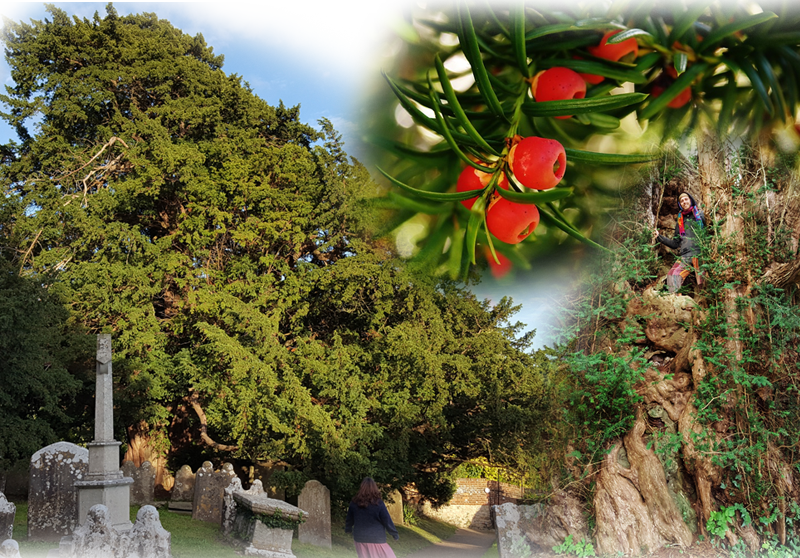
Yew
 3
3 1
1 8
8Will it grow where I live?
Yew is hardy to zone 5 – that covers all of Central Europe and the British Isles, and every USDA zone from 5 upwards.
Or check it for your location right here:
Profile
- Family
- Taxaceae
- Habit
- Tree
- Height
- 15 m
- Spread
- 10 m
- Growth
- very slow
- Lifespan
- 5000 years
- First yield
- after 15 years
- Hardiness
- zone 5–7
- Shade tolerance
- full shade
- Soil
- Sand, Silt, Loam, Clay
- Soil moisture
- very dry – very moist
- pH
- 5 – 8
- Planned in gardens
- 3×
Flowering & harvest
| J | F | M | A | M | J | J | A | S | O | N | D | |
|---|---|---|---|---|---|---|---|---|---|---|---|---|
| Flowering | ||||||||||||
| Fruit harvest |
Uses
Edible: Fruit - eaten raw. It is very sweet and has a jelly-like consistency that many enjoy, although some may find it overly sweet. While some people appreciate the flavor, they may not like the slimy texture often compared to mucus. All parts of the plant, including the seeds, are toxic. It is advised to spit out the large seed found at the fruit's center when consuming it. Swallowing the seed whole poses no danger, but if it is bitten into, a bitter taste will be noticed, and the seed should be immediately removed to avoid any issues. The fruit is a small berry, approximately 10 mm in size, containing a single seed. There are suggestions of using the peel as a tea alternative, but this is not recommended.
Medicinal: The yew plant is highly toxic and has been historically utilized for medicinal purposes, mainly for addressing chest issues. Recent studies have revealed the presence of "taxol" in the plant's shoots, showing potential as an anticancer medication, especially for ovarian cancer treatment. Despite its low taxol concentrations, the plant is utilized for research rather than commercial purposes. Caution is advised when using this treatment, and it should only be administered under medical supervision. Apart from the fleshy fruit, all parts of the plant possess medicinal properties like antispasmodic, cardiotonic, diaphoretic, emmenagogue, expectorant, narcotic, and laxative. Internally, the leaves have been traditionally used to alleviate conditions such as asthma, bronchitis, hiccups, indigestion, rheumatism, and epilepsy. Externally, the leaves have been applied in steam baths for rheumatism treatment. A homeopathic remedy derived from the plant's young shoots and berries is employed in managing various ailments like cystitis, skin rashes, headaches, heart and kidney issues, and rheumatism.
Other uses: This plant is ideal for creating hedges due to its easy trimming nature. It can be pruned even when fully grown, with reports of very old trees regenerating well after pruning. The leaves can be brewed into a solution that acts as an insect repellent. Certain types can serve as ground cover if appropriately spread out. Its wood is known for being dense, tough, long-lasting, and flexible, making it a valuable material for carpentry, including crafting bows and tool grips. Additionally, it is favored as firewood and sometimes used as incense.
Growing
Site: Yew does not belong beside horse paddocks, pastures, runs or livestock enclosures, as even small amounts of needles are lethal to horses. Where small children play the position deserves a second thought, since the red fruits invite nibbling. Otherwise it is the most accommodating choice there is: no other native tree tolerates such deep shade, it copes with urban climate and air pollution, and at 15 to 30 centimetres a year it grows so slowly that eight to fifteen metres is a matter of centuries. As a hedge, plant 30 to 50 centimetres apart. It is dioecious: for fruit, and thus for its value to birds, you need female plants and a male nearby. Care: Shape in June, and again in August if needed. As the only conifer, yew reliably reshoots from old wood, and even trees several centuries old can be cut back hard, so an overgrown stand is never beyond saving. Collect clippings at once and never throw them over a pasture fence; that is the single commonest cause of poisoning in horses. Roe and red deer browse young plants heavily, so protection is needed where there is much game. Feeding is unnecessary. Watch for waterlogging, which is the one thing that really harms yew.
Propagation
Yew is most reliably propagated from cuttings, and the orientation of the shoot decides the outcome: cuttings from upright leading shoots give upright trees, cuttings from side branches stay permanently broad and flat. Take semi-ripe to ripe wood from August to October, eight to fifteen centimetres long, pulled off with a heel of bark or cut on a slant; in a cool, shaded frame they root slowly but reliably over one to two years. Sowing is a matter of patience: the seed is deeply dormant and usually germinates only in the second spring. The red aril must be washed off, after which about four months warm and four months cold follow; simpler is autumn sowing outdoors, which leaves that work to nature. For fruit you need female plants and at least one male nearby.
Value for wildlife
Yew is a textbook case that insect counts alone do not determine wildlife value. As caterpillar food it is practically meaningless, with a single species, the red-barred tortrix, and it yields no nectar at all; the wind-pollinated male flowers do, however, shed plenty of pollen in March and April, which bees carry off. Its value lies elsewhere. The red fleshy aril is non-toxic and first-rate bird food in late summer and autumn: some two dozen species are documented, among them blackbird, song, mistle, fieldfare, redwing and ring ouzel, starling, waxwing, jay and redstart. From late summer mistle thrushes even defend individual yews as territory. Greenfinch, bullfinch, hawfinch, nuthatch and tits additionally crack the seeds themselves. On top of that comes what no broadleaved tree can offer: the dense evergreen foliage is winter cover from wind and birds of prey and a very readily accepted nesting site.
Notable
Special features: drought, wind, and pollutant-resistant; perfect hedge protection; height peaks at 90 years; formerly used as a medicinal plant, but due to its high toxicity, it was considered too dangerous, as better alternatives exist. The poison was once applied to arrowheads. Consecrated to the goddess of death by the Celts; the most powerful magic wands are made from yew.
Origin & habitat
Europe, north-west Africa and the Near East: from the Azores and the Atlas Mountains across Europe and Asia Minor to the Caucasus and northern Iran. The northern limit runs from Ireland and Great Britain via Norway to Sweden and Finland, the eastern limit from Latvia along the Russian-Polish border to the Carpathians and into northern Turkey. The European range is not a continuous block but a patchy mosaic, largely limited by the species' modest frost hardiness. Its strongholds lie in northern Portugal and Spain, in Brittany and Normandy, in southern Scandinavia and the Baltic states, in the Carpathians, the Balkans and in northern and central Italy. It is absent from Denmark, northern Belgium, the Netherlands and along the lower and middle Elbe and Saale. In the Bavarian Alps it climbs to 1350 metres, in Valais to 1600 metres.
Yew is the most shade-tolerant tree species in Europe and grows in the understorey of deciduous and mixed woodland, preferably beech forest, as well as in ravines, on shaded slopes and on rocky sites. Five per cent of open daylight is enough for it to flower and set seed. It prefers moist, fertile, easily penetrable and often basic soils over limestone, but thrives equally on silicate and organic substrates and tolerates moist, seasonally moist and very dry conditions alike. It copes with a lack of soil oxygen better than most woody plants. Its optimum lies in an oceanic, humid climate with more than 1000 millimetres of annual rainfall. In Central Europe it has become rare and survives mainly in protected areas; centuries of timber use and heavy browsing by roe and red deer have largely brought natural regeneration to a halt.
⚠️ Hazards
Toxicity: highly toxic
All plant parts, excluding the pulp, are extremely poisonous and can cause paralysis of the heart.
Frequently asked questions
Yew: how big does it get?
Yew (Taxus baccata) grows as a Tree and reaches roughly 15 m in height when mature, with a spread of about 10 m. Growth is very slow.
Yew: what site does it need?
Yew tolerates full shade. Suitable soils are Sand, Silt, Loam, Clay. Soil moisture should be in the range very dry – very moist. The pH may lie between 5 and 8.
Yew: is it hardy?
Yew is listed as hardy in zone 5–7 and survives normal winters outdoors there.
Yew: will it grow in Central Europe?
Yew is hardy to zone 5 – that covers all of Central Europe and the British Isles, and every USDA zone from 5 upwards.
Yew: when does it flower?
In a temperate northern-hemisphere climate it flowers in March.
Yew: when is it harvested?
In a temperate northern-hemisphere climate the fruit ripens from July to August.
Yew: is it poisonous?
Yew is classified as highly toxic. With wild plants, never rely on a database alone — only on a confident identification.
Yew: what is it used for?
Rated on a scale up to 10: Edible 3/10, Medicinal 1/10, Other uses 8/10.
Plan this plant into your own garden
Permaplans plans your garden to scale on the map — with a site check, harvest calendar and over 1,000 plants. Free for iPhone, Android, Mac, Windows & Linux.
Will this plant grow where you live? → Check your site
Community experience
No first-hand reports for this plant yet.
Growing it? Write in the app what works for you – your post will show up here.
💬 Get the app and join in