
 6
6 3
3 6
6Will it grow where I live?
Japanese nutmeg-yew is hardy to zone 7: lowlands, river valleys and cities across Central Europe are fine, harsher continental or upland sites need winter protection or a container.
Or check it for your location right here:
Profile
- Family
- Taxaceae
- Habit
- Tree
- Height
- 20 m
- Spread
- 10 m
- Growth
- very slow
- Lifespan
- 1000 years
- First yield
- after 15 years
- Hardiness
- zone 7–9
- Shade tolerance
- full shade
- Soil
- Sand, Silt, Loam
- Soil moisture
- semi-dry – very moist
- pH
- 5.5 – 7.5
- Synonyms
- Taxus nucifera
Flowering & harvest
| J | F | M | A | M | J | J | A | S | O | N | D | |
|---|---|---|---|---|---|---|---|---|---|---|---|---|
| Flowering | ||||||||||||
| Fruit harvest |
Uses
Edible: Seeds (raw or roasted) result in oil that has a pleasant, fragrant, and resinous flavor.
Medicinal: Seeds possess deworming properties and the plant also has a calming effect, aids digestion, and functions as a laxative.
Other uses: Oilwood is the most valuable Japanese wood, prized for its elasticity, hardness, durability, fine grain, and color. It is utilized for fuel and charcoal production.
Growing
Thrives in regular garden soil, tolerates some lime, but prefers acidic soil and dislikes wind. Requires a sheltered location with high humidity or moist soil near a river, and tolerates forest shade well. Best growth occurs in hot, very humid summers. Trees may not be fully cold-resistant in all parts of Germany but can thrive in northern regions. In 1970, a tree at Wakehurst Place reached a height of 11 meters. A shrub at Kew, growing in the shade of conifers, measured approximately 2.5 meters tall and 4 meters wide in September 1993, bearing a heavy fruit load. However, no fruit was observed in 1994. Another specimen at Cambridge Botanic Gardens was 6 meters tall and wide, producing a significant seed load in late summer 1996. This plant shows promising potential as a nut crop in Germany. The 'Shibunashigaya' variety is cultivated in Japan for its edible seeds, known for its superior seed production. Seeds require two summers to ripen. The plants are dioecious, necessitating both male and female plants for seed production. Occasionally, trees exhibit monoecious characteristics with dioecious branches. Some individual trees have shown heavy yields of fertile seeds multiple times, suggesting the tree is not hermaphroditic.
Notable
Special features: Needles are very prickly; needs a moist, warm, and protected location; the tree is actually heterosexual. However, there have been some specimens that bear both sexes and are thus self-fertile.
Origin & habitat
East Asia - Central and Southern Japan.
In most well-drained soils, viburnum bushes can be commonly found in hedges and woodlands, often dominating as the undergrowth shrub.
⚠️ Hazards
Although information is lacking, I hesitate to fully approve a relative of the yew. Exercise caution in consuming the seeds, and treat the needles and bark with the same level of care as you would with the common yew.
Frequently asked questions
Japanese nutmeg-yew: how big does it get?
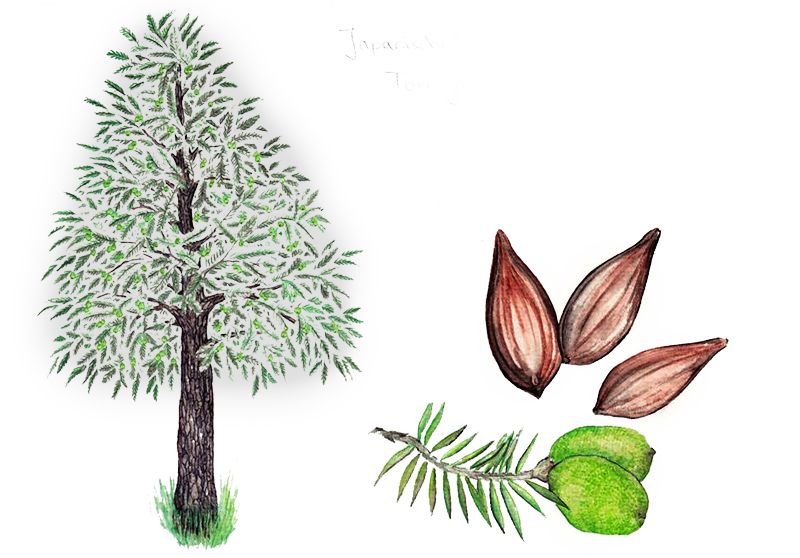
Japanese nutmeg-yew (Torreya nucifera) grows as a Tree and reaches roughly 20 m in height when mature, with a spread of about 10 m. Growth is very slow.
Japanese nutmeg-yew: what site does it need?
Japanese nutmeg-yew tolerates full shade. Suitable soils are Sand, Silt, Loam. Soil moisture should be in the range semi-dry – very moist. The pH may lie between 5.5 and 7.5.
Japanese nutmeg-yew: is it hardy?
Japanese nutmeg-yew is listed as hardy in zone 7–9 and survives normal winters outdoors there.
Japanese nutmeg-yew: will it grow in Central Europe?
Japanese nutmeg-yew is hardy to zone 7: lowlands, river valleys and cities across Central Europe are fine, harsher continental or upland sites need winter protection or a container.
Japanese nutmeg-yew: when does it flower?
In a temperate northern-hemisphere climate it flowers in May.
Japanese nutmeg-yew: when is it harvested?
In a temperate northern-hemisphere climate the fruit ripens in November.
Japanese nutmeg-yew: is it poisonous?
Individual parts of Japanese nutmeg-yew are noted as mildly problematic — the plant does not count as poisonous. With wild plants, never rely on a database alone, only on a confident identification.
Japanese nutmeg-yew: what is it used for?
Rated on a scale up to 10: Edible 6/10, Medicinal 3/10, Other uses 6/10.
Plan this plant into your own garden
Permaplans plans your garden to scale on the map — with a site check, harvest calendar and over 1,000 plants. Free for iPhone, Android, Mac, Windows & Linux.
Will this plant grow where you live? → Check your site
Community experience
What Permaplans users wrote about this plant – taken from the app as is. 1 post.
wäre spannend und interessant zu klären in wie sehr die Samen zum Verzehr komplett unbedenklich geeignet sind also ob eine Giftigkeit besteht oder nicht. kleiner Schreibfehler bei medizinischer Wirkung "beruhigend"
Growing it? Write in the app what works for you – your post will show up here.
💬 Get the app and join in