
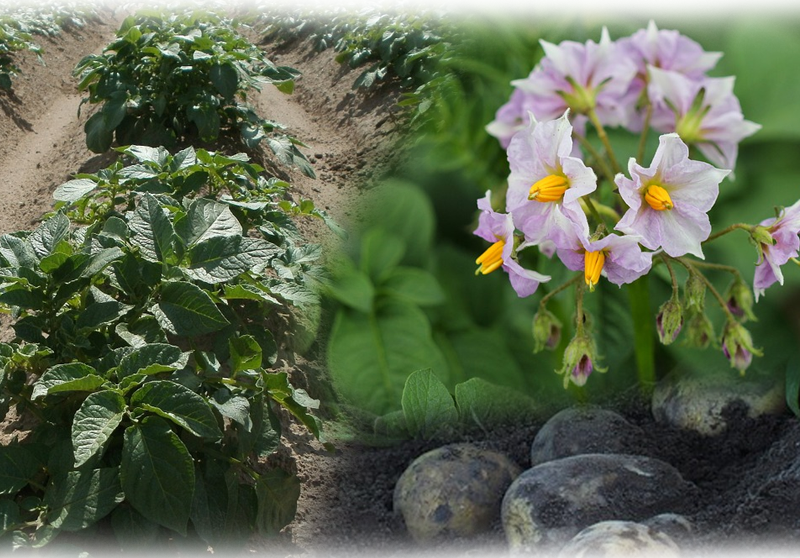
Potato
 9
9 7
7 5
5Will it grow where I live?
Potato is an annual and grows outdoors across Central Europe – one season from spring sowing to autumn harvest.
Or check it for your location right here:
Profile
- Family
- Solanaceae
- Habit
- perennial
- Height
- 1.1 m
- Spread
- 0.6 m
- Growth
- fast
- Lifespan
- 1 year
- First yield
- after 1 year
- Yield per plant
- up to 2 kg
- Yield in cultivation
- up to 40 t/ha
- Energy yield
- 3000 kcal per m² a year
- Hardiness
- zone 3–10
- Shade tolerance
- light shade
- Soil
- Sand, Silt, Loam, Clay
- Soil moisture
- semi-dry – very moist
- pH
- 5 – 7
Flowering & harvest
| J | F | M | A | M | J | J | A | S | O | N | D | |
|---|---|---|---|---|---|---|---|---|---|---|---|---|
| Flowering | ||||||||||||
| Fruit harvest |
Uses
Edible: Potatoes are a versatile food that can be cooked in various ways, with a mild taste that easily takes on the flavors of other ingredients. They can be consumed raw, but are commonly boiled, baked, fried, or included in soups and stews. Additionally, they can be ground into powder for thickening or used in baked goods like bread and cookies. While potatoes are high in starch, they lack many essential nutrients. It's important to note that the green skin of potatoes contains the toxin solanine, so any green areas should be discarded before consumption. While eating a small amount of green potatoes is usually safe, it's recommended to exercise caution.
Medicinal: Potatoes have healing properties that can assist with different health issues. Potato juice can alleviate stomach ulcers, but it's advisable to consume it moderately. A poultice created from boiled potatoes can alleviate rheumatic complaints and skin conditions. In India, potato peels are utilized to treat swollen gums and burns. The tubers contain trace amounts of alkaloids that support digestion. Potato plants exhibit cardiotonic effects and can assist with managing high blood pressure. Extracts from potato plants possess antimicrobial and antispasmodic qualities.
Other uses: The potato is a significant starch source utilized in different industries, such as sizing cotton and manufacturing industrial alcohol. Ripe potato juice is an effective cleaner for silk, cotton, and wool, while boiled potato water can be used to clean silver and polish furniture. Potatoes are also utilized in facial masks for skin softening and cleansing. Additionally, potatoes serve as a biomass source as their starch can be converted into glucose and further fermented into alcohol.
Growing
Site: Rotation decides everything here — leave at least three, better four years before potatoes or other nightshades return to the same ground, otherwise nematodes and soil fungi build up. Keep your distance from tomatoes: both suffer the same late blight, and an infected potato row will pass it to the tomatoes beside it. Avoid freshly limed beds, which encourage common scab. On newly broken or compacted ground the potato makes a good first crop, because earthing up and lifting work the soil through. All green parts of the plant and the berries are poisonous — a row's distance from small-animal runs, chicken enclosures and play areas is worth keeping. Spacing: 75 centimetres between rows, 30 within the row. Care: Chit the tubers two to three weeks before planting, in the light at about 10 degrees; this brings the harvest forward by a fortnight. Plant once the soil reaches 8 degrees, usually mid-April, about ten centimetres deep. Earth up twice: this keeps light off the tubers and stops them greening, buffers late frost and lets further stolons form. Water evenly during tuber formation — alternating drought and wet causes hollow heart and second growth. Pick Colorado beetles and their larvae off by hand while the planting is small. In warm wet weather late blight announces itself with brown leaf patches edged in white; remove affected haulm at once and do not compost it. Cut the haulm two weeks before lifting so the skins set. Store dark, airy and at 4 to 8 degrees.
Propagation
Plant seeds early in spring in a greenhouse. Transplant seedlings into pots once they are big enough, then move them to their final spot after the last frost. While potatoes are typically grown from tubers, it is possible to get a decent harvest in the first year if they grow fast. Named variety seeds may not produce the exact same type but generally yield a good crop. Harvest tubers in autumn, store them in a cool, frost-free place during winter. Start germinating the potatoes in the new year and plant them in spring.
Value for wildlife
For wildlife the potato is one of the quiet crops. Its flowers carry no nectar; only pollen is on offer, and that rarely — the US pollinator survey rates it unattractive to honey bees, while bumblebees and mining bees of the genus Andrena may visit under some conditions. They shake the pollen out of the porose anthers by buzz pollination. The crop does not depend on pollination anyway: the harvest is the tuber, and insect visits matter only in breeding. The haulm is defended by solanine and left alone by deer and livestock; the conspicuous animals on it are Colorado beetles and aphids, not beneficials. A small contribution remains all the same: for weeks the potato ridge is open, loose soil where blackbirds, starlings and other ground feeders work for worms and grubs, and tubers left behind after lifting are cleared by mice and corvids. If you want to do something for insects in the vegetable garden, put it at the edge of the potato patch, not into it.
Notable
Special features: Can be stored in a cool place or freeze-dried, as in the Andes. Produces early and late potatoes, as well as starch, fodder, and table potatoes. Good as a first sow in uncultivated beds: for hay potatoes, simply spread the potatoes on the soil and cover well; otherwise, plant them 10-20 cm deep.
Origin & habitat
The Andes of South America: from Venezuela through Peru and Bolivia to Argentina and the Chilean island of Chiloé. The genus originates there — the oldest traces of wild potatoes are estimated at some 13,000 years, and domestication took place around 8,000 years ago in Andean settlement cultures. The potato reached Europe in the sixteenth century, where it remained an ornamental and collector's plant before rising to staple status in the eighteenth. Today it is grown worldwide across the temperate zones and in tropical highlands; China and India lead production, while in Europe Germany, Poland, France and Ukraine are the largest growers.
The potato is purely a cultivated plant and has no habitat of its own in Central Europe — it does not naturalise lastingly, because the tubers survive winter outdoors only in mild situations. Its wild relatives grow in the high valleys and forest margins of the Andes, mostly between 2,000 and 4,000 metres: nutrient-rich, well-aerated soils, strong day-night swings, short growing seasons and a steadily moist, cool climate without summer heat. That explains its demands in the garden: loose, slightly acid soil at pH 5 to 6, even watering, and midsummer temperatures that do not stay much above 25 degrees, since tuber formation stalls beyond that.
⚠️ Hazards
Toxicity: toxic
All green parts of the plant, including tubers, are toxic due to the presence of solanine, an alkaloid. Solanine is also found in potato sprouts during germination, regardless of light exposure or green coloration.
Frequently asked questions
Potato: how big does it get?
Potato (Solanum tuberosum) grows as a perennial and reaches roughly 1.1 m in height when mature, with a spread of about 0.6 m. Growth is fast.
Potato: what site does it need?
Potato tolerates light shade. Suitable soils are Sand, Silt, Loam, Clay. Soil moisture should be in the range semi-dry – very moist. The pH may lie between 5 and 7.
Potato: is it hardy?
Potato is listed as hardy in zone 3–10 and survives normal winters outdoors there.
Potato: will it grow in Central Europe?
Potato is an annual and grows outdoors across Central Europe – one season from spring sowing to autumn harvest.
Potato: when does it flower?
In a temperate northern-hemisphere climate it flowers from June to July.
Potato: when is it harvested?
In a temperate northern-hemisphere climate the fruit ripens from July to October.
Potato: when does it start cropping, and how much?
Potato crops in its first year. Expect up to 2 kg per plant, in cultivation up to 40 t per hectare. Figures assume a good site; variety, soil and climate shift them considerably.
Potato: is it poisonous?
Potato is classified as toxic. With wild plants, never rely on a database alone — only on a confident identification.
Potato: what is it used for?
Rated on a scale up to 10: Edible 9/10, Medicinal 7/10, Other uses 5/10.
Plan this plant into your own garden
Permaplans plans your garden to scale on the map — with a site check, harvest calendar and over 1,000 plants. Free for iPhone, Android, Mac, Windows & Linux.
Will this plant grow where you live? → Check your site
Community experience
No first-hand reports for this plant yet.
Growing it? Write in the app what works for you – your post will show up here.
💬 Get the app and join in