
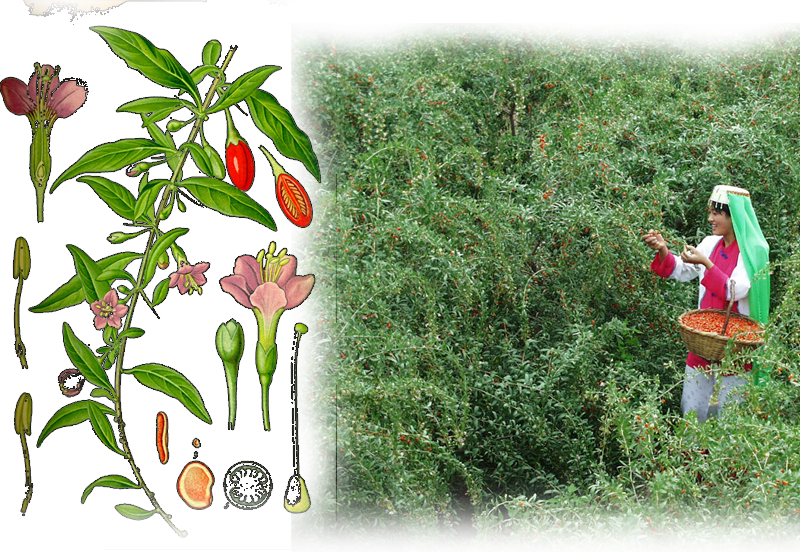
Goji berry
 6
6 7
7 3
3Will it grow where I live?
Goji berry is hardy to zone 6, which covers nearly all of Central Europe and the British Isles; only harsh upland sites (Alps, high ridges) call for winter protection.
Or check it for your location right here:
Profile
- Family
- Solanaceae
- Habit
- Shrub
- Height
- 2.8 m
- Spread
- 4 m
- Growth
- fast
- Lifespan
- 60 years
- First yield
- after 3 years
- Yield per plant
- up to 4 kg a year
- Yield in cultivation
- up to 4 t/ha
- Energy yield
- 1360 kcal per m² a year
- Hardiness
- zone 6–9
- Shade tolerance
- partial shade
- Soil
- Sand, Silt, Loam
- Soil moisture
- dry – very moist
- pH
- 5.5 – 6.5
- Synonyms
- Goji
Flowering & harvest
| J | F | M | A | M | J | J | A | S | O | N | D | |
|---|---|---|---|---|---|---|---|---|---|---|---|---|
| Flowering | ||||||||||||
| Fruit harvest |
Varieties (9)
9 varieties of Goji berry are listed in the Permaplans variety finder — each with its own page: taste, ripening time, disease resistance, parentage and use.
- Amber Sweet Rare golden-yellow goji with a sweet-tart, aromatic taste.
- Big Lifeberry Western garden cultivar with notably large, juicy-sweet berries for fresh picking.
- Crimson Star Very productive, compact cultivar with large, sweet-tart berries and strong cold hardiness.
- Korean Big Korean selection of the small red-fruited type with a bold, herbal taste.
- Ningxia No.1 The leading commercial cultivar from Ningxia – the benchmark for premium, sweet dried goji.
- No.1 Lhasa Sweet, high-yielding commercial selection that topped multi-year variety trials.
- Phoenix Tears Chinese heirloom prized for extra-sweet, orange-red jellybean-shaped fruit.
- Sweet Lifeberry Sister cultivar to Big Lifeberry with sweeter, only slightly tangy fruit.
- Turgidus High-yielding orange-red selection that performed at the top of trials.
Uses
Edible: Fruit - raw or cooked. The fruit is a berry with a diameter of about 2 cm, having a mild sweet licorice flavor. Only fully ripe fruits should be consumed. Young shoots can be cooked and used as a vegetable, offering a slightly cress-like taste, also described as minty. The leaves wilt quickly after harvesting. Caution is advised, see notes above. The leaves can be used as a tea substitute.
Medicinal: Traditional Chinese Medicine treats two parts of this plant separately. The dried berries, gouqizi, are regarded there as a means of strengthening liver and kidneys and are used for weak eyesight, dizziness and exhaustion; they are food as much as medicine and go into soups, teas and rice dishes. The dried root bark, digupi, is traditionally used for persistent fever and heat conditions. Both are traditional applications without robust proof of efficacy by present-day standards; the European marketing as a superfood rests above all on the content of zeaxanthin and lutein, which contribute to the supply of the retina.
Other uses: Beyond its fruit, goji is used above all as a shrub with a job to do. Its far-reaching, dense root system binds sandy soils, dunes and banks and is used for slope stabilisation - the very trait that makes it a nuisance in a border. As a free-growing thorny hedge it forms an impenetrable boundary within a few years, giving cover and holding back livestock; coppiced regularly it stays dense. It tolerates wind and coastal climate but reacts sensitively to salt, so it does not belong in the front dune line or along roads treated with de-icing salt. For small gardens and balconies container culture is the most sensible form, since it deals with the suckers at the same time. The young leaves are cooked as a leaf vegetable in East Asia; in the EU, however, only the berries are approved as food. Ornamental cultivars are planted for the violet flowers and the long fruiting season.
Growing
Site: Full sun on free-draining, moderately fertile soil; poor soils actually give a better fruit set, while rich soils produce nothing but growth. More important than the soil is the question of how to get rid of it again: goji throws vigorous root suckers and layers its arching branches at the same time, so that within a few years it spreads metres and forms dense thicket. In Europe it counts as invasive because it can displace native ruderal vegetation; it has no place beside natural areas, dry stone walls or species-rich grassland. In the garden it belongs inside a rhizome barrier, in a large container, or in a spot that is mown all round. The shoots carry thorns and do not belong beside narrow paths, seating areas or children's areas. Birds carry the seed far beyond the plot. It is sensitive to salt, so roadside positions are out. Care: The shrub is undemanding, hardy to about -25 degrees and copes well with drought; water only in the planting year and in long dry spells. Feed not at all or very sparingly. Pruning decides the yield: fruit is borne on one-year wood, so thin hard in late winter, take out old wood and build an upright framework of a few leaders - unpruned the shrub grows straggling and flops to the ground, where the branches root. A support or wire frame keeps it upright and the fruit clean. Powdery mildew appears regularly and is limited by airy pruning; aphids and occasionally slugs attack young growth. Harvest continuously from August to October, most gently by shaking onto a cloth, since the soft berries darken where handled.
Propagation
Goji can be propagated several ways, with the vegetative methods reserved for named cultivars. Suckers are the easiest: rooted root shoots are severed in autumn or early spring and planted straight into their new position. Layering is equally reliable - pin an arching shoot to the ground in summer and earth it up lightly, and by the following year it has rooted and can be separated. Softwood cuttings of half-ripe shoots, 5 to 10 cm long, root at a high percentage from July to August given even moisture and slight bottom heat; hardwood cuttings from the winter prunings also succeed in an outdoor bed. Seed raising is straightforward: wash the seed from fully ripe berries, dry it and sow it shallowly in spring at 18 to 22 degrees, where it germinates promptly without any chilling. Seedlings turn out uneven, however, come into bearing later and often carry smaller fruit, so this route is only worthwhile for hedging.
Value for wildlife
Goji is a neophyte from East Asia for which no reliable species counts for wild bees or beetles exist in Central Europe. Its strongest argument is the length of its flowering: the small violet funnel-shaped flowers open continuously from June to September and thus bridge the midsummer gap, when many spring bloomers are long finished. Pollination is by bumblebees and bees, and self-pollination is possible as well. As a caterpillar host it is accepted by hawkmoths, among them the tobacco hornworm and the death's-head hawkmoth, which arrive as migrants from the south. The berries ripen from August to October and are eaten by birds, which also disperse the seed; that is one reason for its readiness to spread. The thorny thicket gives birds and small mammals good cover and nesting opportunities. Anyone chiefly wanting to support native insects is better served by dogwood, dog rose or guelder rose.
Notable
Special features: tolerant to (sea) wind, forms many runners; 6500 plants are planted per hectare; can be stored dried for 1-2 years; recommended varieties for fresh consumption are: 'Turgidus', 'No.1 Lifeberry'; Wild form tastes rather bitter peppery and is more suitable for drying;. susceptible to powdery mildew, prefers sandy soil as a pioneer plant;
Origin & habitat
East Asia, centred on northern China. The exact homeland is disputed, because the species has long been cultivated and has escaped widely; the range given today runs from south-eastern Europe through Central Asia to China, but the focus of wild occurrence and the entire commercial crop lie in East Asia. The north-west Chinese region of Ningxia on the Yellow River is the classic growing area and still supplies most of the world crop. Goji reached Europe in the 18th century as an ornamental and hedging plant and has been naturalised ever since; in Germany the escaped populations are concentrated in the east and are scarcer in the west. Growing it for the fruit market has only been an issue in Central Europe for a few decades.
Goji is a full-light plant of open, disturbed ground. In Central Europe it turns up as a neophyte along path edges, railway embankments, walls, hedges, banks and waste ground, often on free-draining, moderately fertile soil in ruderal situations. It prefers neutral to slightly acidic, moderately dry substrates and tolerates neither salt nor heavy metals. The straggling, arching thicket with its strong suckers forms dense, impenetrable stands that can displace native ruderal vegetation - which is why the species is regarded as invasive in Europe, though it is not on the EU list of species of Union concern. In its region of origin it grows under markedly continental conditions with hot dry summers and severe winters, and it is hardy to about -25 degrees.
⚠️ Hazards
Interaction with anticoagulants, thorns No cases of human poisoning are known and the berries are regarded as non-toxic. What does matter medically is the interaction with anticoagulants: constituents of the goji berry act on liver metabolism and can strengthen the effect of vitamin K antagonists such as warfarin, increasing the risk of bleeding. Anyone taking such medication should avoid larger amounts and discuss it with their doctor. By the same route an enhanced effect on blood-sugar and blood-pressure medication is conceivable. Goji belongs to the nightshade family; in the EU only the berries are approved as food, not the young leaves customary in East Asia. The shoots carry thorns.
Frequently asked questions
Goji berry: how big does it get?
Goji berry (Lycium barbarum) grows as a Shrub and reaches roughly 2.8 m in height when mature, with a spread of about 4 m. Growth is fast.
Goji berry: what site does it need?
Goji berry tolerates partial shade. Suitable soils are Sand, Silt, Loam. Soil moisture should be in the range dry – very moist. The pH may lie between 5.5 and 6.5.
Goji berry: is it hardy?
Goji berry is listed as hardy in zone 6–9 and survives normal winters outdoors there.
Goji berry: will it grow in Central Europe?
Goji berry is hardy to zone 6, which covers nearly all of Central Europe and the British Isles; only harsh upland sites (Alps, high ridges) call for winter protection.
Goji berry: when does it flower?
In a temperate northern-hemisphere climate it flowers in July.
Goji berry: when is it harvested?
In a temperate northern-hemisphere climate the fruit ripens from September to October.
Goji berry: when does it start cropping, and how much?
Goji berry first crops after 3 years. A mature plant gives up to 4 kg a year, in cultivation up to 4 t per hectare. Figures assume a good site; variety, soil and climate shift them considerably.
Goji berry: is it poisonous?
Individual parts of Goji berry are noted as mildly problematic — the plant does not count as poisonous. With wild plants, never rely on a database alone, only on a confident identification.
Goji berry: what is it used for?
Rated on a scale up to 10: Edible 6/10, Medicinal 7/10, Other uses 3/10.
Which Goji berry varieties are there?
The Permaplans variety finder lists 9 varieties of Goji berry, including Amber Sweet, Big Lifeberry, Crimson Star, Korean Big, Ningxia No.1, No.1 Lhasa, Phoenix Tears, Sweet Lifeberry, Turgidus. Each variety has its own page with taste, ripening time, disease resistance and parentage.
Plan this plant into your own garden
Permaplans plans your garden to scale on the map — with a site check, harvest calendar and over 1,000 plants. Free for iPhone, Android, Mac, Windows & Linux.
Will this plant grow where you live? → Check your site
Community experience
No first-hand reports for this plant yet.
Growing it? Write in the app what works for you – your post will show up here.
💬 Get the app and join in