
Gooseberry
 8
8 5
5 3
3Will it grow where I live?
Gooseberry is hardy to zone 5 – that covers all of Central Europe and the British Isles, and every USDA zone from 5 upwards.
Or check it for your location right here:
Profile
- Family
- Grossulariaceae
- Habit
- Shrub
- Height
- 1.2 m
- Spread
- 1.2 m
- Growth
- medium
- Lifespan
- 35 years
- First yield
- after 3 years
- Yield per plant
- up to 4 kg a year
- Yield in cultivation
- up to 9 t/ha
- Energy yield
- 400 kcal per m² a year
- Hardiness
- zone 5–8
- Shade tolerance
- partial shade
- Soil
- Sand, Silt, Loam
- Soil moisture
- semi-dry – very moist
- pH
- 5.5 – 7
- Planned in gardens
- 3×
Flowering & harvest
| J | F | M | A | M | J | J | A | S | O | N | D | |
|---|---|---|---|---|---|---|---|---|---|---|---|---|
| Flowering | ||||||||||||
| Fruit harvest |
Varieties (16)
16 varieties of Gooseberry are listed in the Permaplans variety finder — each with its own page: taste, ripening time, disease resistance, parentage and use.
- Captivator Near-thornless sweet red variety from Canada — child-friendly and easy to pick.
- Careless Large-fruited English classic with whitish-green berries — the quintessential cooking gooseberry.
- Hinnonmäki Gelb Very sweet, yellow-green sibling of the red Hinnonmäki — a top dessert berry for the garden.
- Hinnonmäki Grün Refreshing tart green Hinnonmäki — versatile for kitchen and fresh eating.
- Hinnonmäki Rot Hardy Finnish red-berried variety with sweet-aromatic flavour — ideal for cold sites.
- Invicta Robust, heavy-cropping commercial standard with excellent mildew resistance.
- Leveller Large, sweet yellow-green dessert variety — an English exhibition classic.
- MucurinesRobust green variety with good mildew resistance — a proven classic for cooking.
- Pax Near-thornless, mildew-resistant red variety — comfortable to pick and healthy.
- Pixwell Hardy, nearly thornless American variety — low-maintenance and reliable.
- Poorman The finest American red gooseberry — sweet, aromatic and mildew-tolerant.
- Redeva Mildew-resistant red variety with good flavour and reliable yield.
- Rokula Early, mildew-resistant red variety for the home garden.
- Rolonda Large-fruited, mildew-resistant red variety with high yield.
- Whinham's Industry Old, robust English classic with sweet red berries — tolerant even of part shade.
- Xenia Large, red, nearly thornless premium variety with sweet flavour — a modern dessert gooseberry.
Uses
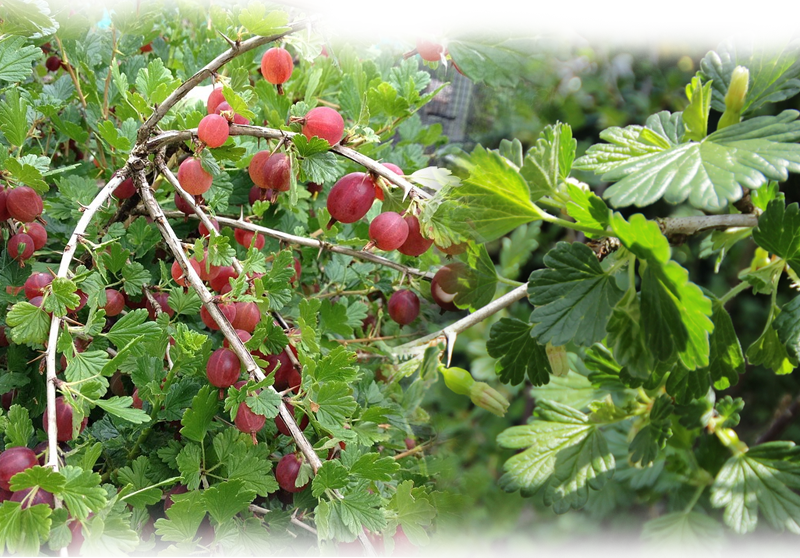
Edible: The rounded, slightly egg-shaped and often finely hairy berries ripen in July and August. Picked half-ripe and still firm they taste decidedly sour — which is exactly how they are traditionally used for compote, tarts, jelly and jam, since at that stage they are rich in pectin and set well. Left on the bush until fully ripe and soft, they turn sweet-sour and make good fresh eating. The wild form usually stays under 1 cm across, while cultivars reach up to 3 cm and come with greenish-white, yellow or red fruit. On vitamin C the species behaves the opposite way to most fruit: the content peaks in the unripe green berries and falls to around 35 mg per 100 g by full ripeness.
Medicinal: The fruit has a laxative effect. Cooked unripe gooseberries are used in spring as a tonic to cleanse the body. The leaves were used to treat gravel. An infusion taken before menstruation is said to be a useful tonic for adolescent girls. The leaves contain tannin and have been used as an astringent to treat dysentery and wounds.
Other uses: Its dense, strongly spined growth makes the gooseberry a useful hedging shrub beyond the fruit harvest: as an understorey and in field hedges it keeps larger animals out while giving small birds sheltered nest sites. In cosmetics the pulp is used in face masks for oily skin for its mildly astringent effect. The species also matters in breeding: the North American wild species Ribes hirtellum and Ribes cynosbati were crossed in to improve mildew resistance and to produce less spiny cultivars — though such varieties do not quite match the flavour of selections derived purely from Ribes uva-crispa.
Growing
The gooseberry makes no great demands on soil or climate, but it wants a warm site that does not dry out. Growth stays weak on light sandy ground, while very heavy soils produce soft, over-vigorous shoots; a humus-rich, nutrient-rich loam with some lime suits it best. Full sun gives the sweetest fruit, while in half shade it ripens later and yields less. Dormant wood is hardy to about -28 °C, but flowers and young fruit are vulnerable to late frost. Variety choice is decisive: American gooseberry mildew attacks susceptible cultivars regularly and resistant ones hardly at all. Prune in spring by thinning out and shortening the shoots. Do not plant near five-needled pines — Ribes species are an alternate host of blister rust.
Propagation
Gooseberries can be raised on their own roots from hardwood cuttings, or grafted onto a rootstock to form half- and full standards. For cuttings, take well-ripened shoots about 30 cm long during the winter prune between November and February and insert them into pots of open compost or straight into a nursery bed outdoors; they root reliably and push out several new shoots in spring. Take the material from young, healthy bushes, since older plants pass diseases on to their offspring. Sowing seed is worthwhile only for the wild form — cultivars segregate in the seedling generation and lose both fruit size and mildew resistance.
Value for wildlife
The gooseberry flowers very early, often in March, and its inconspicuous greenish bells are geared to bumblebees, which are regarded as the actual pollinators; honey bees take little of the nectar and gather mostly pollen. Around twelve wild bee species have been recorded on it. Its greater value lies in being a larval food plant for 18 moth and butterfly species, four of them closely tied to the genus Ribes. The thorny, dense twiggy growth offers small birds sheltered nest sites, and fruit left on the bush is welcome bird food in autumn.
Notable
Features: in cultivation since the 16th century, with over 500 described varieties bearing red, yellow and greenish-white fruit; several varieties together increase yield, and mildew-resistant ones are preferable; best fruit on one- and two-year-old wood, so older shoots are cut out at ground level in spring leaving 4-5 shoots of one to three years; fully ripe it is as sweet as grapes; the flowers are hermaphrodite and self-fertile, pollinated chiefly by bumblebees and also by hoverflies and other flies, bees and sawflies; its larger relative is the North American Oregon gooseberry (Ribes divaricatum), reaching up to 3 m
Origin & habitat
Southern to central Europe, the Caucasus, North Africa and China. In Europe the range extends north to roughly the 63rd parallel and continues through Asia Minor and the Caucasus into the Himalaya and on to northern and north-eastern China; records also exist from North Africa. In northern and south-eastern Europe the species counts as naturalised rather than original. How far the natural range once reached is an open question, because the gooseberry has been escaping from gardens for some four hundred years and wild and cultivated stock now overlap. North of the Alps it climbs to about 1,100 m, and in the Allgäu Alps to 1,700 m.
Unlike the blackcurrant, the gooseberry avoids wet ground. It grows in hedges, field copses, open deciduous woodland and along woodland edges on moderately dry to fresh soils that are nutrient-rich and preferably calcareous. Phytosociologically it belongs to the blackthorn scrub of the Prunetalia — the thorny mantle communities that mediate between woodland and open country, a niche its own spines suit well. It tolerates half shade without difficulty and ascends in the mountains to around 1,100 m. For the garden that translates into free-draining, humus-rich soil: no waterlogging, but no parched sand either.
⚠️ Hazards
No poisonous parts known. The shoots carry simple to three-parted spines 7-15 mm long — wear gloves when picking and pruning.
Frequently asked questions
Gooseberry: how big does it get?
Gooseberry (Ribes uva-crispa) grows as a Shrub and reaches roughly 1.2 m in height when mature, with a spread of about 1.2 m. Growth is medium.
Gooseberry: what site does it need?
Gooseberry tolerates partial shade. Suitable soils are Sand, Silt, Loam. Soil moisture should be in the range semi-dry – very moist. The pH may lie between 5.5 and 7.
Gooseberry: is it hardy?
Gooseberry is listed as hardy in zone 5–8 and survives normal winters outdoors there.
Gooseberry: will it grow in Central Europe?
Gooseberry is hardy to zone 5 – that covers all of Central Europe and the British Isles, and every USDA zone from 5 upwards.
Gooseberry: when does it flower?
In a temperate northern-hemisphere climate it flowers in April.
Gooseberry: when is it harvested?
In a temperate northern-hemisphere climate the fruit ripens in July.
Gooseberry: when does it start cropping, and how much?
Gooseberry first crops after 3 years. A mature plant gives up to 4 kg a year, in cultivation up to 9 t per hectare. Figures assume a good site; variety, soil and climate shift them considerably.
Gooseberry: is it poisonous?
No toxicity is recorded for Gooseberry. With wild plants, never rely on a database alone — only on a confident identification.
Gooseberry: what is it used for?
Rated on a scale up to 10: Edible 8/10, Medicinal 5/10, Other uses 3/10.
Which Gooseberry varieties are there?
The Permaplans variety finder lists 16 varieties of Gooseberry, including Captivator, Careless, Hinnonmäki Gelb, Hinnonmäki Grün, Hinnonmäki Rot, Invicta, Leveller, Mucurines, Pax, Pixwell, Poorman, Redeva and 4 more. Each variety has its own page with taste, ripening time, disease resistance and parentage.
Plan this plant into your own garden
Permaplans plans your garden to scale on the map — with a site check, harvest calendar and over 1,000 plants. Free for iPhone, Android, Mac, Windows & Linux.
Will this plant grow where you live? → Check your site
Community experience
No first-hand reports for this plant yet.
Growing it? Write in the app what works for you – your post will show up here.
💬 Get the app and join in