
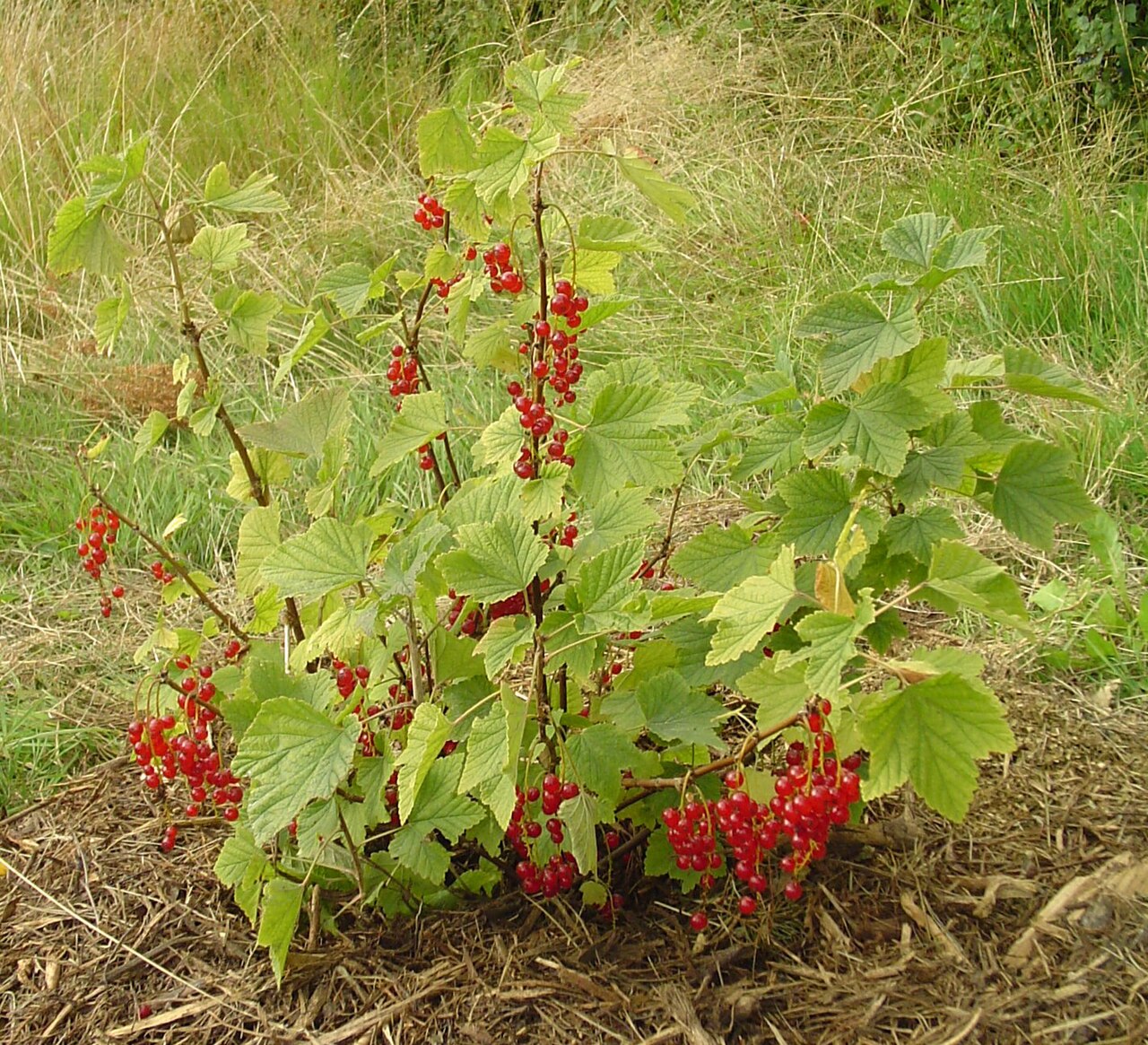
Red currant
 6
6 1
1 1
1Will it grow where I live?
Red currant is hardy to zone 3 – that covers all of Central Europe and the British Isles, and every USDA zone from 3 upwards.
Or check it for your location right here:
Profile
- Family
- Grossulariaceae
- Habit
- Shrub
- Height
- 1.2 m
- Spread
- 1.2 m
- Growth
- medium
- Lifespan
- 20 years
- First yield
- after 2 years
- Full yield
- after 5 years
- Productive years
- 17 years
- Hardiness
- zone 3–7
- Shade tolerance
- partial shade
- Soil
- Sand, Silt, Clay
- Soil moisture
- dry – moist
- pH
- 5.5 – 7
Flowering & harvest
| J | F | M | A | M | J | J | A | S | O | N | D | |
|---|---|---|---|---|---|---|---|---|---|---|---|---|
| Flowering | ||||||||||||
| Fruit harvest |
Varieties (16)
16 varieties of Red currant are listed in the Permaplans variety finder — each with its own page: taste, ripening time, disease resistance, parentage and use.
- Blanka Late, extremely productive white variety with very long trusses.
- Detvan Mid-early Slovak variety with uniform, aromatic berries.
- Heinemanns Rote Spätlese Very late German heritage variety — harvest well into August.
- Jonkheer van Tets The classic early redcurrant with large, bright-red berries on long trusses.
- Junifer Very early, high-yielding French variety with uniform trusses.
- Primus Robust, long-trussed white variety with high, reliable yields.
- Red Lake American classic with large, bright-red berries on long trusses.
- Rolan Mid-late variety with large berries on long trusses and mild flavour.
- Rondom Robust, high-yielding processing variety with firm, tart berries.
- Rosetta Late variety with very large, sweet berries on long trusses.
- Rote Vierländer Old North-German heirloom from the Vierlande region with aromatic berries.
- Rovada Late top variety with extremely long trusses and huge yields.
- Stanza Compact, healthy variety with dark-red, tart berries — even for small gardens.
- Tatran Robust Slovak selection with long trusses and good winter hardiness.
- Weiße Versailler The white classic: large, yellowish-white, mild berries for snacking.
- Zitavia Very early white variety with long, loose trusses — easy to harvest.
Uses
Edible: The translucent red berries hang in trusses and ripen from July to August. They taste pronouncedly sour and are high in vitamin C, which is why they are processed more often than eaten raw. Their high pectin content means the juice sets reliably without additives — redcurrant jelly is a classic of home preserving and doubles as a setting aid for pectin-poor fruit. Beyond that the berries suit juice, cordial, preserves, tart fillings, fruit wine and liqueur. Fruit ripened in full sun tastes distinctly sweeter than fruit from half shade. White currants are a pigment-poor selection of the same species and milder in flavour.
Other uses: Beyond the fruit harvest the redcurrant is a rewarding landscape shrub. It is planted in field hedges, as understorey in groups of shrubs and in roadside greenery as cover and food for birds — more than thirty bird species take the berries, and the twiggy growth offers shelter. Because it stays compact and tolerates half shade, suitable cultivars also do well in large containers on a balcony or terrace, or trained as an espalier against a north wall where hardly any other fruit crop still yields. For half and full standards the cultivar is grafted onto the golden currant (Ribes aureum), which supplies a stable upright stem.
Growing
The redcurrant is among the least demanding of fruit shrubs. It wants fresh to moist, humus-rich and nutrient-rich soil; markedly dry sands and permanently waterlogged hollows are both unsuitable. Sun gives the sweetest berries, but it still crops reliably in half shade, which sets it apart from almost every other fruit crop. The bush stays manageable at a good 1 to 1.5 m in height and spread, and suitable cultivars can even be kept in containers. The wood is hardy to about -28 °C. For most varieties picking runs from July into August, with late cultivars carrying on into September. Plant in autumn, and keep the framework open by removing old and weak shoots regularly. Like all Ribes species it should not be placed near five-needled pines, being an alternate host of blister rust.
Propagation
The redcurrant is as easy to propagate as any fruit crop: hardwood cuttings of pencil-thick one-year shoots, taken in late autumn or winter and pushed into loose soil with two or three buds above ground, root over winter almost without exception. Layering works just as reliably — bend a low shoot down and earth it up. Sowing matters only in breeding, since seedlings do not come true and the seed also needs a cold period. For standards the cultivar is grafted onto Ribes aureum.
Value for wildlife
The flowers of the redcurrant are inconspicuously green and hang in trusses, yet they appear early and are visited by around twelve wild bee species, among them mining bees and tree and red-tailed bumblebees; none specialises on it. More significant is its role as a larval food plant: 14 moth and butterfly species use it, five of them confined to Ribes, including the currant clearwing and two tussock-moth species. Its greatest value lies in the fruit — 34 bird species have been recorded feeding, from blackbird, robin and blackcap to bullfinch and jay. Leaving part of the crop on the bush supports a remarkable number of species in midsummer.
Notable
Special features: fruits on older wood, most heavily on 2-3 year old shoots -> remove canes older than about 4 years at the base, build a bush of 8-12 shoots of differing ages; unlike the blackcurrant, which fruits mainly on one-year wood and is therefore renewed more drastically; self-fertile, a second cultivar is not needed but raises yields; shade-tolerant -> still gives usable crops in half shade, can be trained as an espalier on a north wall
Origin & habitat
Western, central and southern Europe. The species is treated botanically as an aggregate species combining several closely related wild lineages — chiefly Ribes spicatum and Ribes sylvestre, with the rock currant also involved in the crosses. Ribes spicatum extends from northern Europe into northern Asia, while the western lineages centre on Central Europe. In Germany the species occurs wild scattered to moderately frequently and is not considered threatened. The cultivated forms grown in gardens today derive from these European wild species and were already taken into cultivation in the Middle Ages; they escape and naturalise in many places.
In the wild the redcurrant occupies damp, half-shaded situations: floodplain woodland and riverside scrub, moist broadleaf and ravine forests, and shaded slopes with well-watered, humus-rich soils. It is a plant of nutrient-rich ground and avoids both drying sands and permanently waterlogged hollows. As a shrub of the middle layer it grows beneath a light canopy and manages with considerably less direct sun than most fruit crops — which is what recommends it for half-shaded corners and for underplanting larger trees in the garden. In the Alps it ascends into the montane zone.
⚠️ Hazards
The redcurrant is regarded as harmless: no poisonous plant parts are known and the fruit is a classic soft fruit. The shrub bears no spines, so picking and pruning are entirely safe.
Frequently asked questions
Red currant: how big does it get?
Red currant (Ribes rubrum) grows as a Shrub and reaches roughly 1.2 m in height when mature, with a spread of about 1.2 m. Growth is medium.
Red currant: what site does it need?
Red currant tolerates partial shade. Suitable soils are Sand, Silt, Clay. Soil moisture should be in the range dry – moist. The pH may lie between 5.5 and 7.
Red currant: is it hardy?
Red currant is listed as hardy in zone 3–7 and survives normal winters outdoors there.
Red currant: will it grow in Central Europe?
Red currant is hardy to zone 3 – that covers all of Central Europe and the British Isles, and every USDA zone from 3 upwards.
Red currant: when does it flower?
In a temperate northern-hemisphere climate it flowers from April to May.
Red currant: when is it harvested?
In a temperate northern-hemisphere climate the fruit ripens from July to August.
Red currant: when does it start cropping, and how much?
Red currant first crops after 2 years. Full yield comes after 5 years. The productive period lasts about 17 years, within a lifespan of around 20 years. Figures assume a good site; variety, soil and climate shift them considerably.
Red currant: is it poisonous?
No toxicity is recorded for Red currant. With wild plants, never rely on a database alone — only on a confident identification.
Red currant: what is it used for?
Rated on a scale up to 10: Edible 6/10, Medicinal 1/10, Other uses 1/10.
Which Red currant varieties are there?
The Permaplans variety finder lists 16 varieties of Red currant, including Blanka, Detvan, Heinemanns Rote Spätlese, Jonkheer van Tets, Junifer, Primus, Red Lake, Rolan, Rondom, Rosetta, Rote Vierländer, Rovada and 4 more. Each variety has its own page with taste, ripening time, disease resistance and parentage.
Plan this plant into your own garden
Permaplans plans your garden to scale on the map — with a site check, harvest calendar and over 1,000 plants. Free for iPhone, Android, Mac, Windows & Linux.
Will this plant grow where you live? → Check your site
Community experience
No first-hand reports for this plant yet.
Growing it? Write in the app what works for you – your post will show up here.
💬 Get the app and join in