
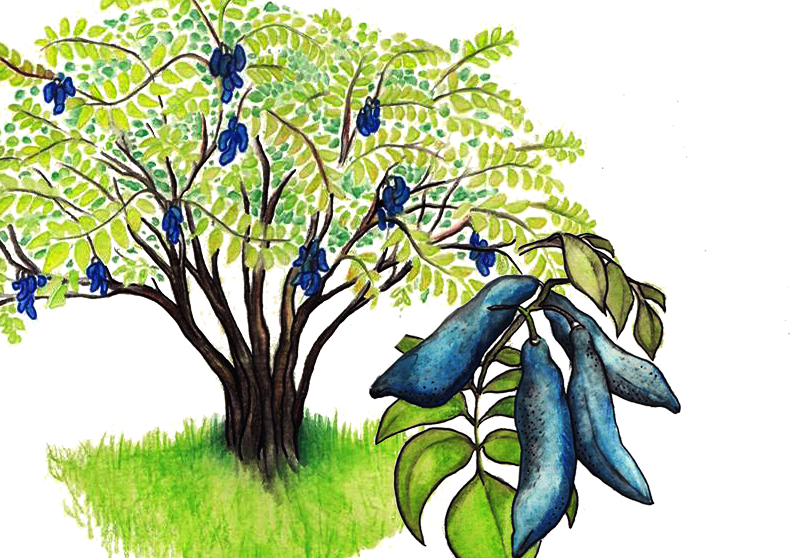
Bluebell bush
 6
6 3
3Will it grow where I live?
Bluebell bush is hardy to zone 5 – that covers all of Central Europe and the British Isles, and every USDA zone from 5 upwards.
Or check it for your location right here:
Profile
- Family
- Lardizabalaceae
- Habit
- Shrub
- Height
- 4.5 m
- Spread
- 4 m
- Growth
- medium
- Lifespan
- 50 years
- First yield
- after 5 years
- Yield per plant
- up to 5 kg a year
- Hardiness
- zone 5–8
- Shade tolerance
- partial shade
- Soil
- Sand, Silt, Loam
- Soil moisture
- semi-dry – very wet
- pH
- 6 – 7.5
- Synonyms
- Blaugurke, Blaugurkenbaum, Blauschotenbaum
Flowering & harvest
| J | F | M | A | M | J | J | A | S | O | N | D | |
|---|---|---|---|---|---|---|---|---|---|---|---|---|
| Flowering | ||||||||||||
| Fruit harvest |
Uses
Edible: The cobalt-blue, white-bloomed follicles contain a translucent, gelatinous pulp in which numerous black seeds are embedded. Only the pulp is eaten: the pod is broken open and the mass sucked out, leaving the seeds and the thick leathery skin. In its Chinese homeland the fruit is gathered and eaten raw. The flavour is mild, faintly sweet and not pronounced; the specialist literature expressly leaves open whether it meets European expectations of fruit. It serves for eating fresh in small quantity, but lacks the acidity and aroma for juice, purée or preserving. It ripens from September to October, late in the year, and holds on the bush for some weeks.
Other uses: The real value of the blue sausage shrub lies in its strangeness: hardly any other hardy shrub carries cobalt-blue fruit. The follicles, up to ten centimetres long and as thick as a thumb, hang in groups on the shoots in September and October and are so unusually coloured that the species is planted almost exclusively as an ornamental. The foliage adds to this: pinnate leaves up to eighty centimetres long with thirteen to twenty-five leaflets give the shrub an almost tropical appearance and make it a structural plant for partly shaded planting. Its Chinese name alludes bluntly to the shape and colour of the fruit. No craft or technical use is known; the shoots are sparsely branched and full of pith, suited neither to weaving nor to turning.
Growing
An easily cultivated plant that grows well in various soil types, preferring nutrient-rich, moist loam and a sunny location shielded from cold winds. It can also thrive in partial shade. While very resilient, late frosts may harm the flowers and young shoots in spring. Blooms emerge in spring on the ends of fresh upright stems. It takes a couple of years for the plants to produce fruit. They are quite decorative, growing relatively fast, but may look thin and sparse in winter. Typically, they do not need pruning. In recent botanical classifications, this species is now often considered just a synonym of D. insignis.
Propagation
Seeds should be sown right after they ripen in a cool environment, where they typically sprout easily in spring. If storing seeds, plant them in a greenhouse in February. They usually sprout well within 1-3 months at 18°C. Once seedlings are big enough, transfer them to separate pots and keep them sheltered during the initial winter. Plant them outdoors in late spring, following the final frosts.
Value for wildlife
No surveys of the wildlife value of the blue sausage shrub exist for Central Europe — the species is planted so rarely here that it does not appear in the relevant data collections. What can be said follows from the build of the plant. The hermaphrodite, greenish-yellow bell flowers hang in racemes in May and June; they are inconspicuous but openly accessible and are therefore likely to benefit short-tongued insects above all, such as flies and small wild bees. No specialist pollinators are known, and no Central European moth or butterfly larvae are tied to it. The cobalt-blue follicles, up to ten centimetres long and filled with gelatinous pulp, ripen from September to October. The dependable garden value lies in the structure: sparsely branched shoots up to five metres tall, carrying pinnate leaves up to 80 centimetres long, cast dense shade and give cover.
Notable
Special features: only shrub in the plant family; plant in a sheltered location; grows naturally in China in humid gorges at an altitude of 900-3600m; easy to propagate by seed; pollinators are flies and hymenoptera. The shrub/fruit certainly serves more than this, but this is still unknown.... Propagation: root cuttings;
Origin & habitat
East Asia: the mountain forests of western China. The blue sausage shrub is native there up to about 3000 metres above sea level, in the same family as the akebia. Outside this range it occurs only in cultivation: it reached European and North American collections in the late nineteenth century as a curiosity and is still planted mainly by collectors and botanic gardens. There are no naturalised populations in Central Europe, and none are to be expected, since the shrub sets fruit only irregularly here and its seedlings are sensitive to late frost.
The blue sausage shrub comes from the mountain forests of western China and climbs there to about 3000 metres. These are humid, cool-summered situations with ample rainfall, where it stands as understorey among larger trees; accordingly it takes half shade well and suffers in full midday sun and prolonged drought. Its soil demands are modest, provided the ground is free-draining and not permanently wet. For Central European gardens this yields a clear picture: sheltered, warm but not parched positions with even soil moisture, ideally in the light shade of larger trees. It survives winter frost, but breaks into growth early and is therefore vulnerable to late frost, which costs the fruit set in unfavourable years.
⚠️ Hazards
Little information is available regarding seeds, immature fruits, and other plant parts, suggesting a higher likelihood of potential toxicity.
Frequently asked questions
Bluebell bush: how big does it get?
Bluebell bush (Decaisnea fargesii) grows as a Shrub and reaches roughly 4.5 m in height when mature, with a spread of about 4 m. Growth is medium.
Bluebell bush: what site does it need?
Bluebell bush tolerates partial shade. Suitable soils are Sand, Silt, Loam. Soil moisture should be in the range semi-dry – very wet. The pH may lie between 6 and 7.5.
Bluebell bush: is it hardy?
Bluebell bush is listed as hardy in zone 5–8 and survives normal winters outdoors there.
Bluebell bush: will it grow in Central Europe?
Bluebell bush is hardy to zone 5 – that covers all of Central Europe and the British Isles, and every USDA zone from 5 upwards.
Bluebell bush: when does it flower?
In a temperate northern-hemisphere climate it flowers in June.
Bluebell bush: when is it harvested?
In a temperate northern-hemisphere climate the fruit ripens in October.
Bluebell bush: when does it start cropping, and how much?
Bluebell bush first crops after 5 years. A mature plant gives up to 5 kg a year. Figures assume a good site; variety, soil and climate shift them considerably.
Bluebell bush: is it poisonous?
Individual parts of Bluebell bush are noted as mildly problematic — the plant does not count as poisonous. With wild plants, never rely on a database alone, only on a confident identification.
Bluebell bush: what is it used for?
Rated on a scale up to 10: Edible 6/10, Other uses 3/10.
Plan this plant into your own garden
Permaplans plans your garden to scale on the map — with a site check, harvest calendar and over 1,000 plants. Free for iPhone, Android, Mac, Windows & Linux.
Will this plant grow where you live? → Check your site
Community experience
No first-hand reports for this plant yet.
Growing it? Write in the app what works for you – your post will show up here.
💬 Get the app and join in