
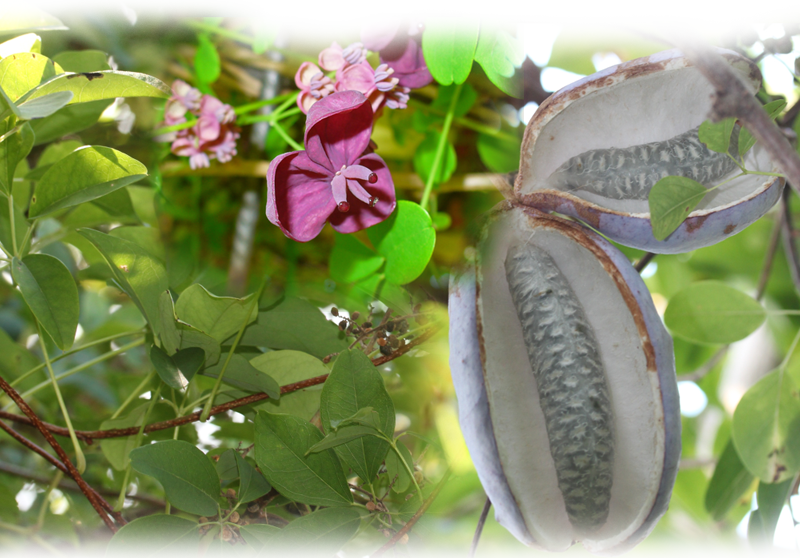
Chocolate vine
 7
7 6
6 5
5Will it grow where I live?
Chocolate vine is hardy to zone 4 – that covers all of Central Europe and the British Isles, and every USDA zone from 4 upwards.
Or check it for your location right here:
Profile
- Family
- Lardizabalaceae
- Habit
- Climber
- Height
- 13.5 m
- Spread
- 2 m
- Growth
- very fast
- Lifespan
- 40 years
- First yield
- after 4 years
- Full yield
- after 15 years
- Yield per plant
- up to 20 kg a year
- Yield in cultivation
- up to 30 t/ha
- Energy yield
- 1600 kcal per m² a year
- Hardiness
- zone 4–8
- Shade tolerance
- full shade
- Soil
- Sand, Silt, Loam
- Soil moisture
- semi-dry – very moist
- pH
- 5 – 8
- Synonyms
- Akebie
Flowering & harvest
| J | F | M | A | M | J | J | A | S | O | N | D | |
|---|---|---|---|---|---|---|---|---|---|---|---|---|
| Flowering | ||||||||||||
| Fruit harvest |
Varieties (6)
6 varieties of Chocolate vine are listed in the Permaplans variety finder — each with its own page: taste, ripening time, disease resistance, parentage and use.
- Alba Pure-white flowering form, often producing pale, whitish-bloomed pods.
- Deep Purple Selection with especially dark, near blackish-purple flowers.
- Purple Rain Free-flowering selection with deep purple, vanilla-scented blooms.
- Silver Bells Ivory-white to cream flowers with a chocolate-brown eye and a delicate fragrance.
- Variegata Variegated ornamental form with cream-and-green mottled foliage and pale mauve flowers.
- White ChocolateAkebia cultivar with pale, creamy-white flowers.
Uses
Edible: Fruit - raw. Sweet but bland. The fruit has a delicate taste and a soft, juicy texture. Sometimes lemon juice is added to enhance the flavor. The fruit's bitter peel is fried and eaten. The fruit is 5 - 10 cm long and up to 4 cm wide. Soft young shoots are used in salads or pickled. The leaves are used as a tea substitute.
Medicinal: In China and Japan the dried bark of akebia is a traditional remedy; it is known there as mu tong and used for urinary complaints and to promote lactation. There is no proof of effect by present-day standards. One distinction matters: the trade name mu tong has in the past also covered species of the genus Aristolochia, whose aristolochic acids damage the kidneys and cause cancer, and which are therefore not marketable in the EU. Such confusions have caused severe kidney damage in Europe. Self-medication with akebia bark is accordingly not acceptable.
Other uses: The long, pliable shoots of akebia are a traditional basketry material in Japan, worked peeled or unpeeled and yielding a particularly tough weave. In the garden its main value is as a screening climber: it covers pergolas, walls, fences and larger trees quickly and densely, stays in leaf into winter in mild districts, and is often placed by seating areas and entrances for the scent of its flowers. On larger areas it can also be grown as ground cover, though only where its spread can be controlled. In China and Japan the dried bark of the plant is a traditional remedy.
Growing
Site: Akebia needs a load-bearing support — it twines six to ten metres high and grows heavy over the years; light wires and thin trellises fail. It wants warmth, shelter from wind and a sunny to half-shaded position, though it also succeeds on north walls, and it is a plant for vine-growing climates: it takes winter temperatures down to about minus ten to minus fifteen degrees, and is distinctly more frost-tender when young. The key point concerns cropping: although both sexes occur on the same plant, its own pollen generally cannot fertilise its own flowers — a single plant stays fruitless. A second, genetically different akebia or an Akebia trifoliata alongside is required. And it counts as invasive: it escapes via bird-carried seed and self-rooting shoots, so it does not belong near woodland or hedgerows. Keep fruit and prunings off the open compost heap. Care: Keep the soil evenly moist; drought stress shows as leaf drop and failed fruit set. It grows hesitantly for the first few years and flowers first at about the fifth, after which it gathers pace considerably. Prune after flowering, as the flowers are borne on the previous year's wood; regular thinning is necessary or the plant goes bare inside and builds a dense felt of dead shoots. Remove rooted runners and seedlings regularly, or it will travel further than intended. Protect young plants through their first winters. Harvest in September and October as soon as the pods split along the seam; after that they drop quickly. The fruit keeps about two weeks at room temperature and up to three months in cool storage. No significant pests or diseases occur.
Propagation
Layering is quickest: shoots lying near the ground root by themselves and need only be severed and moved — the very trait that makes akebia a problem plant is an advantage in propagation. Half-ripened shoots taken in July and August under film or in a shaded propagating bed also succeed; they root slowly but reliably. For sowing, extract the seed fresh from ripe fruit, clean off the pulp and sow at once, as it will not tolerate drying; it germinates on the surface, in good light and at around fifteen degrees, within one to three months. Seed held over from the previous year needs a month of chilling and then germinates only poorly. One planning note: cuttings and layers give clones of the mother plant, and clones do not pollinate one another. If you want a crop, raise the second plant from seed or buy it from a different source.
Value for wildlife
Akebia has little to offer central European wildlife. As an East Asian introduction it has acquired neither wild bees nor moth caterpillars here, and no species counts are documented. Its flowers, scented of vanilla and chocolate in April and May, are pollinated in their homeland by small flies and beetles — and the absence of exactly those pollinators is, alongside its self-incompatibility, the second reason for the often meagre fruit set. Some structural value remains: the dense, long-held foliage on walls and pergolas gives birds cover and nesting opportunities, and the seeds are eaten by birds. That last point is also the problem, as it is how the species reaches the wider landscape; in North America this has become serious forest damage. Anyone greening a facade or pergola mainly for wildlife will achieve many times as much with ivy, honeysuckle or traveller's joy.
Notable
Special characteristics: thrives on north-facing walls, prefers partial shade and loamy soil; fruits last for 2 weeks at room temperature, 3 months when stored; the plant is said to exhibit invasive behavior in some locations; there are fruit selections: 'White Chocolate' & 'Alba', ...; cross-pollination possible with related Akebia trifoliata.
Origin & habitat
East Asia: China, Japan and Korea. There five-leaf akebia grows at altitudes between 300 and 1,500 metres and has long been used both as a fruit and as a medicinal plant. It reached Europe in 1845 as an ornamental and remained a specialist plant for pergolas and house walls. In the United States, where it has been planted since the nineteenth century, it has naturalised across the whole east from New England to Georgia and blankets the forest floor there — several states class it as invasive. In central Europe it appears on the watch list of invasive species, but it is not on the EU list of species of Union concern and is therefore not prohibited.
In its native range akebia occupies open deciduous and mixed woodland, woodland edges, stream valleys and scrub in the hill country of East Asia. It is a high-twining liana that hauls itself six to ten metres up trees and over rocks, overgrowing the crowns of smaller woody plants; at ground level it forms dense, self-rooting mats. Its leaves are deciduous but hang on through most of the winter in mild vine-growing districts. The naturalised stands of North America show where this growth form leads when herbivores and competition are absent: there it replaces the entire herb layer of deciduous forest and prevents natural tree regeneration.
⚠️ Hazards
The seed tastes bitter when I chew on it. I assume it contains toxic substances.
Frequently asked questions
Chocolate vine: how big does it get?
Chocolate vine (Akebia quinata) grows as a Climber and reaches roughly 13.5 m in height when mature, with a spread of about 2 m. Growth is very fast.
Chocolate vine: what site does it need?
Chocolate vine tolerates full shade. Suitable soils are Sand, Silt, Loam. Soil moisture should be in the range semi-dry – very moist. The pH may lie between 5 and 8.
Chocolate vine: is it hardy?
Chocolate vine is listed as hardy in zone 4–8 and survives normal winters outdoors there.
Chocolate vine: will it grow in Central Europe?
Chocolate vine is hardy to zone 4 – that covers all of Central Europe and the British Isles, and every USDA zone from 4 upwards.
Chocolate vine: when does it flower?
In a temperate northern-hemisphere climate it flowers in May.
Chocolate vine: when is it harvested?
In a temperate northern-hemisphere climate the fruit ripens in October.
Chocolate vine: when does it start cropping, and how much?
Chocolate vine first crops after 4 years. Full yield comes after 15 years. A mature plant gives up to 20 kg a year, in cultivation up to 30 t per hectare. Figures assume a good site; variety, soil and climate shift them considerably.
Chocolate vine: is it poisonous?
Individual parts of Chocolate vine are noted as mildly problematic — the plant does not count as poisonous. With wild plants, never rely on a database alone, only on a confident identification.
Chocolate vine: what is it used for?
Rated on a scale up to 10: Edible 7/10, Medicinal 6/10, Other uses 5/10.
Which Chocolate vine varieties are there?
The Permaplans variety finder lists 6 varieties of Chocolate vine, including Alba, Deep Purple, Purple Rain, Silver Bells, Variegata, White Chocolate. Each variety has its own page with taste, ripening time, disease resistance and parentage.
Plan this plant into your own garden
Permaplans plans your garden to scale on the map — with a site check, harvest calendar and over 1,000 plants. Free for iPhone, Android, Mac, Windows & Linux.
Will this plant grow where you live? → Check your site
Community experience
No first-hand reports for this plant yet.
Growing it? Write in the app what works for you – your post will show up here.
💬 Get the app and join in