
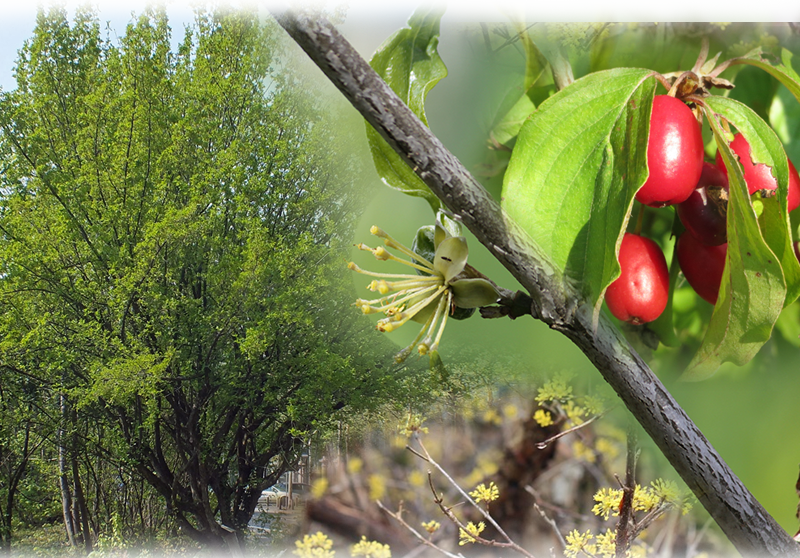
Cornelian cherry
 7
7 6
6 8
8Will it grow where I live?
Cornelian cherry is hardy to zone 4 – that covers all of Central Europe and the British Isles, and every USDA zone from 4 upwards.
Or check it for your location right here:
Profile
- Family
- Cornaceae
- Habit
- Shrub
- Height
- 5.5 m
- Spread
- 5 m
- Growth
- medium
- Lifespan
- 100 years
- First yield
- after 10 years
- Productive years
- 150–200 years
- Yield per plant
- up to 40 kg a year
- Yield in cultivation
- up to 25 t/ha
- Energy yield
- 1500 kcal per m² a year
- Hardiness
- zone 4–8
- Shade tolerance
- partial shade
- Soil
- Sand, Silt, Loam, Clay
- Soil moisture
- dry – very moist
- pH
- 6.5 – 7.5
- Planned in gardens
- 3×
Flowering & harvest
| J | F | M | A | M | J | J | A | S | O | N | D | |
|---|---|---|---|---|---|---|---|---|---|---|---|---|
| Flowering | ||||||||||||
| Fruit harvest |
Varieties (23)
23 varieties of Cornelian cherry are listed in the Permaplans variety finder — each with its own page: taste, ripening time, disease resistance, parentage and use.
- Alyosha Yellow-fruited, mild and sweet cornelian cherry with pear-shaped fruits.
- Bylda
- Dublany
- Elegantnyj Strikingly bottle-shaped, bright-red cornelian cherry with a sweet-sour flavour.
- Flava Historic yellow-fruited cornelian cherry with mild, sweet and low-acid fruits.
- Fructu Violaceo Historic selection with strikingly dark-violet, almost black-red fruits.
- Jantarnyj Yellow-fruited cornelian cherry from Ukraine.
- Jolico Large-fruited Austrian cornelian cherry.
- Kazanlak
- Korallowyj Marka
- Koralovyj Marka Unusually coral-orange cornelian cherry with very high sugar content and mild aroma.
- Lukjanovskij Bottle-shaped, dark-red cornelian cherry regarded as one of the most aromatic cultivars.
- Lutea
- Marceli
- Nikolka Early, dark-red cornelian cherry for the first harvest in August.
- Radost
- Schönbrunner Gourmetdirndl Austrian gourmet selection of cornelian cherry (Dirndl).
- Shan
- Svetlyachok Large-fruited, pear-shaped late cultivar with dark-red, sweet fruits.
- SzaferEastern European cornelian cherry selection.
- Ugoliok Dark-fruited cornelian cherry from Ukraine.
- Vydubetskij Large-fruited late cultivar with pear-shaped, dark-red fruits up to 3.5 cm long.
- Wydubieckij
Uses
Edible: Fruit is consumed fresh, dried, or preserved. It has a juicy texture with a pleasing acidic taste. When fully ripe, the fruit emits a plum-like scent and has a soft consistency, while unripe ones are more astringent. Due to its low pectin content, it is often mixed with other fruits for jam-making. In the past, the fruit was pickled in brine and served as a substitute for olives. Each fruit is of moderate size, reaching up to 15 mm, and contains a single large seed. The seeds yield a small amount of edible oil, and when roasted and ground, they can be used as a coffee alternative.
Medicinal: The fruit has been recorded as an astringent since antiquity: Dioscorides describes it in the first century, and the binding effect of its high tannin content runs through the old herbals as far as Hahnemann's pharmacist's lexicon of 1793. Hildegard of Bingen recommended baths of leaves and bark for rheumatic pain, and tea from dried leaves for coughs. Nutritionally documented is its high vitamin C content of 70 to 125 (–200) mg per 100 g together with a high proportion of anthocyanins; more recent work is directed at this antioxidant potential. The fruit is non-toxic — unlike cherry and plum, the stones contain no amygdalin, so they pose no hydrogen cyanide risk.
Other uses: Oil is obtained from the seeds of the plant. The bark is used as a dye, while the leaves contain tannins. The plant is known to yield a red dye, although the specific plant part for this extraction is unspecified. Its wood, valued by woodworkers, is dense and sinks in water. It is utilized in making tools, machine components, and various other items.
Growing
Site: Humus-rich, calcareous and not too dry, in sun to partial shade. Above all it needs room: at least three metres, old shrubs reach ten metres across, and the crown regularly grows wider than tall. Its distinguishing feature is when it flowers — from late February it is one of the very first food sources available and draws early-flying wild bees, bumblebee queens and hoverflies. In decidedly frosty positions that same trait reduces the crop, because the flowers freeze or no insects fly in the cold. At higher altitudes it grows well, but the fruit no longer ripens there. Care: Where rooting space is restricted the leaf margins scorch, so keep it evenly moist while the fruit develops in summer. Pruning is unnecessary given room; it tolerates thinning well and regenerates even after being cut to the stool. Young plants are at risk from browsing and need protection for the first few years. Disease is rare, occasionally leaf spot — then thin the plant and clear the autumn leaves. Harvest by shaking the fruit onto a net spread beneath.
Propagation
Wild forms are easily raised from seed: the stones are cleaned of pulp immediately after harvest, washed and stratified. They lie over for one to two years and usually germinate only in the third spring — patience is the real requirement here. Seedlings flower after six to eight years; among the offspring of large-fruited cultivars a good number of large- and heavy-fruiting types reappear. Cultivars must be propagated vegetatively, usually by summer budding: such plants flower in the second year and bear from the fourth. Winter grafting also works. Layered branches root reliably, which makes layering a simple garden method — the same trait makes the species useful for stabilising banks.
Value for wildlife
As one of the first woody plants to flower each year — from late February into March depending on the weather — the cornelian cherry is a key forage source for early-flying insects. Three wild bee species are documented, among them Andrena tibialis and Andrena scotica, none of them specialists; honey bees, overwintered bumblebee queens and hoverflies join them. In cold springs the flowering can fall so early that hardly any insects are on the wing and fruit set suffers. It serves as a larval food plant for four moth and butterfly species, again without specialists. Around fifteen bird species eat the fruit, among them blackbird, hawfinch, blackcap and woodpigeon; dormouse and edible dormouse take it too. The dense branchwork carries nests and provides cover.
Notable
Special features: Pollinator, pruning, wind resistant, and soil erosion resistant; fertilization is much better with cross-pollinated seeds. Alternation is not possible with all varieties. The Lower Saxony State Agriculture and Water Board reports yields of up to 80 kg for some trees. Good for urban allotments and as food for native wildlife; seedlings can take 20 years to bear fruit for the first time.
Origin & habitat
Central and southern Europe to Asia Minor and the Caucasus. The natural range of the cornelian cherry extends from central and southern Europe across Asia Minor into Central Asia. The largest continuous wild stands are in the Caucasus region, which is also the centre of its diversity and the origin of most modern fruiting cultivars. In Austria the species is concentrated in eastern and southern Lower Austria, in the northern Burgenland and in the Upper Austrian pre-Alpine country south of Linz; the Pielach valley owes its nickname Dirndltal to these stands and still markets the fruit commercially. In terms of altitude it ranges from the lowlands into hill country.
The cornelian cherry is a shrub of half-open transitional ground: it grows in open mixed deciduous woodland, along summer-warm woodland edges, in scrub and hedgerows and on dry slopes. It is distinctly heat-loving and avoids dense shaded stands as well as waterlogged and compacted soils; it prefers humus-rich, calcareous and not overly dry sites in sun to partial shade. In fringe communities it forms dense stands together with privet, wayfaring tree, whitebeam, hawthorn and barberry, which as a boundary between woodland and open land carry a community of their own. It copes well with moderate summer drought, but where rooting space is restricted it responds quickly with scorched leaf margins.
Frequently asked questions
Cornelian cherry: how big does it get?
Cornelian cherry (Cornus mas) grows as a Shrub and reaches roughly 5.5 m in height when mature, with a spread of about 5 m. Growth is medium.
Cornelian cherry: what site does it need?
Cornelian cherry tolerates partial shade. Suitable soils are Sand, Silt, Loam, Clay. Soil moisture should be in the range dry – very moist. The pH may lie between 6.5 and 7.5.
Cornelian cherry: is it hardy?
Cornelian cherry is listed as hardy in zone 4–8 and survives normal winters outdoors there.
Cornelian cherry: will it grow in Central Europe?
Cornelian cherry is hardy to zone 4 – that covers all of Central Europe and the British Isles, and every USDA zone from 4 upwards.
Cornelian cherry: when does it flower?
In a temperate northern-hemisphere climate it flowers in March.
Cornelian cherry: when is it harvested?
In a temperate northern-hemisphere climate the fruit ripens in September.
Cornelian cherry: when does it start cropping, and how much?
Cornelian cherry first crops after 10 years. A mature plant gives up to 40 kg a year, in cultivation up to 25 t per hectare. The productive period lasts about 150–200 years. Figures assume a good site; variety, soil and climate shift them considerably.
Cornelian cherry: is it poisonous?
No toxicity is recorded for Cornelian cherry. With wild plants, never rely on a database alone — only on a confident identification.
Cornelian cherry: what is it used for?
Rated on a scale up to 10: Edible 7/10, Medicinal 6/10, Other uses 8/10.
Which Cornelian cherry varieties are there?
The Permaplans variety finder lists 23 varieties of Cornelian cherry, including Alyosha, Bylda, Dublany, Elegantnyj, Flava, Fructu Violaceo, Jantarnyj, Jolico, Kazanlak, Korallowyj Marka, Koralovyj Marka, Lukjanovskij and 11 more. Each variety has its own page with taste, ripening time, disease resistance and parentage.
Plan this plant into your own garden
Permaplans plans your garden to scale on the map — with a site check, harvest calendar and over 1,000 plants. Free for iPhone, Android, Mac, Windows & Linux.
Will this plant grow where you live? → Check your site
Community experience
No first-hand reports for this plant yet.
Growing it? Write in the app what works for you – your post will show up here.
💬 Get the app and join in