
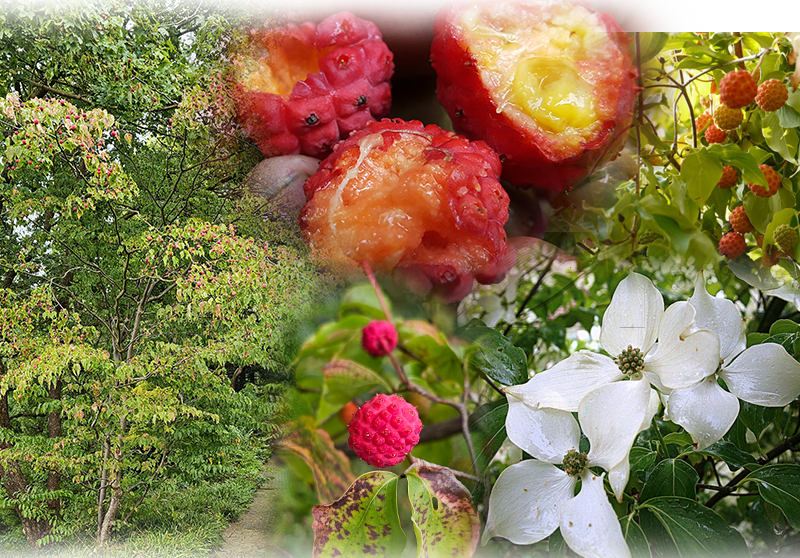
Chinese dogwood
 7
7 2
2 5
5Will it grow where I live?
Chinese dogwood is hardy to zone 5 – that covers all of Central Europe and the British Isles, and every USDA zone from 5 upwards.
Or check it for your location right here:
Profile
- Family
- Cornaceae
- Habit
- Tree
- Height
- 9 m
- Spread
- 6 m
- Growth
- slow
- Lifespan
- 90 years
- First yield
- after 6 years
- Full yield
- after 30 years
- Yield per plant
- up to 15 kg a year
- Yield in cultivation
- up to 4 t/ha
- Energy yield
- 500 kcal per m² a year
- Hardiness
- zone 5–8
- Shade tolerance
- partial shade
- Soil
- Sand, Silt, Loam, Clay
- Soil moisture
- dry – moist
- pH
- 5.5 – 7.5
- Synonyms
- Blumenhartriegel, Fruchthartriegel,
Flowering & harvest
| J | F | M | A | M | J | J | A | S | O | N | D | |
|---|---|---|---|---|---|---|---|---|---|---|---|---|
| Flowering | ||||||||||||
| Fruit harvest |
Varieties (1)
1 varieties of Chinese dogwood are listed in the Permaplans variety finder — each with its own page: taste, ripening time, disease resistance, parentage and use.
Uses
Edible: Fruit can be enjoyed raw or cooked, being sweet and juicy in small amounts. While the skin is tough and unappealing, the flesh is delicious with a pudding-like texture, making it a favorite late summer fruit. The fruit is approximately 2 cm in diameter. Young leaves can also be cooked.
Medicinal: No medicinal use is documented for kousa dogwood. It should not be confused with the related Cornus officinalis, whose dried fruit flesh is used in traditional Chinese medicine as shan zhu yu; those records do not apply to Cornus kousa.
Other uses: The wood of kousa dogwood is exceptionally hard, heavy and tough, as dogwood timber generally is. In East Asia it goes into mallets, tool handles, wedges and fine turnery; the trunks are too short and too crooked for construction. Most of its value today lies in ornament: the white bracts stand above the foliage from May into July, the leaves turn wine-red to scarlet in autumn, and older trunks shed their bark in light and dark brown plates that give the shrub structure through the winter too. In Japan and China it is a traditional temple and garden tree. In Europe it was long treated as a pure ornamental even though the fruit is good to eat — a misunderstanding the wild-fruit movement is only now undoing.
Growing
Site: The decisive factor is lime — kousa dogwood will not take it. Limestone chippings in the subsoil, builders' rubble against a house wall, mortar residue or hard tap water all lead to iron-deficiency chlorosis, with pale leaves and green veins. What it needs is humus-rich, evenly moist, acid to slightly acid soil in sun to light partial shade. It reaches three to six metres in height and width, more in good positions, and grows slowly; even so, give it generous final spacing, because it takes pruning badly. The fruits drop in September and October and crush into sticky red marks on paving and terraces — do not plant it over a seating area or path. If you want a crop, choose a warm position: in cool regions the fruit often fails to ripen. Care: Best of all, do not prune. Kousa dogwood flowers on wood several years old, builds its tiered crown over time and answers hard cutting back with bare patches; remove only deadwood and inward-growing shoots. It roots shallowly, so do not hoe the root zone — mulch it with leaves, bark humus or conifer litter, which also keeps the pH down. Water evenly in dry spells, preferably with rainwater; drought stress shows as browning leaf margins. Feed only with acidifying products. Nothing needs doing about anthracnose, which barely touches this species while it damages Cornus florida severely. Young plants get a mulch layer over the rootball for their first winters; established shrubs are hardy to about -28 degrees. Birds will take a share of the ripe fruit.
Propagation
Kousa dogwood is easy to raise from seed, but slow. Collect ripe fruit in October and rub and wash the flesh off carefully, since it contains germination inhibitors. The seed then goes either straight into a sheltered outdoor bed or, after four to five months of cold stratification at about five degrees, into pots; it not uncommonly comes up only in the second spring, so leave the seedbed standing. Seedlings take six to ten years to flower and vary in fruit size and flavour. Named cultivars and fruiting selections are therefore grafted, usually as a winter bench graft onto seedling rootstocks of the same species. Semi-ripe cuttings taken in July under mist root acceptably, but must push new growth the same year or they winter badly. Low branches can be layered.
Value for wildlife
Kousa dogwood is an East Asian introduction with limited but not negligible value. What looks like one large white flower is a set of four bracts; the true flowers sit in the middle as an inconspicuous greenish head and offer only modest nectar and pollen. The tally is correspondingly sober: about three wild bee species are documented as visitors in Central Europe, none of them specialists. Its performance as a structural and food shrub is considerably better. The dense, tiered branching carries nests, and the soft red compound fruits ripen in September and October, just as blackbirds and thrushes are laying in reserves for migration. Adding a cornelian cherry or common dogwood to the same garden brings the native insect side along with it.
Notable
Special features: Sensitive to prolonged drought (see shallow rooting); best pruned during flowering. Flavor varies by variety; well-known varieties include 'Milky Way,' 'China Girl,' 'Big Apple,' and 'Norman Hadden.' The latter is a cross with Cornus capitata (larger fruits, but less frost-hardy). Cornus kousa is generally less fruitful.
Origin & habitat
East Asia: Japan, Korea and China. Kousa dogwood occupies the mountain forests of Japan from Honshu to Kyushu and the Korean peninsula; the large-fruited variety var. chinensis comes from mainland China, where it ranges from Sichuan through Hubei to Zhejiang and climbs to around 2,200 metres. The species reached Europe and North America in the nineteenth century as an ornamental. In China it has long been valued as a fruit tree as well, whereas in Europe it was planted almost solely for its flowers. It has not naturalised in Central Europe and remains tied to gardens, parks and nursery catalogues.
In its homeland kousa dogwood is a tree of the second canopy layer and of woodland edges in mountain forest. It grows in valleys, on shaded slopes and along streams and forest tracks, in open and closed mixed and broadleaf woodland alike, in China between roughly 400 and 2,200 metres. The soils there are humus-rich, evenly moist and acid to slightly acid — the species is decidedly lime-avoiding and absent from shallow limestone. It tolerates partial shade well and still flowers reliably there, which is why its characteristic place is beneath the open crowns of other trees. Waterlogging and summer desiccation limit its occurrence.
Frequently asked questions
Chinese dogwood: how big does it get?
Chinese dogwood (Cornus kousa) grows as a Tree and reaches roughly 9 m in height when mature, with a spread of about 6 m. Growth is slow.
Chinese dogwood: what site does it need?
Chinese dogwood tolerates partial shade. Suitable soils are Sand, Silt, Loam, Clay. Soil moisture should be in the range dry – moist. The pH may lie between 5.5 and 7.5.
Chinese dogwood: is it hardy?
Chinese dogwood is listed as hardy in zone 5–8 and survives normal winters outdoors there.
Chinese dogwood: will it grow in Central Europe?
Chinese dogwood is hardy to zone 5 – that covers all of Central Europe and the British Isles, and every USDA zone from 5 upwards.
Chinese dogwood: when does it flower?
In a temperate northern-hemisphere climate it flowers in June.
Chinese dogwood: when is it harvested?
In a temperate northern-hemisphere climate the fruit ripens in October.
Chinese dogwood: when does it start cropping, and how much?
Chinese dogwood first crops after 6 years. Full yield comes after 30 years. A mature plant gives up to 15 kg a year, in cultivation up to 4 t per hectare. Figures assume a good site; variety, soil and climate shift them considerably.
Chinese dogwood: is it poisonous?
No toxicity is recorded for Chinese dogwood. With wild plants, never rely on a database alone — only on a confident identification.
Chinese dogwood: what is it used for?
Rated on a scale up to 10: Edible 7/10, Medicinal 2/10, Other uses 5/10.
Which Chinese dogwood varieties are there?
The Permaplans variety finder lists 1 varieties of Chinese dogwood, including Satomi. Each variety has its own page with taste, ripening time, disease resistance and parentage.
Plan this plant into your own garden
Permaplans plans your garden to scale on the map — with a site check, harvest calendar and over 1,000 plants. Free for iPhone, Android, Mac, Windows & Linux.
Will this plant grow where you live? → Check your site
Community experience
No first-hand reports for this plant yet.
Growing it? Write in the app what works for you – your post will show up here.
💬 Get the app and join in