
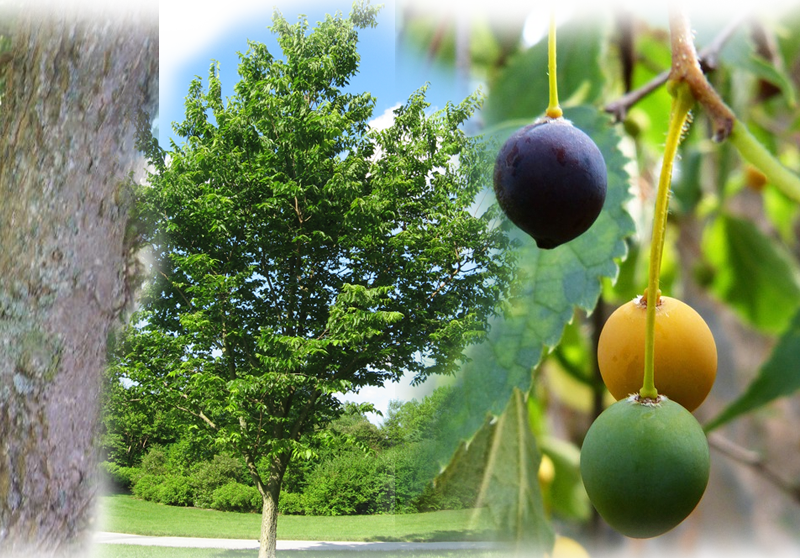
American hackberry
 6
6 2
2 4
4Will it grow where I live?
American hackberry is hardy to zone 3 – that covers all of Central Europe and the British Isles, and every USDA zone from 3 upwards.
Or check it for your location right here:
Profile
- Family
- Cannabaceae
- Habit
- Tree
- Height
- 22.5 m
- Spread
- 15 m
- Growth
- fast
- Lifespan
- 180 years
- First yield
- after 8 years
- Yield per plant
- up to 15 kg a year
- Yield in cultivation
- up to 2.5 t/ha
- Energy yield
- 200 kcal per m² a year
- Hardiness
- zone 3–9
- Shade tolerance
- full sun
- Soil
- Sand, Silt
- Soil moisture
- dry – very wet
- pH
- 5 – 8
- Planned in gardens
- 3×
Flowering & harvest
| J | F | M | A | M | J | J | A | S | O | N | D | |
|---|---|---|---|---|---|---|---|---|---|---|---|---|
| Flowering | ||||||||||||
| Fruit harvest |
Uses
Edible: Fruit - raw. The fruit is very sweet and enjoyable to eat fresh or for making jellies and preserves. It is similar in size to a black currant, with little flesh around a large seed, which makes harvesting difficult. The flesh is dry and mealy but sweet in taste. The seeds can be ground finely for flavoring, and North American Indians consumed them with roasted corn.
Medicinal: The roots and root bark of New Jersey tea have been traditionally utilized by Native Americans for treating fever, mucous membrane issues like catarrh, and throat irritations. Nowadays, these roots are mainly used for their astringent, expectorant, and antispasmodic qualities, especially in conditions such as asthma, bronchitis, and coughs. With 8% tannin content, the roots and root bark are highly astringent and also exhibit antispasmodic, antisyphilitic, hemostatic, and sedative properties. Additionally, an alkaloid found in the roots shows a mild antihypertensive effect. Internally, the plant is employed for various ailments including bronchial problems, throat irritations, hemorrhoids, among others. A decoction of the bark serves as a skin wash for cancer and venereal diseases. Harvested in autumn or spring, the roots are dried and stored for future use.
Other uses: A dye is obtained from the roots of this tree, which is quite tolerant to wind and can be grown as part of a shelterbelt. The wood is soft, weak, coarse-grained, and heavy, weighing 45 pounds per cubic foot. It is occasionally utilized in the commercial production of affordable furniture, veneer, fence fuel, etc.
Growing
The yew tree can thrive in various soil types, including fertile loam, dry gravel, and sandy soils. It can also withstand alkaline conditions, drought, and strong winds. Yew trees are adaptable and easy to relocate. These trees prefer warm summers and abundant sunlight. In some regions, they may not reach full maturity and can be vulnerable to frost damage during winter. Yew plants exhibit a wide range of sizes in their natural habitat, from small shrubs to large trees. They have a rapid growth rate and can live for centuries, potentially reaching up to 1,000 years. Yew trees typically yield a bountiful fruit harvest annually. Pollarding is an effective method for managing yew trees, as they readily regrow after pruning or damage from fire. Additionally, plants of this genus are known for their resistance to the honey fungus.
Propagation
Seeds should be planted in a cool environment right after they are fully developed. It is recommended to cold stratify stored seeds for 2-3 months before planting them in a greenhouse between February and March. While germination rates are usually high, stored seeds might require 12 months or longer to sprout. These seeds can be stored for a maximum of 5 years. Once seedlings are sufficiently grown, they should be transferred to separate pots. It is common for seedling leaves to display numerous white spots lacking chlorophyll; this is a normal occurrence, and mature plants will eventually develop typical green leaves. During their initial winter, nurture the seedlings in a cool setting before transferring them outdoors in late spring or early summer of the following year. Provide some protection from the cold during their first winter outside.
Value for wildlife
In Central Europe the common hackberry is a stranger, and its insect fauna shows it: the close associations of its homeland do not travel with it. There it is a larval food plant for the hackberry emperor and the tawny emperor, and four psyllid species of the genus Pachypsylla produce the conspicuous leaf galls without doing the tree any real harm. These species are absent from European gardens. What remains is substantial enough: the pea-sized sweet drupes hang into winter and are taken by birds — in North America typically by American robin and cedar waxwing, here by thrushes and other frugivores. The inconspicuous wind-pollinated flowers yield neither nectar nor pollen worth mentioning. The broad crown and the coarsely warty corky bark of older trunks provide nest sites and shelter.
Notable
Special features: popular with butterflies; drought-resistant + wind+salt-tolerant, heat-loving + urban climate-compatible; the seeds are rich in protein and fat, no exact details; the European nettle tree Celtis australis is less frost-hardy with better wood, but possibly less tasty fruit.
Origin & habitat
North America: from Ontario, Québec and Manitoba in Canada across the eastern and central United States down to Texas. Within this wide range the common hackberry is the most important North American hackberry in forestry terms, though it nowhere dominates, occurring instead scattered through mixed hardwood forest, with a clear preference for river floodplains and limestone country. It has been introduced well beyond that range: in Europe it is a popular park and street tree, hardier than the southern nettle tree, and in Australia it has become naturalised. In Central Europe it occurs only in cultivation, with no self-sustaining wild populations.
In its home range the common hackberry grows in species-rich mixed hardwood forest across eastern and central North America, concentrated in river floodplains, at the foot of slopes and on limestone ground; it climbs to about 1800 metres. It requires moderately dry to fresh, slightly acid to alkaline, nutrient-rich soils in sun to light shade, and avoids both pure sand and heavy clay. It likes warmth and is largely frost-hardy. What makes it interesting for Central European planting is the combination of drought and urban tolerance: it copes with compacted, heat-loaded street conditions where native forest trees fail. In Australia it is naturalised.
Frequently asked questions
American hackberry: how big does it get?
American hackberry (Celtis occidentalis) grows as a Tree and reaches roughly 22.5 m in height when mature, with a spread of about 15 m. Growth is fast.
American hackberry: what site does it need?
American hackberry tolerates full sun. Suitable soils are Sand, Silt. Soil moisture should be in the range dry – very wet. The pH may lie between 5 and 8.
American hackberry: is it hardy?
American hackberry is listed as hardy in zone 3–9 and survives normal winters outdoors there.
American hackberry: will it grow in Central Europe?
American hackberry is hardy to zone 3 – that covers all of Central Europe and the British Isles, and every USDA zone from 3 upwards.
American hackberry: when does it flower?
In a temperate northern-hemisphere climate it flowers in May.
American hackberry: when is it harvested?
In a temperate northern-hemisphere climate the fruit ripens in November.
American hackberry: when does it start cropping, and how much?
American hackberry first crops after 8 years. A mature plant gives up to 15 kg a year, in cultivation up to 2.5 t per hectare. Figures assume a good site; variety, soil and climate shift them considerably.
American hackberry: is it poisonous?
No toxicity is recorded for American hackberry. With wild plants, never rely on a database alone — only on a confident identification.
American hackberry: what is it used for?
Rated on a scale up to 10: Edible 6/10, Medicinal 2/10, Other uses 4/10.
Plan this plant into your own garden
Permaplans plans your garden to scale on the map — with a site check, harvest calendar and over 1,000 plants. Free for iPhone, Android, Mac, Windows & Linux.
Will this plant grow where you live? → Check your site
Community experience
No first-hand reports for this plant yet.
Growing it? Write in the app what works for you – your post will show up here.
💬 Get the app and join in