
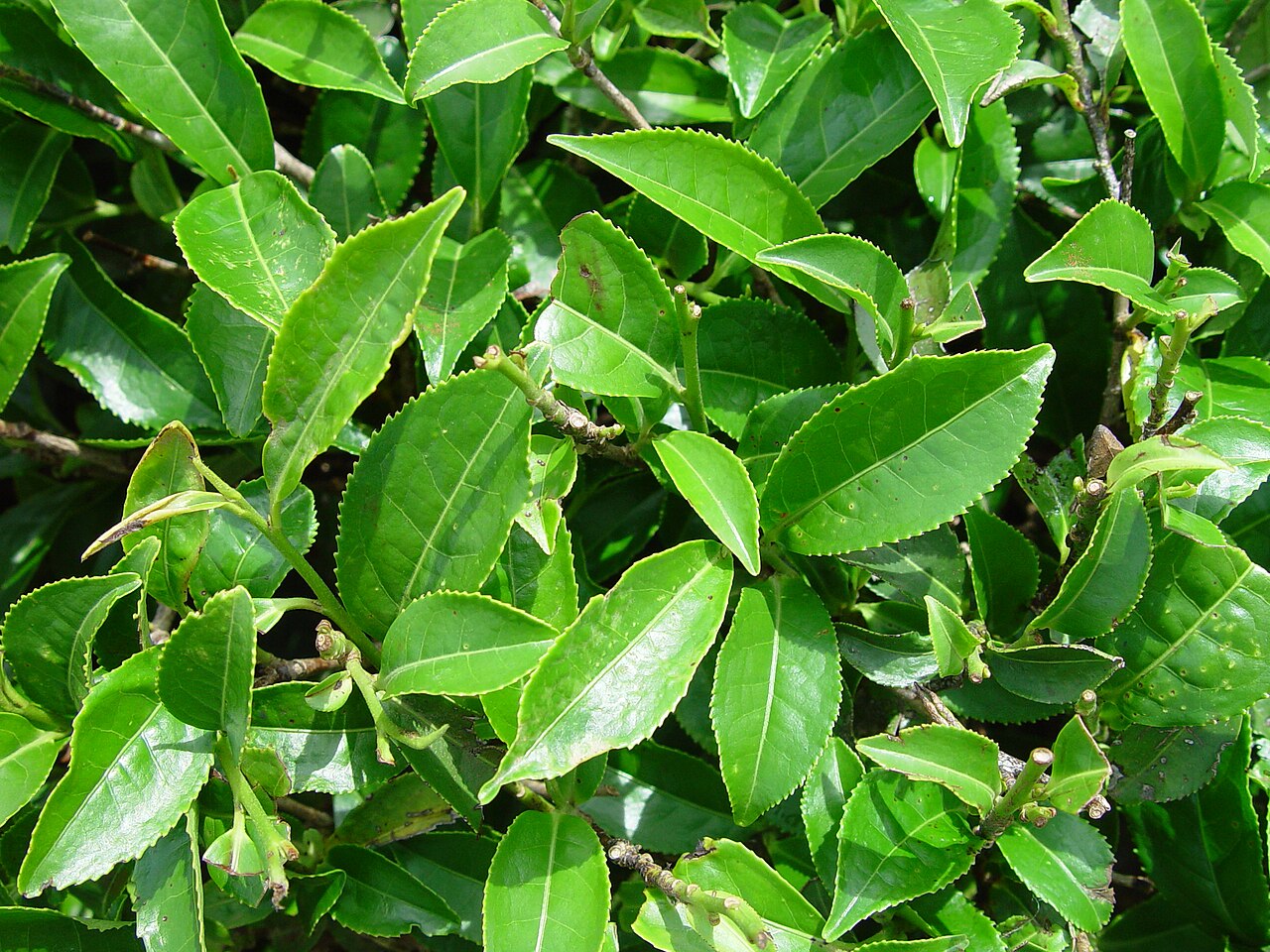
Tea plant
 7
7 7
7 1
1Will it grow where I live?
Tea plant is only hardy to zone 8, so outdoors year-round it needs the mildest spots in Central Europe – wine-growing regions, the Rhine valley, coasts, Lake Constance, Ticino – or a container overwintered under cover. Most of the British Isles and the Pacific coast of North America qualify. It also needs warm summers – in Central Europe that means wine-growing regions, cities or a sheltered south-facing wall.
Or check it for your location right here:
Profile
- Family
- Theaceae
- Habit
- Shrub
- Height
- 9.5 m
- Spread
- 2.5 m
- Growth
- very slow
- Lifespan
- 100 years
- First yield
- after 3 years
- Hardiness
- zone 8–10
- Shade tolerance
- partial shade
- Soil
- Sand, Silt
- Soil moisture
- semi-dry – very wet
- pH
- 5.6 – 6.6
Varieties (13)
13 varieties of Tea plant are listed in the Permaplans variety finder — each with its own page: taste, ripening time, disease resistance, parentage and use.
- Benifuuki Bred for black tea, now famous as an allergy-fighting green tea rich in methylated catechins.
- Da Hong Pao Legendary Wuyi rock oolong with roasted mineral character and the 'yan yun' rock rhyme.
- Fuding Dabai Large-leaf classic behind white teas – the basis for Bai Hao Yinzhen and Bai Mudan.
- Jin Xuan Taiwan's creamy 'milk oolong' clone (TTES 12) with a naturally buttery, sweet aroma.
- Longjing 43 Early-flushing clone behind famous Xihu Longjing – a flat-pressed, nutty-roasted green tea.
- Qingxin The premier clone for Taiwan's high-mountain (gaoshan) oolong – delicately floral and complex.
- Saemidori Refined cross yielding sweet, mild gyokuro and kabusecha with a vivid green liquor.
- Tieguanyin China's most famous oolong – floral and orchid-like, usually lightly oxidised and green.
- TV1 Assam's first Tocklai vegetative clone – a high-yielding workhorse for robust black tea.
- TV23 Aromatic, high-quality Tocklai clone for malty Assam black tea.
- UPASI-9 High-yielding South-Indian UPASI clone for the highland tea gardens of the Nilgiris.
- Yabukita Japan's benchmark green-tea cultivar – aromatic, vigorous and grown on roughly 70% of the country's tea acreage.
- Yutakamidori Early-flushing southern-Japan cultivar prized for mild, deep-green fukamushi sencha.
Uses
Origin & habitat
East Asia – China? The exact origin is uncertain.
Shady areas at an elevation of 2100 to 2700 metres in Yunnan.
Frequently asked questions
Tea plant: how big does it get?
Tea plant (Camellia sinensis) grows as a Shrub and reaches roughly 9.5 m in height when mature, with a spread of about 2.5 m. Growth is very slow.
Tea plant: what site does it need?
Tea plant tolerates partial shade. Suitable soils are Sand, Silt. Soil moisture should be in the range semi-dry – very wet. The pH may lie between 5.6 and 6.6.
Tea plant: is it hardy?
Tea plant is listed as hardy in zone 8–10 and survives normal winters outdoors there.
Tea plant: will it grow in Central Europe?
Tea plant is only hardy to zone 8, so outdoors year-round it needs the mildest spots in Central Europe – wine-growing regions, the Rhine valley, coasts, Lake Constance, Ticino – or a container overwintered under cover. Most of the British Isles and the Pacific coast of North America qualify. It also needs warm summers – in Central Europe that means wine-growing regions, cities or a sheltered south-facing wall.
Tea plant: is it poisonous?
Individual parts of Tea plant are noted as mildly problematic — the plant does not count as poisonous. With wild plants, never rely on a database alone, only on a confident identification.
Tea plant: what is it used for?
Rated on a scale up to 10: Edible 7/10, Medicinal 7/10, Other uses 1/10.
Which Tea plant varieties are there?
The Permaplans variety finder lists 13 varieties of Tea plant, including Benifuuki, Da Hong Pao, Fuding Dabai, Jin Xuan, Longjing 43, Qingxin, Saemidori, Tieguanyin, TV1, TV23, UPASI-9, Yabukita and 1 more. Each variety has its own page with taste, ripening time, disease resistance and parentage.
Plan this plant into your own garden
Permaplans plans your garden to scale on the map — with a site check, harvest calendar and over 1,000 plants. Free for iPhone, Android, Mac, Windows & Linux.
Will this plant grow where you live? → Check your site
Community experience
No first-hand reports for this plant yet.
Growing it? Write in the app what works for you – your post will show up here.
💬 Get the app and join in