
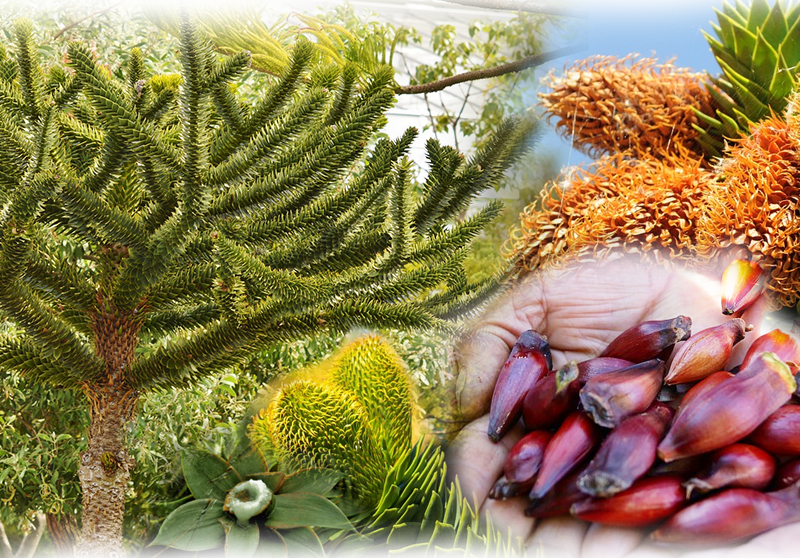
Chilean araucaria
 6
6 6
6 5
5Will it grow where I live?
Chilean araucaria is hardy to zone 7: lowlands, river valleys and cities across Central Europe are fine, harsher continental or upland sites need winter protection or a container.
Or check it for your location right here:
Profile
- Family
- Araucariaceae
- Habit
- Tree
- Height
- 35 m
- Spread
- 20 m
- Growth
- very slow
- Lifespan
- 1500 years
- First yield
- after 28 years
- Full yield
- after 60 years
- Yield in cultivation
- up to 1 t/ha
- Energy yield
- 220 kcal per m² a year
- Hardiness
- zone 7–11
- Shade tolerance
- partial shade
- Soil
- Sand, Silt, Loam
- Soil moisture
- semi-dry – very moist
- pH
- 5.5 – 7.5
- Synonyms
- Araukarie, Araukarienbaum
Flowering & harvest
| J | F | M | A | M | J | J | A | S | O | N | D | |
|---|---|---|---|---|---|---|---|---|---|---|---|---|
| Flowering | ||||||||||||
| Fruit harvest |
Uses
Edible: Seeds can be consumed either raw or cooked, being high in starch. They have a soft texture similar to cashew nuts with a subtle pine nut taste, making them delicious and enjoyable to eat. These seeds, about the size of an almond (3 cm long x 1 cm wide), can be eaten in significant amounts and are a dietary staple. Harvested in the autumn, they can be stored for a minimum of 9 months in a cool, dry location.
Medicinal: The leaves or the entire herb have cardiotonic, diuretic, and antihypertensive properties. They are utilized in managing hypertensive headaches, dizziness, insomnia, irritability, oliguria, and renal edema, enhancing renal blood flow. Additionally, they can address renal and cardiac edema, along with ascites in liver cirrhosis.
Other uses: Trees can withstand salty air well and are suitable for shelterbelt planting. They grow slowly with a sparse canopy that provides limited protection. Resin extracted from the trunk is mainly used for medicinal reasons. The pale yellowish wood is high-quality, polishes beautifully, and is utilized in joinery and carpentry.
Growing
Site: In central Europe the monkey puzzle succeeds only in mild, oceanic positions, in wine-growing climates and in winter-mild urban settings; in harsh uplands and frost basins it is lost in the long run. It needs deep, free-draining soil with steady moisture, tolerates neither summer heat on dry ground nor waterlogging, and reacts badly to air pollution. Its space requirement is considerable, reaching 20 to 30 metres and spreading with age. Two things belong in the siting decision: the branches carry tough, knife-sharp scale leaves that cause real injuries, and the female cones weigh up to two kilograms and fall from a great height. So keep clearance from paths, seating, play areas and parking. Care: Water deeply in dry spells, young plants especially, and protect their root zone through the first few winters. Do not prune: the monkey puzzle does not resprout from old wood, every branch removed leaves a permanent gap in the regular whorl, and a lost leader is never replaced. Lower branches age and die back of their own accord, which is normal and no sign of disease. It is susceptible to honey fungus, so fresh tree stumps nearby are unwelcome. Growth is very slow, at most around 30 centimetres a year, and it does not flower until about 15 years old. The species is dioecious: there will be seed only if a male and a female tree stand within range.
Propagation
The monkey puzzle is raised from seed. The piñones are 3 to 5 centimetres long and unusually heavy, a thousand of them weighing 3.3 to 5 kilograms; they carry no drying-tolerant storage tissue and lose viability within a few weeks. The rule is therefore: sow fresh or not at all. Lay the seeds on their side, half buried, in deep pots, because the seedling first drives a strong taproot downwards and needs the room; stratification is unnecessary, an overnight soak helps. At around 15 to 20 degrees they germinate within a few weeks. Seedlings grow agonisingly slowly and may take five to ten years to clear grass height. Cuttings succeed only from the leading shoot, as side shoots go on growing permanently askew. True-to-type clones of known sex are not yet available in the trade.
Value for wildlife
In central Europe the monkey puzzle is ecologically an outsider: it is wind-pollinated, yields no bee forage, and has no specialised insects here. As a large evergreen it does at least provide year-round cover and windbreak, though its crown is so sparse and so heavily armed that scarcely any bird nests in it. In its native range the balance looks very different. There the fat-rich seeds are a central link in the food chain. The austral parakeet breaks into the ripening cones, rodents such as the Chilean rock rat hoard them and in doing so carry the heavy seeds further than the tree could ever throw them, and the Pehuenche have harvested them for millennia. The monkey puzzle has no wind dispersal; its spread depends entirely on these animals.
Notable
Notable: pehuén, sacred tree of the Pehuenche - whose name means "people of the monkey puzzle"; piñones harvested in March, traditionally lassoed down from the tree; tastes between potato, almond+peanut; one cone holds up to 200 seeds and weighs up to 2kg; dioecious, never seeds without a partner tree; lives over 1000 years; worldwide trade banned under CITES.
Origin & habitat
Southern Chile and western Argentina, Andes. The monkey puzzle occupies a very small range on both sides of the Andes between roughly 37 and 39.5 degrees south: in Chile the Araucanía Region and the south of the Biobío Region from Antuco volcano to Villarrica volcano, and in Argentina the province of Neuquén from Caviahue through Villa Pehuenia to Lanín volcano. A separate remnant stand survives in the coastal range in Nahuelbuta National Park. It grows there between 600 and 1700 metres. The IUCN lists it as endangered, international trade is banned under CITES, and Chile prohibits its exploitation. Outside this range it occurs only as a planted tree.
The monkey puzzle grows in temperate mountain rainforest on young volcanic soils, together with southern beeches of the genus Nothofagus. Rainfall ranges from 1000 to 4500 millimetres a year and temperatures from minus 20 to plus 30 degrees: a harsh but consistently moist site without summer drought. Structurally it is the emergent, its crowns rising as a loose top layer above the closed Nothofagus canopy. Fire is decisive for its survival. The thick bark, breaking into coarse plates, shields trunk and crown from ground fires that clear competing woody plants, so the species regrows with a head start after a burn. More recently introduced pines have begun to crowd it out, growing faster than it can.
Frequently asked questions
Chilean araucaria: how big does it get?
Chilean araucaria (Araucaria araucana) grows as a Tree and reaches roughly 35 m in height when mature, with a spread of about 20 m. Growth is very slow.
Chilean araucaria: what site does it need?
Chilean araucaria tolerates partial shade. Suitable soils are Sand, Silt, Loam. Soil moisture should be in the range semi-dry – very moist. The pH may lie between 5.5 and 7.5.
Chilean araucaria: is it hardy?
Chilean araucaria is listed as hardy in zone 7–11 and survives normal winters outdoors there.
Chilean araucaria: will it grow in Central Europe?
Chilean araucaria is hardy to zone 7: lowlands, river valleys and cities across Central Europe are fine, harsher continental or upland sites need winter protection or a container.
Chilean araucaria: when does it flower?
In a temperate northern-hemisphere climate it flowers from May to June.
Chilean araucaria: when is it harvested?
In a temperate northern-hemisphere climate the fruit ripens in October.
Chilean araucaria: when does it start cropping, and how much?
Chilean araucaria first crops after 28 years. Full yield comes after 60 years. In cultivation, up to 1 t per hectare is typical. Figures assume a good site; variety, soil and climate shift them considerably.
Chilean araucaria: is it poisonous?
No toxicity is recorded for Chilean araucaria. With wild plants, never rely on a database alone — only on a confident identification.
Chilean araucaria: what is it used for?
Rated on a scale up to 10: Edible 6/10, Medicinal 6/10, Other uses 5/10.
Plan this plant into your own garden
Permaplans plans your garden to scale on the map — with a site check, harvest calendar and over 1,000 plants. Free for iPhone, Android, Mac, Windows & Linux.
Will this plant grow where you live? → Check your site
Community experience
No first-hand reports for this plant yet.
Growing it? Write in the app what works for you – your post will show up here.
💬 Get the app and join in