Hemp palm
 2
2 4
4 9
9Will it grow where I live?
Hemp palm is only hardy to zone 8, so outdoors year-round it needs the mildest spots in Central Europe – wine-growing regions, the Rhine valley, coasts, Lake Constance, Ticino – or a container overwintered under cover. Most of the British Isles and the Pacific coast of North America qualify.
Or check it for your location right here:
Profile
- Family
- Palmae
- Habit
- Tree
- Height
- 12 m
- Spread
- 4 m
- Growth
- very slow
- Lifespan
- 150 years
- First yield
- after 10 years
- Hardiness
- zone 8–11
- Shade tolerance
- partial shade
- Soil
- Sand, Silt, Loam
- Soil moisture
- semi-dry – very moist
- pH
- 5 – 7.5
- Synonyms
- T. excelsus. Chamaerops fortunei. C. excelsus.
Flowering & harvest
| J | F | M | A | M | J | J | A | S | O | N | D | |
|---|---|---|---|---|---|---|---|---|---|---|---|---|
| Flowering |
Uses
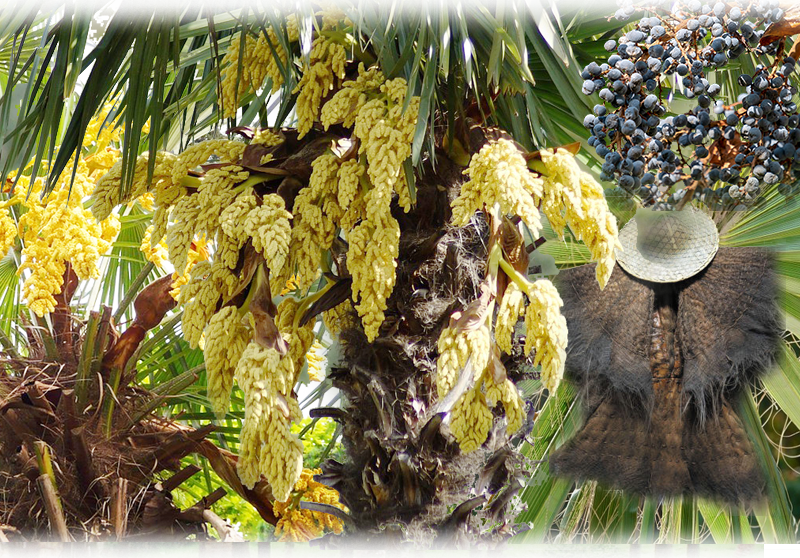
Edible: Young flower buds are boiled and utilized in a way similar to bamboo shoots. Fresh flowers and terminal buds seem to be edible as well.
Medicinal: The plant's flowers and seeds possess astringent and hemostatic qualities. Its root or fruit can act as a contraceptive when prepared as a decoction. The ash from the plant's fine hairs also has hemostatic properties and can be utilized with boiling water to address various bleeding disorders like hemorrhage, nosebleeds, hematemesis, bloody stools, metrorrhagia, gonorrhea, and other sexually transmitted diseases.
Other uses: The fibers surrounding the trunk are utilized for producing ropes and textiles. Fibers obtained from the petiole are used for making brushes, ropes, and rough fabrics. Bark mixed with some stem fibers is used to create a mat. The leaves are woven into hats, rough coats, and fans.
Growing
Requires rich, moist, well-drained soil in a sunny, sheltered location to thrive, especially shielded from cold, dry winds. Individual leaves have a lifespan of approximately 3 years and wind damage can lead to an untidy appearance, reducing the plant's ability to photosynthesize. This species is generally resilient in the southern and western regions. Mature plants have been known to withstand temperatures as low as -18°C, although younger ones are more vulnerable and may suffer damage around -8°C, particularly if exposed to cold winds. It is advisable to protect very young plants during their initial winters outdoors. While it is a relatively slow-growing plant, it can self-seed in the southwest. Palms typically have deep root systems and are best planted when young. Older plants are more tolerant to cold than younger ones. In borderline cold areas, it is recommended to grow them in containers for a few years, shield them in winter, and transplant them into their permanent spots only when necessary due to size. Even large palms can be transplanted, although their thick roots are delicate and can dry out. Providing strong support, ample water, and removing excess leaves can aid in the plant's recovery. The flowers emit a sweet fragrance. To obtain seeds, both male and female plants must be cultivated.
Notable
Special features: tolerates short-term drought, waterlogging, and low temperatures; highly resistant to toxic gases (soot, sulfur dioxide, hydrogen fluoride); grows wild in disturbed forest habitats in Switzerland; Tr. fortunei wagnerianus is a more robust form with smaller leaves; young plants north of the Alps require winter protection.
Origin & habitat
East Asia - Central and Eastern China.
Montane Eichenwälder bis zu 2400 Meter.
Frequently asked questions
Hemp palm: how big does it get?
Hemp palm (Trachycarpus fortunei) grows as a Tree and reaches roughly 12 m in height when mature, with a spread of about 4 m. Growth is very slow.
Hemp palm: what site does it need?
Hemp palm tolerates partial shade. Suitable soils are Sand, Silt, Loam. Soil moisture should be in the range semi-dry – very moist. The pH may lie between 5 and 7.5.
Hemp palm: is it hardy?
Hemp palm is listed as hardy in zone 8–11 and survives normal winters outdoors there.
Hemp palm: will it grow in Central Europe?
Hemp palm is only hardy to zone 8, so outdoors year-round it needs the mildest spots in Central Europe – wine-growing regions, the Rhine valley, coasts, Lake Constance, Ticino – or a container overwintered under cover. Most of the British Isles and the Pacific coast of North America qualify.
Hemp palm: when does it flower?
In a temperate northern-hemisphere climate it flowers in June.
Hemp palm: is it poisonous?
No toxicity is recorded for Hemp palm. With wild plants, never rely on a database alone — only on a confident identification.
Hemp palm: what is it used for?
Rated on a scale up to 10: Edible 2/10, Medicinal 4/10, Other uses 9/10.
Plan this plant into your own garden
Permaplans plans your garden to scale on the map — with a site check, harvest calendar and over 1,000 plants. Free for iPhone, Android, Mac, Windows & Linux.
Will this plant grow where you live? → Check your site
Community experience
No first-hand reports for this plant yet.
Growing it? Write in the app what works for you – your post will show up here.
💬 Get the app and join in