
 7
7 6
6 7
7Will it grow where I live?
Chinese mahogany is hardy to zone 6, which covers nearly all of Central Europe and the British Isles; only harsh upland sites (Alps, high ridges) call for winter protection. It also needs warm summers – in Central Europe that means wine-growing regions, cities or a sheltered south-facing wall.
Or check it for your location right here:
Profile
- Family
- Meliaceae
- Habit
- Tree
- Height
- 20 m
- Spread
- 8 m
- Growth
- fast
- Lifespan
- 150 years
- First yield
- after 8 years
- Yield per plant
- up to 1 kg a year
- Yield in cultivation
- up to 1 t/ha
- Hardiness
- zone 6–12
- Shade tolerance
- full sun
- Soil
- Sand, Silt, Loam
- Soil moisture
- semi-dry – very moist
- pH
- 6 – 8
- Synonyms
- Gemüsebaum, Maggi-Baum
Flowering & harvest
| J | F | M | A | M | J | J | A | S | O | N | D | |
|---|---|---|---|---|---|---|---|---|---|---|---|---|
| Flowering | ||||||||||||
| Fruit harvest | ||||||||||||
| Leaf harvest |
Uses
Edible: The young, reddish emerging shoots and leaves are a highly prized spring vegetable in China, sold under the name xiangchun. The flavour is floral and reminiscent of onion or garlic, owing to organosulfur compounds. Red-flushing provenances are considered tastier than green ones. The leaves supply plenty of vitamin A and contain about six per cent protein, one per cent fat and 6.6 per cent carbohydrate in the dry matter. Timing of harvest matters: use only the soft shoots of the first flush, because the foliage accumulates considerable nitrate as temperatures rise. Before cooking, the shoots are briefly blanched, which sharply reduces nitrite content; raw in salad, only small quantities of very young leaves should be used. Dried leaves serve as a tea substitute.
Medicinal: The plant's bark possesses astringent, carminative, antipyretic, ophthalmic, and hemostatic qualities. It is utilized in decoction form for ailments such as diarrhea, chronic dysentery, flatulence, bloody stools, seminal effusions, leukorrhea, metrorrhagia, and gonorrhea.
Other uses: The timber is this tree's second product and scarcely inferior to the first. It is reddish to red-brown, light yet hard, extremely durable, easy to work and takes a high polish. Because its colour and figure come very close to true mahogany, it counts in China as a valuable furniture timber and has been used there for centuries for cabinets, chests and window frames; in instrument making it serves as a mahogany substitute for electric guitar bodies. The wood has a delicate fragrance and is burned as incense in temples, while offcuts make good fuel. Bark and root bark additionally yield tannin.
Growing
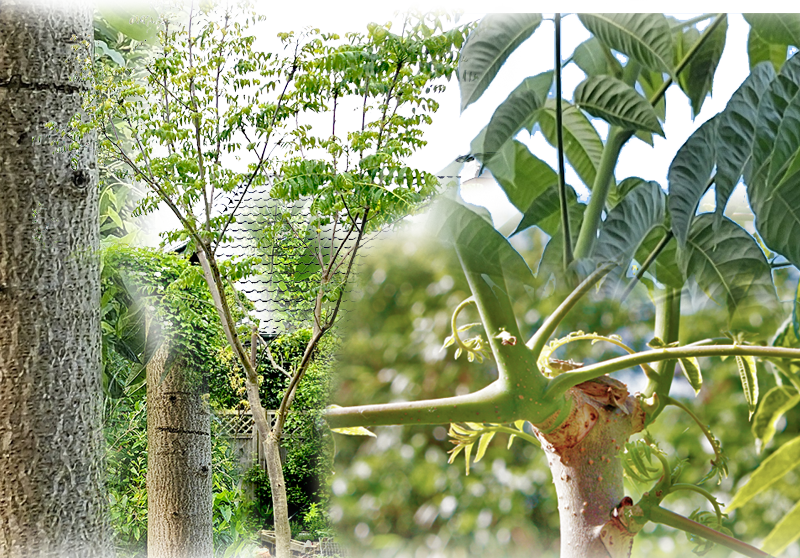
Site: Toona sinensis produces plentiful root suckers that appear metres away in lawn and beds, so it does not belong beside perennial borders or on a boundary line. The position should be sheltered from wind, because the large pinnate leaves tear easily, and it must be right from the start: as a heart-rooter the tree transplants badly later on. Grown freely it reaches 15 to 20 metres; kept as a vegetable tree at one to two metres it fits into any garden. The flower panicles are intensely fragrant in high summer and draw bees, which near a seating area may be welcome or a nuisance. Care: Harvest the young shoots in spring while they are still reddish and soft; later growth turns tough and accumulates nitrate. If you run the tree as a salad tree, cut it back to one or two metres in summer and harvest the regrowth. Sever or mow off root suckers regularly, or a thicket develops. The species is hardy to about minus 20 degrees, with young wood and late frost on the new growth the weak points: give trunk protection and a mulch layer in the first years and do not feed late in the season. Diseases and pests are practically absent in Central Europe.
Propagation
Root cuttings are the most reliable method, since the species produces plenty of root suckers anyway. In December or January dig up pieces of root four to five centimetres long, lay them flat in pots, cover thinly and keep frost-free at about ten degrees; they shoot reliably in spring. Simpler still is to lift a rooted sucker in winter and transplant it straight away. Seed is the poorer option: it is short-lived, rarely ripens in Central Europe and needs about three months of cold stratification. Seedlings grow fast in their first year but are frost-sensitive and should be kept sheltered for two winters. The red-leaved cultivars can only be propagated true vegetatively.
Value for wildlife
There are no reliable species counts for Toona sinensis in the Central European fauna, and that is no accident: as a neophyte without native relatives it has no specialist herbivores here, and the caterpillars of native moths and butterflies will not touch its foliage. Its contribution lies in the flowers. The large, intensely and sweetly scented panicles open in high summer, at a time when forage is running thin in many gardens, and are visited by honeybees, bumblebees, hoverflies and beetles; both nectar and pollen yields are considerable. The tree only flowers, however, once older and grown freely, so anyone keeping it low as a vegetable tree forgoes that. Its value to birds is slight, as the capsules hold only dry winged seed. It offers cover in summer alone, standing bare in winter.
Notable
Special features: Forms suckers; although the tree can grow large, it is best kept as a salad tree at 1-2m in height. Cut back during the summer → new growth; propagation via root cuttings (4-5cm long); flowers have a strong fragrance; leaves like vegetable broth: very spicy; the only cold-tolerant mahogany plant.
Origin & habitat
East and South Asia: China, the Himalayan region and South-East Asia. The natural range covers most of eastern, central and south-western China, from Hebei and Shaanxi through Sichuan, Hubei, Hunan and Jiangsu to Guangdong, Guangxi and Yunnan as well as Tibet, and extends further through Bhutan, Nepal and north-eastern India into Myanmar, Thailand, Laos, Malaysia and western Indonesia. Its centre of gravity lies in subtropical situations below about 1500 metres. In China the species has been cultivated as a vegetable tree for centuries and is planted far beyond its original range. It reached Europe and North America in the eighteenth century as an ornamental and park tree; it is the most cold-tolerant species of its genus and the only one that can be kept outdoors here.
Toona sinensis is a tree of subtropical and tropical mountain and valley country and grows mainly below 1500 metres. It stands in deciduous and semi-evergreen mixed broadleaved forest, along woodland edges, in river valleys and on slopes, mostly on deep, humus-rich and freely drained soils with sufficient moisture. As a light-demanding species with rapid juvenile growth it occupies gaps and marginal positions. Its range reaches from the mild winters of southern China to the cold winters of northern China, which explains a frost hardiness unusual for a member of the mahogany family. There are no wild occurrences in Central Europe: here the species is found only in gardens, parks and nurseries, and it does not escape.
Frequently asked questions
Chinese mahogany: how big does it get?
Chinese mahogany (Toona sinensis) grows as a Tree and reaches roughly 20 m in height when mature, with a spread of about 8 m. Growth is fast.
Chinese mahogany: what site does it need?
Chinese mahogany tolerates full sun. Suitable soils are Sand, Silt, Loam. Soil moisture should be in the range semi-dry – very moist. The pH may lie between 6 and 8.
Chinese mahogany: is it hardy?
Chinese mahogany is listed as hardy in zone 6–12 and survives normal winters outdoors there.
Chinese mahogany: will it grow in Central Europe?
Chinese mahogany is hardy to zone 6, which covers nearly all of Central Europe and the British Isles; only harsh upland sites (Alps, high ridges) call for winter protection. It also needs warm summers – in Central Europe that means wine-growing regions, cities or a sheltered south-facing wall.
Chinese mahogany: when does it flower?
In a temperate northern-hemisphere climate it flowers from June to July.
Chinese mahogany: when is it harvested?
In a temperate northern-hemisphere climate the fruit ripens in November.
Chinese mahogany: when does it start cropping, and how much?
Chinese mahogany first crops after 8 years. A mature plant gives up to 1 kg a year, in cultivation up to 1 t per hectare. Figures assume a good site; variety, soil and climate shift them considerably.
Chinese mahogany: is it poisonous?
No toxicity is recorded for Chinese mahogany. With wild plants, never rely on a database alone — only on a confident identification.
Chinese mahogany: what is it used for?
Rated on a scale up to 10: Edible 7/10, Medicinal 6/10, Other uses 7/10.
Plan this plant into your own garden
Permaplans plans your garden to scale on the map — with a site check, harvest calendar and over 1,000 plants. Free for iPhone, Android, Mac, Windows & Linux.
Will this plant grow where you live? → Check your site
Community experience
What Permaplans users wrote about this plant – taken from the app as is. 1 post.
die Blätter sind einfach nur lecker
Growing it? Write in the app what works for you – your post will show up here.
💬 Get the app and join in