
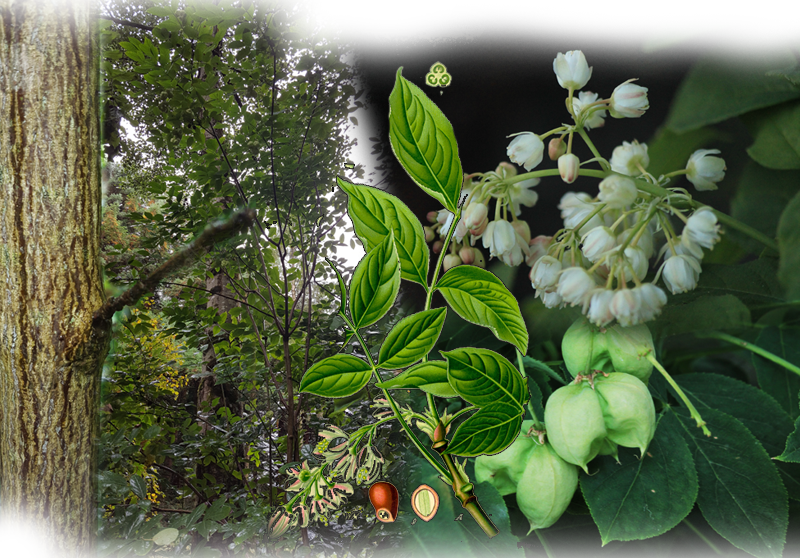
Pimpernut
 5
5 2
2 6
6Will it grow where I live?
Pimpernut is hardy to zone 5 – that covers all of Central Europe and the British Isles, and every USDA zone from 5 upwards.
Or check it for your location right here:
Profile
- Family
- Staphyleaceae
- Habit
- Shrub
- Height
- 4.5 m
- Spread
- 4 m
- Growth
- medium
- Lifespan
- 40 years
- First yield
- after 5 years
- Yield per plant
- up to 0.4 kg a year
- Yield in cultivation
- up to 0.5 t/ha
- Energy yield
- 300 kcal per m² a year
- Hardiness
- zone 5–9
- Shade tolerance
- partial shade
- Soil
- Sand, Silt, Loam
- Soil moisture
- semi-dry – very wet
- pH
- 6.5 – 7.5
Flowering & harvest
| J | F | M | A | M | J | J | A | S | O | N | D | |
|---|---|---|---|---|---|---|---|---|---|---|---|---|
| Flowering | ||||||||||||
| Fruit harvest |
Uses
Edible: Inside the strikingly inflated bladder capsules sit small nutlets that look like hazelnuts and taste rather like pistachios — which is why the species is called false pistachio in Italian. Raw or roasted they make a good nibbling nut; in Germany children have traditionally known them as a wild fruit. In the Bavarian Forest they are made into a bladdernut liqueur, and they go into the herbal schnapps with the curious name Stichpimpulibockforcelorum. The long flower racemes are usable too: candied they yield a sweet, and in Georgian cooking the racemes pickled in brine become the salad jonjoli, which tastes somewhere between olive and caper — there the Colchis bladdernut is used for it as well. The nut is credited with an aphrodisiac effect that is not documented.
Other uses: Besides its fruit the bladdernut has a small use history of its own. Dried seeds, which can also be dyed, once served to make jewellery — above all necklaces, sometimes rosaries; the hard, glossy kernel suits that well. Horticulturally it is raised in nurseries for planting road verges with native woody species, which given its rarity in the wild makes double sense. As an ornamental, however, gardens often hold not this species but the Colchis bladdernut (Staphylea colchica) or a hybrid of the two — worth checking the label if a native planting is the aim. The ornamental value of the species itself lies in the hanging white panicles of early summer and in the inflated capsules, which stay on into winter and rattle in the wind.
Growing
Site: A multi-stemmed, broadly spreading shrub of three to five metres that needs a mild position: sun to partial shade, warm, sheltered from wind and as humid as possible. It flowers best in years following hot summers and stays sparse in cold, draughty spots. The soil should be rich in lime and nutrients, loose, preferably stony and seepage-moist — loam or loess with a good mull layer matches its natural site; it tolerates neither drought nor waterlogging. It is hardy to about minus 20 degrees. As a neighbour it is uncomplicated: no thorns, no toxic parts, so it is safe beside paths, seating and play areas. In May and June it is a good bee plant, and in winter the inflated, rattling capsules carry the ornamental value. One point belongs in the planning: the species is endangered in Germany and legally protected — planting stock comes from a nursery, and nothing is dug up in the wild. Care: Undemanding once established. A layer of leaf mulch replaces feeding and keeps the soil evenly moist; water through longer dry spells in the first years. Regular pruning is unnecessary, as it builds a balanced shape by itself; every few years take out the oldest stems at ground level and the shrub stays dense from the base. Prune after flowering, since the flowers sit on last year's wood. It rejuvenates slowly through root suckers without wandering. Young plants need protection from deer and hare browsing. No significant diseases or pests are described for the species — it counts as robust, and it is rare mainly because Central Europe lacks suitable warm, lime-rich sites, not because it is difficult.
Propagation
The bladdernut needs frost to germinate: without a sufficient cold period the seed stays dormant, and nurseries achieve this by deep-freezing. For home propagation, sow the nutlets fresh in autumn outdoors or into pots left outside over winter; germination can stretch over more than one season, and patience is part of the method. Alternatively stratify moist and cold in the fridge for several months. Vegetatively it is easier: root suckers can be detached with a piece of root, and stems bent to the ground layer reliably. Semi-ripe summer cuttings also work, though less willingly than with currants. Anyone wanting native provenance should have the species confirmed at purchase, because the trade often offers the Colchis bladdernut or hybrids.
Value for wildlife
Reliable species counts do not exist for the bladdernut, which follows from its rarity — a species endangered in Germany and naturally present in only two federal states is hardly surveyed systematically. What is documented: it counts as bee-friendly and a good honey source. The hanging white panicles open in May and June and supply nectar and pollen in the gap between fruit blossom and the summer flush; the flower shape is open enough for bumblebees, wild bees and hoverflies. Its dense, multi-stemmed structure offers cover and nesting opportunities for open nesters in ravine woods and at woodland edges, and the nutlets are used by rodents. Planting it does more for species protection than for species numbers anyway: the real value lies in getting an endangered native shrub back into the landscape at all.
Notable
Special features: warmth and humus-loving; rare → protected by nature conservation; suitable as an underplanting for forest edges, trees, or as a solitary plant; for moderately dry + alkaline + shady + warm location; late returnee (survived the last Ice Age behind the Caucasus, originally native here); like fortune cookie;
Origin & habitat
South-eastern Europe to Asia Minor, with outposts in south-eastern Central Europe. The main range of the European bladdernut runs from south-eastern Europe to Asia Minor; in the east it includes the Carpathian arc, the high-rainfall Sudetes and the Silesian lowland, with occurrences in the Lower Beskids around Dukla, in Magura National Park and in the Jura near Złoty Potok. In Central Europe it is probably native only at the transition from the Upper to the High Rhine, in the Lake Constance area, along the Danube from Ulm to Lower Austria, at Lake Lucerne and the Walensee, and along the Alpine Rhine. In all German states north of Bavaria and Baden-Württemberg it is not native; the far northern sites on the Spitzhut near Hildesheim go back to plantings of the late 19th century, when the central uplands were "beautified" with non-native species. In Germany it is classed as endangered, globally as least concern.
The bladdernut is a shrub of warm, lime-rich broadleaf woodland and its edges. It grows on slopes and woodland margins, in herb-rich beech, maple and oak woods, in ravine forests and open broadleaf woodland, and phytosociologically belongs to the Berberidion and Tilio-Acerion alliances and to the Cephalanthero-Fagenion suballiance; it is also a weak character species of downy oak woods. Its best stands are on lime- and nutrient-rich, loose, stony and seepage-moist loam or loess with a good mull layer, in areas with a mild climate and fairly high air humidity. It is a semi-shade indicator and needs warmth — in the Alps it climbs only to about 600 metres. This combination of warmth, lime, moisture and partial shade is rare in Central Europe, and that is precisely the reason for its rarity.
Frequently asked questions
Pimpernut: how big does it get?
Pimpernut (Staphylea pinnata) grows as a Shrub and reaches roughly 4.5 m in height when mature, with a spread of about 4 m. Growth is medium.
Pimpernut: what site does it need?
Pimpernut tolerates partial shade. Suitable soils are Sand, Silt, Loam. Soil moisture should be in the range semi-dry – very wet. The pH may lie between 6.5 and 7.5.
Pimpernut: is it hardy?
Pimpernut is listed as hardy in zone 5–9 and survives normal winters outdoors there.
Pimpernut: will it grow in Central Europe?
Pimpernut is hardy to zone 5 – that covers all of Central Europe and the British Isles, and every USDA zone from 5 upwards.
Pimpernut: when does it flower?
In a temperate northern-hemisphere climate it flowers in May.
Pimpernut: when is it harvested?
In a temperate northern-hemisphere climate the fruit ripens in October.
Pimpernut: when does it start cropping, and how much?
Pimpernut first crops after 5 years. A mature plant gives up to 0.4 kg a year, in cultivation up to 0.5 t per hectare. Figures assume a good site; variety, soil and climate shift them considerably.
Pimpernut: is it poisonous?
No toxicity is recorded for Pimpernut. With wild plants, never rely on a database alone — only on a confident identification.
Pimpernut: what is it used for?
Rated on a scale up to 10: Edible 5/10, Medicinal 2/10, Other uses 6/10.
Plan this plant into your own garden
Permaplans plans your garden to scale on the map — with a site check, harvest calendar and over 1,000 plants. Free for iPhone, Android, Mac, Windows & Linux.
Will this plant grow where you live? → Check your site
Community experience
No first-hand reports for this plant yet.
Growing it? Write in the app what works for you – your post will show up here.
💬 Get the app and join in