
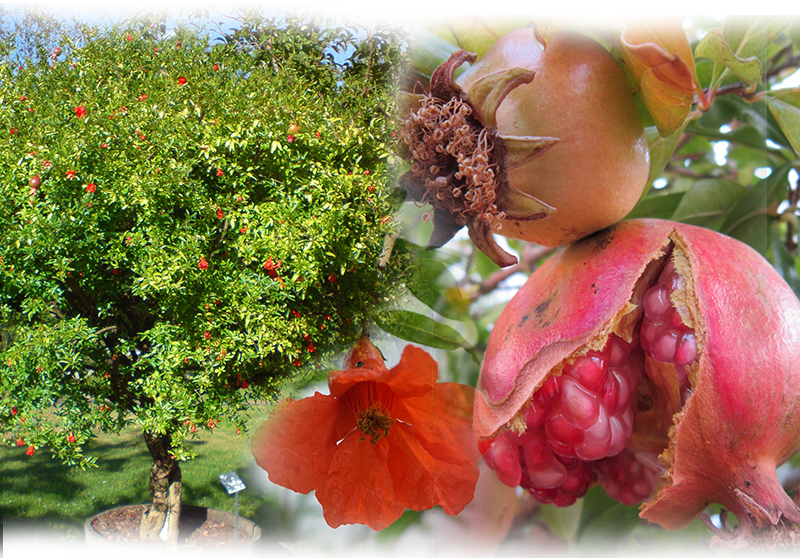
Pomegranate
 9
9 6
6 4
4Will it grow where I live?
Pomegranate is only hardy to zone 8, so outdoors year-round it needs the mildest spots in Central Europe – wine-growing regions, the Rhine valley, coasts, Lake Constance, Ticino – or a container overwintered under cover. Most of the British Isles and the Pacific coast of North America qualify. It also needs warm summers – in Central Europe that means wine-growing regions, cities or a sheltered south-facing wall.
Or check it for your location right here:
Profile
- Family
- Lythraceae
- Habit
- Tree
- Height
- 5.5 m
- Spread
- 5 m
- Growth
- fast
- Lifespan
- 120 years
- First yield
- after 3 years
- Hardiness
- zone 8–11
- Shade tolerance
- light shade
- Soil
- Sand, Silt, Loam
- Soil moisture
- very dry – very moist
- pH
- 6 – 7.5
Flowering & harvest
| J | F | M | A | M | J | J | A | S | O | N | D | |
|---|---|---|---|---|---|---|---|---|---|---|---|---|
| Flowering | ||||||||||||
| Fruit harvest |
Varieties (3)
3 varieties of Pomegranate are listed in the Permaplans variety finder — each with its own page: taste, ripening time, disease resistance, parentage and use.
Uses
Edible: What is edible on a pomegranate is not the flesh in the usual sense but the juicy seed coat: each of the 300 to 400 seeds sits in a translucent, pink to deep red aril with a sweet-sour, aromatic taste. The leathery rind and the membranous partitions are bitter and are discarded. To open the fruit, score it several times and break it apart into segments. Juice makes up about 37 percent of the fruit; it can be extracted with a citrus press and forms the basis for syrups, sorbets and grenadine. In Middle Eastern cooking the arils accompany meat, fish and salads, and go into fruit salads and jellies. Per 100 grams the fruit contains around 16 grams of carbohydrate and 10 milligrams of vitamin C. The juice leaves stains on fabric that water will not remove.
Medicinal: The pomegranate is among the longest medicinally used crop plants. Fruit and rind were traditionally used for diarrhoea and ulcers; root, stem and fruit rind were regarded until the Middle Ages as a powerful tapeworm remedy and appear in pharmacy as Cortex Granati. The active constituents are alkaloids of the pelletierine type. The fruit itself is credited with anti-inflammatory and antioxidant effects, attributed to polyphenols such as punicalagin, punicalin and ellagic acid, and to anthocyanins.
Other uses: Color flowers and husks of unripe fruits (red/black) for ink, dried husks for yellow dye; Tannin content over 20% (from dried husk, bark, root bark) for ink; Wood (very hard, compact, dense-grained, durable, yellow) for agricultural tools.
Growing
The pomegranate needs a long, hot summer to ripen its fruit — five to seven months pass between flowering and harvest. It requires full sun, a very sheltered position and free-draining, moderately fertile soil; it resents heavy, wet substrates but takes drought well. Hardiness is limited: established wood tolerates about minus ten degrees, which restricts planting out to wine-growing climates with additional winter protection. The usual approach in Central Europe is container culture with bright, cool, frost-free overwintering around five degrees. Cultivars from Central Asia and southern Russia such as Salavatski or Kazake are considerably hardier and are rated to zone 6. Pruning is done in spring; the plant can be kept as a shrub or trained on a short trunk.
Propagation
The simplest route is hardwood cuttings: pieces of well-ripened one-year-old shoots about twenty centimetres long, cut in late winter, root reliably with bottom heat and give true-to-type plants. Semi-ripe cuttings in summer also work but need high humidity. Since the plant resprouts readily from the base, layering and detached root suckers can be used as well. Sowing is straightforward — fresh seed cleaned of pulp germinates warm within a few weeks — but does not come true and takes several years to reach first flowering. It is worth doing mainly when selecting deliberately for hardier seedlings.
Value for wildlife
The striking coral-red flowers of the pomegranate open in June and July and yield nectar generously. Besides honeybees and the three wild bee species recorded on it in Central Europe, it is chiefly flower beetles of the genera Cetonia and Trichodes that effect cross-pollination; the hermaphrodite flowers can also self-pollinate. As a larval food plant the pomegranate is irrelevant here, since native moths and butterflies are not adapted to it. Its ecological contribution in a Central European garden is therefore limited to summer forage, which at least falls into a flower-poor period. As it is grown almost exclusively in containers and moved under cover for winter, any role as cover or nesting habitat is ruled out.
Notable
Notes: Needs 5-7 months from flower to ripe fruit → wine-growing climate or container culture only; hardy to about -10°C, cultivars Salavatski+Kazake to zone 6; flowers borne at the tips of current-year shoots → thin only lightly in spring or lose the crop; three flower forms (bellied urn-shaped hermaphrodite fertile, bell-shaped male sterile) → only the bellied ones set fruit; cross-pollination improves yield; fruit does not ripen after picking → let it colour on the bush, then stores for months at 0-5°C; juice+rind stain permanently;
Origin & habitat
Southeast Europe to East Asia - Himalayas.
In the forest, various animal species such as deer, foxes, and birds live. The steppe, on the other hand, is characterized by vast grasslands where gazelles and zebras live. Farmland is cultivated by farmers and provides space for growing crops and vegetables.
⚠️ Hazards
The root and stem bark is not a home remedy: the pelletierine alkaloids it contains act strongly on the nervous system and can cause convulsions, visual disturbance and circulatory failure in overdose. Clinically more relevant is an interaction — constituents of pomegranate juice inhibit drug-metabolising enzymes in the gut and liver, so that agents such as sildenafil or anticoagulants of the phenprocoumon and warfarin type can accumulate. Anyone taking such medication should discuss larger quantities of juice with their doctor. Commercial juices are also frequently adulterated and sometimes carry pesticide residues.
Frequently asked questions
Pomegranate: how big does it get?
Pomegranate (Punica granatum) grows as a Tree and reaches roughly 5.5 m in height when mature, with a spread of about 5 m. Growth is fast.
Pomegranate: what site does it need?
Pomegranate tolerates light shade. Suitable soils are Sand, Silt, Loam. Soil moisture should be in the range very dry – very moist. The pH may lie between 6 and 7.5.
Pomegranate: is it hardy?
Pomegranate is listed as hardy in zone 8–11 and survives normal winters outdoors there.
Pomegranate: will it grow in Central Europe?
Pomegranate is only hardy to zone 8, so outdoors year-round it needs the mildest spots in Central Europe – wine-growing regions, the Rhine valley, coasts, Lake Constance, Ticino – or a container overwintered under cover. Most of the British Isles and the Pacific coast of North America qualify. It also needs warm summers – in Central Europe that means wine-growing regions, cities or a sheltered south-facing wall.
Pomegranate: when does it flower?
In a temperate northern-hemisphere climate it flowers from May to July.
Pomegranate: when is it harvested?
In a temperate northern-hemisphere climate the fruit ripens in November.
Pomegranate: is it poisonous?
No toxicity is recorded for Pomegranate. With wild plants, never rely on a database alone — only on a confident identification.
Pomegranate: what is it used for?
Rated on a scale up to 10: Edible 9/10, Medicinal 6/10, Other uses 4/10.
Which Pomegranate varieties are there?
The Permaplans variety finder lists 3 varieties of Pomegranate, including Acco, Parfianka, Wonderful. Each variety has its own page with taste, ripening time, disease resistance and parentage.
Plan this plant into your own garden
Permaplans plans your garden to scale on the map — with a site check, harvest calendar and over 1,000 plants. Free for iPhone, Android, Mac, Windows & Linux.
Will this plant grow where you live? → Check your site
Community experience
No first-hand reports for this plant yet.
Growing it? Write in the app what works for you – your post will show up here.
💬 Get the app and join in