
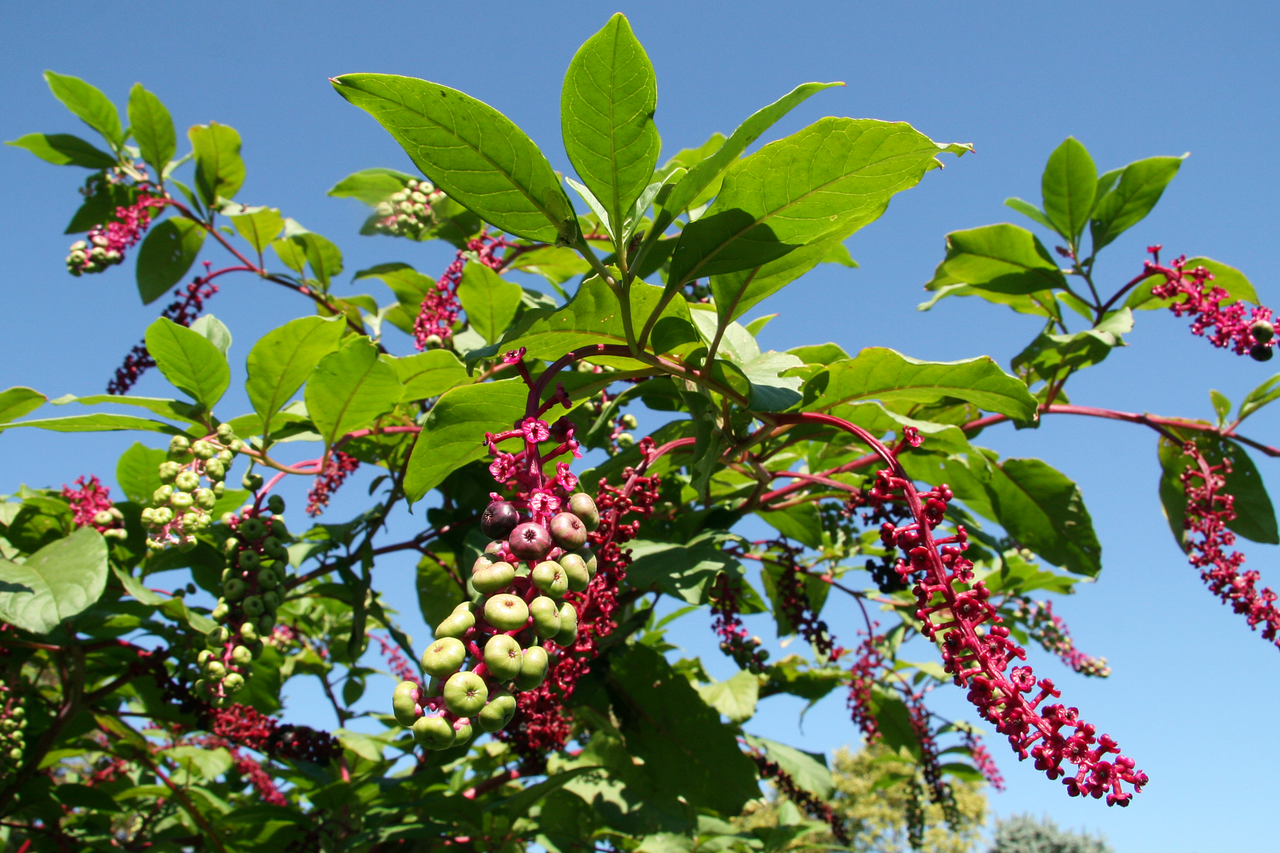
American pokeweed
 3
3 6
6 3
3Will it grow where I live?
American pokeweed is hardy to zone 3 – that covers all of Central Europe and the British Isles, and every USDA zone from 3 upwards.
Or check it for your location right here:
Profile
- Family
- Phytolaccaceae
- Habit
- perennial
- Height
- 3.5 m
- Spread
- 4 m
- Growth
- very fast
- Lifespan
- 10 years
- First yield
- after 2 years
- Hardiness
- zone 3–9
- Shade tolerance
- partial shade
- Soil
- Sand, Silt, Loam
- Soil moisture
- moist – very wet
- pH
- 5 – 7
Flowering & harvest
| J | F | M | A | M | J | J | A | S | O | N | D | |
|---|---|---|---|---|---|---|---|---|---|---|---|---|
| Flowering | ||||||||||||
| Fruit harvest |
Uses
Edible: Only the young spring shoot is edible, and only while it is at most about 20 cm tall and shows no red colouring at all on stem or leaf stalk. It is cut like asparagus, brought to the boil in plenty of water, the water poured away, boiled again and the water poured away again — only then is it treated like spinach. In the southern United States this dish, "poke sallet", is a traditional spring food handed down through generations, together with the rule that every change of water must go. Everything else on the plant is poisonous: the root most of all, plus the seeds, the ripe berries and any shoot already turning red. That reddening is the signal that saponin and phytolaccatoxin levels have risen. The berry juice is not edible either, although it has been used as a food colouring and ink. If you are unsure about a shoot, leave it — the yield is out of all proportion to the risk, and in April there is plenty of uncontroversial wild greenery about.
Other uses: The deep red berry juice served for centuries as a colourant: for ink, textiles, paper and — until it was banned — for deepening the colour of red wine, which is where the German name Kermesbeere comes from. The dye is not lightfast, though, and fades quickly to brown. As an ornamental the plant is genuinely valued for its red stems, white flower spikes and glossy black berry racemes; it builds a head-high structure in a single season and produces a corresponding volume of compost material.
Growing
Undemanding to robust: it wants nutrient-rich, humus-rich, reasonably moist soil at pH 5 to 7 and likes part shade, but takes full sun as readily as marked shade. It dislikes waterlogging. Once established it needs neither water nor feeding. The top growth dies back completely every winter and resprouts from the root in May — hardy to about -20 °C. Allow generous space, it reaches three to four metres across. The only real management point is controlling its spread: cut the fruiting spikes before the berries blacken, or birds will carry them across the neighbourhood. To remove the plant, the entire taproot must be dug out — wear gloves, as fragments resprout.
Propagation
By seed, and it does this by itself: each berry holds about ten seeds, which stay viable in the soil for decades. For deliberate propagation, sow outdoors in autumn or cold-stratify over winter; germination follows in spring, irregularly over several weeks. The root can be divided in early spring before it shoots, each piece needing a bud. The plant flowers and fruits from its second year. Take care with any root work: wear gloves, and if spread is unwanted put cuttings in the waste rather than the compost.
Value for wildlife
The white flower spikes from July to September are visited by honeybees, bumblebees and hoverflies without the species being a major nectar source. Its real importance is to birds: thrushes, blackbirds, starlings and warblers eat the black berries in quantity and carry the seed for kilometres — precisely the mechanism that makes it a neophyte. The same berries are poisonous to mammals and humans, while birds tolerate them without trouble. The dense, tall perennial provides cover but is avoided by deer and hares because of its bitterness.
Notable
Pokeweed is a North American neophyte spreading steadily through southern and central Europe — above all on clear-fells, in gappy plantations and on disturbed, nutrient-rich ground. From a beet-like root weighing several kilograms it resprouts every year and reaches two to three metres in a season. Its seed stays viable in the soil for decades and is carried far by birds; in some forest districts it is now considered a problem for natural regeneration. For the garden that means: an impressive, low-maintenance structural plant with a narrow edible window in spring — but one to keep an eye on, whose fruiting spikes should be cut before the birds distribute them.
Origin & habitat
Native to eastern and central North America from New England to Florida and west to Texas. Brought to Europe as an ornamental and naturalised since the seventeenth century; now established across southern Europe, Italy, Hungary, the Balkans and increasingly in southern Germany, Austria and Switzerland. Also introduced to East Asia and North Africa.
Fertile, humus-rich, moist soils on disturbed and open sites: clear-fells, forest tracks, gappy pine and black locust plantations, railway land, garden margins and ruderal ground. Part shade to sun, from the lowlands to the lower montane belt. In open plantations it can form pure stands and hinder natural regeneration.
⚠️ Hazards
Toxicity: highly toxic
Toxic in all parts except the young spring shoot Pokeweed is poisonous in every part except the very young, still green spring shoot. The root is the most toxic, followed by seed and ripe berries. The active compounds are saponins, phytolaccatoxin and mitogens, causing vomiting, cramping abdominal pain, bloody diarrhoea, circulatory disturbance and, in severe cases, respiratory paralysis. Around ten berries can be dangerous for a child — and the glossy black clusters are decidedly attractive to children. The mitogens can also be absorbed through intact skin, so wear gloves when clearing the plant or working on the root. The berry juice stains skin and clothing persistently. Root and berries are likewise toxic to dogs, pigs and horses. Anyone using the edible shoots must stick strictly to the rules: under 20 cm, no red colouring whatsoever, boiled twice, water discarded each time.
Frequently asked questions
American pokeweed: how big does it get?
American pokeweed (Phytolacca americana) grows as a perennial and reaches roughly 3.5 m in height when mature, with a spread of about 4 m. Growth is very fast.
American pokeweed: what site does it need?
American pokeweed tolerates partial shade. Suitable soils are Sand, Silt, Loam. Soil moisture should be in the range moist – very wet. The pH may lie between 5 and 7.
American pokeweed: is it hardy?
American pokeweed is listed as hardy in zone 3–9 and survives normal winters outdoors there.
American pokeweed: will it grow in Central Europe?
American pokeweed is hardy to zone 3 – that covers all of Central Europe and the British Isles, and every USDA zone from 3 upwards.
American pokeweed: when does it flower?
In a temperate northern-hemisphere climate it flowers from July to September.
American pokeweed: when is it harvested?
In a temperate northern-hemisphere climate the fruit ripens from September to October.
American pokeweed: is it poisonous?
American pokeweed is classified as highly toxic. With wild plants, never rely on a database alone — only on a confident identification.
American pokeweed: what is it used for?
Rated on a scale up to 10: Edible 3/10, Medicinal 6/10, Other uses 3/10.
Plan this plant into your own garden
Permaplans plans your garden to scale on the map — with a site check, harvest calendar and over 1,000 plants. Free for iPhone, Android, Mac, Windows & Linux.
Will this plant grow where you live? → Check your site
Community experience
No first-hand reports for this plant yet.
Growing it? Write in the app what works for you – your post will show up here.
💬 Get the app and join in