
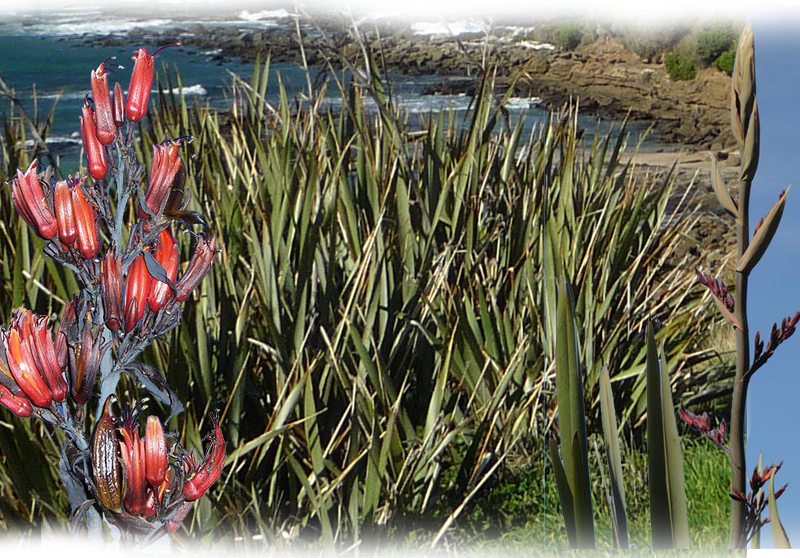
New Zealand flax
 2
2 7
7 9
9Will it grow where I live?
New Zealand flax is only hardy to zone 8, so outdoors year-round it needs the mildest spots in Central Europe – wine-growing regions, the Rhine valley, coasts, Lake Constance, Ticino – or a container overwintered under cover. Most of the British Isles and the Pacific coast of North America qualify. It also needs warm summers – in Central Europe that means wine-growing regions, cities or a sheltered south-facing wall.
Or check it for your location right here:
Profile
- Family
- Asphodelaceae
- Habit
- Shrub
- Height
- 4 m
- Spread
- 6 m
- Growth
- fast
- Lifespan
- 30 years
- First yield
- after 7 years
- Hardiness
- zone 8–11
- Shade tolerance
- partial shade
- Soil
- Sand, Silt, Loam
- Soil moisture
- semi-dry – near water
- pH
- 5.5 – 7.5
- Synonyms
- Neuseeländer Flachs, Harareke
Flowering & harvest
| J | F | M | A | M | J | J | A | S | O | N | D | |
|---|---|---|---|---|---|---|---|---|---|---|---|---|
| Flowering | ||||||||||||
| Fruit harvest |
Uses
Edible: The roasted seed is used as a coffee substitute. An edible nectar is obtained from the flowers. A long hollow grass stem or straw is used to suck it out from the flowers. An edible gum is obtained from the base of the leaves.
Medicinal: The root contains coumarins and has shown to be cytotoxic. It inhibits blood clotting and is used in Korea for medical purposes to treat migraines, colds, and rheumatoid arthritis.
Other uses: High-quality flexible fiber is extracted from the leaves, which are harvested in summer, scraped, soaked, boiled, ground, and processed into cream-colored paper. The split leaves can be used for nets, coats, sandals, straps, and baskets. A leaf strip can serve as emergency cord in the garden. The pulp of the leaves can be fermented into alcohol, and the contained rubber serves as paper glue. A brown dye is obtained from the flowers without a mordant, while a terracotta dye can be extracted from the seed capsules. The flowers are rich in tannin.
Notable
Special features: tolerant to sea wind, flooding, and salt; Leaves for fiber: scraped (outer skin removal) → soaked in water for 2 hours → boiled in lye for 24 hours → beaten in a ball mill for 4 hours; Other leaf strips for tying, knots do not break; Outer leaves are cut diagonally to allow rainwater to drain. There are different varieties for different purposes.
Origin & habitat
New Zealand. Naturalized in Southwest England.
Hedges, scrub, forests, roadsides, banks, etc.
⚠️ Hazards
Since only the edible nectar is mentioned, these parts may have toxic effects as they are not edible flowers. Little is known.
Frequently asked questions
New Zealand flax: how big does it get?
New Zealand flax (Phormium tenax) grows as a Shrub and reaches roughly 4 m in height when mature, with a spread of about 6 m. Growth is fast.
New Zealand flax: what site does it need?
New Zealand flax tolerates partial shade. Suitable soils are Sand, Silt, Loam. Soil moisture should be in the range semi-dry – near water. The pH may lie between 5.5 and 7.5.
New Zealand flax: is it hardy?
New Zealand flax is listed as hardy in zone 8–11 and survives normal winters outdoors there.
New Zealand flax: will it grow in Central Europe?
New Zealand flax is only hardy to zone 8, so outdoors year-round it needs the mildest spots in Central Europe – wine-growing regions, the Rhine valley, coasts, Lake Constance, Ticino – or a container overwintered under cover. Most of the British Isles and the Pacific coast of North America qualify. It also needs warm summers – in Central Europe that means wine-growing regions, cities or a sheltered south-facing wall.
New Zealand flax: when does it flower?
In a temperate northern-hemisphere climate it flowers from May to June.
New Zealand flax: when is it harvested?
In a temperate northern-hemisphere climate the fruit ripens from June to July.
New Zealand flax: is it poisonous?
Individual parts of New Zealand flax are noted as mildly problematic — the plant does not count as poisonous. With wild plants, never rely on a database alone, only on a confident identification.
New Zealand flax: what is it used for?
Rated on a scale up to 10: Edible 2/10, Medicinal 7/10, Other uses 9/10.
Plan this plant into your own garden
Permaplans plans your garden to scale on the map — with a site check, harvest calendar and over 1,000 plants. Free for iPhone, Android, Mac, Windows & Linux.
Will this plant grow where you live? → Check your site
Community experience
No first-hand reports for this plant yet.
Growing it? Write in the app what works for you – your post will show up here.
💬 Get the app and join in