
 2
2 5
5 9
9Will it grow where I live?
Princess tree is hardy to zone 6, which covers nearly all of Central Europe and the British Isles; only harsh upland sites (Alps, high ridges) call for winter protection.
Or check it for your location right here:
Profile
- Family
- Paulowniaceae
- Habit
- Tree
- Height
- 15 m
- Spread
- 10 m
- Growth
- very fast
- Lifespan
- 100 years
- First yield
- after 9 years
- Hardiness
- zone 6–9
- Shade tolerance
- full sun
- Soil
- Sand, Silt, Loam
- Soil moisture
- dry – very moist
- pH
- 5 – 8.9
- Synonyms
- Kiribaum, Kiri,
Flowering & harvest
| J | F | M | A | M | J | J | A | S | O | N | D | |
|---|---|---|---|---|---|---|---|---|---|---|---|---|
| Flowering | ||||||||||||
| Fruit harvest |
Uses
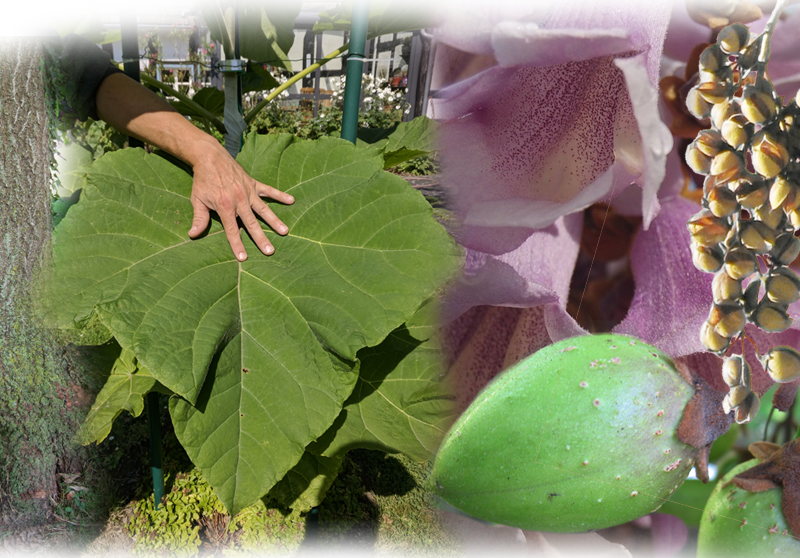
Edible: The foxglove tree is not a fruit tree — the woody seed capsules are inedible and stay on only as winter decoration. What is edible are the flowers and, to a limited extent, the leaves. The large violet bells open in May before the leaves, hold plenty of nectar and taste sweetish; they are added raw to salads, dressed with miso, or deep-fried as tempura in East Asia. The yield is considerable, but the window is short and confined to older, flowering trees. The leaves are named as a famine food when cooked; they are coarsely hairy, of no culinary interest and play no part in cooking, yet they have real value as fodder — a ten-year-old tree yields around a hundred kilograms of leaf a year.
Medicinal: Flowers: for skin conditions; leaves: poultices for bruises; decoctions for washing sores; leaf juice for warts and intestinal parasites; inner bark: tincture for fever and delirium.
Other uses: Leaves for animal feed; wood 70 fm/ha/a (lighter, harder, stronger than spruce, flame-resistant, easy to work, does not splinter, good thermal insulation, beautiful, insect-resistant); used in house, ship, sauna construction, surfboards, furniture, tool handles, musical instruments; also for firewood, charcoal (fireworks), humus formation, decoration, and fragrance.
Growing
Site: With the foxglove tree the question of spread comes before all others. A single seed capsule holds one to two thousand wind-borne seeds, seedlings come up out of wall cracks and paving joints, and the German federal conservation agency lists it as potentially invasive; Switzerland banned sale, supply and import from 1 September 2024. Anyone planting it takes on the duty of removing the capsules before they ripen. It needs a fully sunlit, warm and emphatically sheltered position on deep, free-draining soil — the huge leaves act like sails and tear in wind. Its root system is aggressive and belongs well away from foundations, pipes, paving and drains. Under the crown it grows dark, and in autumn a considerable mass of leaves comes down, though it rots quickly as mulch. Care: Young trees die back regularly in Central Europe and need stem and root protection in their first winters; with age they become hardy. A failure to flower is usually not a fault of site but late frost: the buds are laid down in the previous year and overwinter unprotected. Because it can put on up to six metres in a year, a young tree must be staked until the stem carries itself. Do not feed, and water only while establishing. The classic management is coppicing, to which the Japanese name kiri already points: cut to the stool in early spring it throws metre-long rods with oversized leaves, yields mulch and fodder, and stays small and flowerless — which prevents spread by itself. Young plants get a vole basket.
Propagation
The foxglove tree is exceptionally easy to propagate, which explains its readiness to spread. The seeds are tiny, winged and light-germinating: they are only scattered on the surface and never covered, kept evenly moist, and germinate in great numbers within two to four weeks at around twenty degrees. Seedlings put on more than a metre in the first year but are frost-tender and are overwintered under cover. For forestry and nursery production, however, root cuttings are the method of choice: pencil-thick root pieces five to ten centimetres long, cut in winter, are laid flat and shallow in free-draining medium and shoot reliably in spring. Hardwood cuttings and lifting root suckers also work. The high-performance hybrids of the trade are propagated by tissue culture and are covered by plant variety rights, so raising your own from them is not permitted.
Value for wildlife
The princess tree is a neophyte with no settled relationships to Central European wildlife, and the evidence is correspondingly thin: it is not a larval food plant, no specialist wild bees are known, and no reliable species counts exist for Central Europe. What it offers is quantity at the right moment. The large bell-shaped flowers open in May before the leaves and yield nectar freely; honeybees and bumblebees work them hard, and paulownia honey is harvested in China and south-eastern Europe. The very large leaves cast dense shade and drop autumn litter that breaks down quickly. The woody seed capsules persist through winter. As an ecological argument this carries only so far — the species' tendency to spread weighs heavier, in case of doubt, than what its flowers provide.
Notable
Special features: offers slope erosion protection + rich mulch; needs wind protection & draining, light, preferably deep/disturbed soils; likes hot summers; planted in Japan for the birth (of a daughter) & felled + carpentered for the wedding; Kiri (Japanese = cutting) → short rotation; aggressive roots! Hybrid breeding. Nordmax21® world record; 6m/year; + agroforestry;
Origin & habitat
East Asia: central and western China. From there the princess tree was taken early to Korea and Japan, where it has been cultivated so long that it is widely assumed to be native; its light kiri timber supports a craft of its own. It reached Europe and North America in the nineteenth century as an ornamental. In the warmer parts of both continents it has escaped cultivation: in the south-eastern United States it is regarded as invasive, and in Europe it spreads above all in the Mediterranean, in the Pannonian basin and along railway land, river gravels and waste ground — helped by the fact that a single capsule holds one to two thousand airborne seeds and that seedlings come up from wall crevices and paving joints. In Germany the Federal Agency for Nature Conservation lists it on the Grey List as potentially invasive; Switzerland added it to its Release Ordinance in 2024, banning sale, transfer and import from 1 September 2024. It is not on the EU Union list.
The princess tree comes from the warm-temperate mountain forests of central and western China, where as a light-demanding pioneer it occupies open slopes, forest edges and disturbed ground. That pioneer behaviour governs its appearance everywhere else: it germinates on raw soil, in gravel, in wall crevices and paving joints, and needs little more than light and warmth to do so. It prefers reasonably fertile, moderately dry, free-draining soils in warm, sheltered, sunny positions; waterlogging and permanent shade do not suit it. When young it is frost-sensitive and cut back regularly, becoming hardy with age. In Central Europe it finds its niches along railway land, on waste ground, on river gravels and in heat-loaded city centres.
⚠️ Hazards
The plant has certain compounds that could be toxic, so handling it requires caution.
Frequently asked questions
Princess tree: how big does it get?
Princess tree (Paulownia tomentosa) grows as a Tree and reaches roughly 15 m in height when mature, with a spread of about 10 m. Growth is very fast.
Princess tree: what site does it need?
Princess tree tolerates full sun. Suitable soils are Sand, Silt, Loam. Soil moisture should be in the range dry – very moist. The pH may lie between 5 and 8.9.
Princess tree: is it hardy?
Princess tree is listed as hardy in zone 6–9 and survives normal winters outdoors there.
Princess tree: will it grow in Central Europe?
Princess tree is hardy to zone 6, which covers nearly all of Central Europe and the British Isles; only harsh upland sites (Alps, high ridges) call for winter protection.
Princess tree: when does it flower?
In a temperate northern-hemisphere climate it flowers in May.
Princess tree: when is it harvested?
In a temperate northern-hemisphere climate the fruit ripens in September.
Princess tree: is it poisonous?
Individual parts of Princess tree are noted as mildly problematic — the plant does not count as poisonous. With wild plants, never rely on a database alone, only on a confident identification.
Princess tree: what is it used for?
Rated on a scale up to 10: Edible 2/10, Medicinal 5/10, Other uses 9/10.
Plan this plant into your own garden
Permaplans plans your garden to scale on the map — with a site check, harvest calendar and over 1,000 plants. Free for iPhone, Android, Mac, Windows & Linux.
Will this plant grow where you live? → Check your site
Community experience
What Permaplans users wrote about this plant – taken from the app as is. 1 post.
krasser Baum mit schnellem Wuchs, schafft es unter guter Pflege mit ausreichend Wasser Sonne und Dung enorm zu wachsen. an schlechten Standort kann er sich aber auch schwer tun. als Schattenspender, Opferpflanze, Pionier und Bauholz für Wohnmobile und Wägen interessant. wird immer bekannter. nun werden auch industriell theobromin und Ölsäure aus den Wurzeln extrahiert. falls jemand Bäume braucht der gebe Bescheid ich vermehre sie durch Wurzelstecklinge
Growing it? Write in the app what works for you – your post will show up here.
💬 Get the app and join in