
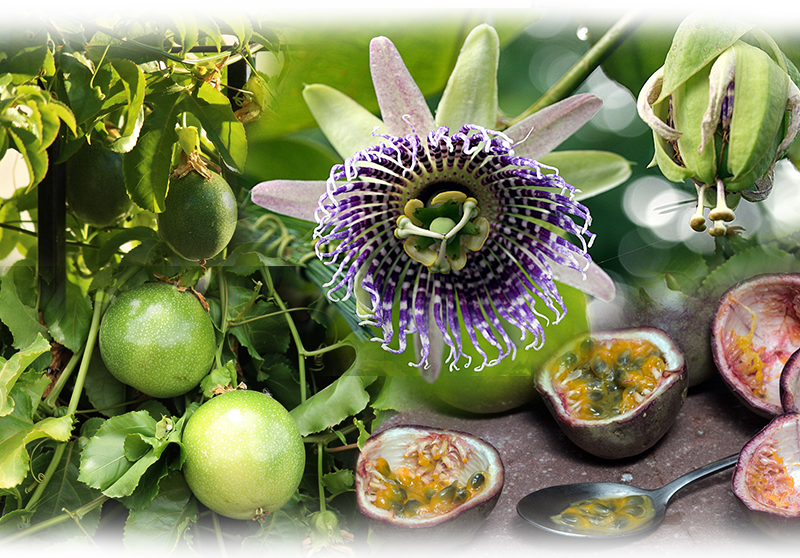
Passion fruit
 9
9 5
5 2
2Will it grow where I live?
Passion fruit is not winter-hardy in Central Europe (zone 9): outdoors from spring to autumn only, otherwise a container plant overwintered frost-free. The summer heat it needs to ripen is out of reach outdoors in Central Europe – greenhouse or conservatory.
Or check it for your location right here:
Profile
- Family
- Passifloraceae
- Habit
- Climber
- Height
- 9.5 m
- Spread
- 10 m
- Growth
- very fast
- Lifespan
- 20 years
- First yield
- after 3 years
- Yield per plant
- up to 30 kg a year
- Yield in cultivation
- up to 20 t/ha
- Energy yield
- 1500 kcal per m² a year
- Hardiness
- zone 9–12
- Shade tolerance
- full sun
- Soil
- Sand, Silt, Loam
- Soil moisture
- semi-dry – very wet
- pH
- 5.5 – 6.5
- Synonyms
- Maracuja, Passionsfrucht,
Flowering & harvest
| J | F | M | A | M | J | J | A | S | O | N | D | |
|---|---|---|---|---|---|---|---|---|---|---|---|---|
| Flowering | ||||||||||||
| Fruit harvest |
Varieties (12)
12 varieties of Passion fruit are listed in the Permaplans variety finder — each with its own page: taste, ripening time, disease resistance, parentage and use.
- Ester Large-fruited purple selection with high juice content and balanced flavour.
- Frederick Very large hybrid passion fruit with purple-red skin and abundant juice.
- Golden Star Robust yellow passion fruit with high juice content, ideal for processing.
- Kaveri Indian purple-yellow hybrid with high juice content for commercial cultivation.
- Misty Gems South African purple commercial cultivar with strong aroma for the fresh market.
- Nelson Vigorous grafted purple passion fruit with deep-violet skin and intense aroma.
- Panama Gold Large, golden-yellow tropical passion fruit with sweet, low-acid pulp.
- Panama Red Very large, reddish-purple passion fruit from tropical North Australia.
- Paul Ecke Californian purple cultivar with especially aromatic, sweet-tart pulp.
- Possum Purple Large, sweet purple passion fruit from Florida with notably low acidity.
- Pratt Hybrid Yellow hybrid passion fruit with rich juice yield for tropical regions.
- Sweet Sunrise Large yellow passion fruit with unusually sweet, mildly tart pulp.
Uses
Edible: What is eaten is not the flesh but the aromatic, jelly-like aril together with the seeds — spooned out or pushed through a sieve. The taste is intensely sharp and aromatic, which is why the juice is usually sweetened or blended. Two forms are in circulation: the purple forma edulis with brown to violet skin that wrinkles on ripening, and the yellow forma flavicarpa with smooth skin and, at eight to twelve centimetres, distinctly larger fruit, which tastes sourer and is grown mainly for juice. The fruit is ripe when it falls of its own accord; the skin then wrinkles and the aroma rounds out. It is used raw, as juice, and in desserts, ice cream, sorbets, sauces and jams. The black to brown seeds are eaten along with it.
Medicinal: An important distinction first: the passionflower used medicinally is Passiflora incarnata, for which a European monograph exists on traditional use for nervous restlessness and difficulty falling asleep. Passiflora edulis is a different species, and those findings cannot simply be transferred. A calming use is nonetheless recorded for it as well: in Brazil and other growing countries the flavonoid-rich leaves are traditionally drunk as an infusion against restlessness and sleeplessness and as a diuretic. Evidence of efficacy for this species is lacking. The fruit itself is a food and not a remedy; its high vitamin C content matters nutritionally, not pharmacologically.
Other uses: Besides the fruit, the passion fruit yields two by-products. Maracuja oil is pressed from the seeds, a light oil rich in linoleic acid used in cosmetics for skin and hair care and arising as a side stream of juice production. The leaves contain flavonoids and are traditionally used as a calming and diuretic infusion. In the garden the third use is the most obvious: as a fast-growing evergreen climber it covers fences, trellises and pergolas within a single season and provides screening, along with the extraordinary flowers that open for only a few hours. In Central Europe this stays confined to container culture and sheltered wall positions; in the Mediterranean it is used as permanent cover.
Growing
Site: In Central Europe the passion fruit is a container plant — neither form is hardy. It needs the warmest, fully sunny, wind-sheltered position available, a south wall or a conservatory. Nothing works without a climbing frame: the shoots climb by tendrils up to ten metres and need a load-bearing trellis, a fence or tensioned wires; a single obelisk in a pot is not enough for a mature plant. The substrate is humus-rich, slightly acid and above all free-draining, the pot correspondingly large and drained. The choice of form decides the crop: the purple forma edulis is self-fertile and therefore right for a single plant, while the yellow forma flavicarpa depends on cross-pollination and sets no fruit alone. The flowers open for only a few hours and are visited outdoors by bumblebees; under glass, hand pollination with a brush is worthwhile. Care: Water generously from May to September and feed weakly each week — a potassium-rich feed improves fruit set; in winter water far less and do not feed at all. Overwinter bright and frost-free at about ten degrees; in a warm room with too little light the plant grows spindly and drops its leaves. Prune in spring before new growth: flowers appear on the current year's wood, so cutting last year's shoots back hard to two or three buds brings more flowers rather than fewer, and bare old canes are removed entirely. Harvest when the fruits drop by themselves; they are then fully ripe and wrinkle in storage, which rounds off the aroma. Spider mites, whitefly and scale insects are the typical pests of winter quarters; fusarium and nematodes chiefly affect the purple form, which is why in commercial growing it is grafted onto the resistant yellow form.
Propagation
Soak the seeds in warm water for 12 hours before planting in a warm greenhouse in late winter or early spring. If planted in January and grown quickly, the plant can flower and fruit in its first year. Seeds typically germinate within 1 to 12 months at 20°C. Transfer the seedlings to individual pots when they are big enough. If planning to grow the plants outdoors, it's advisable to overwinter them in the greenhouse and then transplant them in late spring or early summer after the final frosts. Provide a good mulch in late autumn to protect the roots from the cold. Take 15cm cuttings with a heel from young shoots in spring. In spring, use leaf bud cuttings. For fully mature wood, take cuttings in early summer, which will take about 3 months to root with a high success rate.
Value for wildlife
The wildlife value of passion fruit in Central Europe is slight, because the plant stands in a container here and produces few flowers. Its floral biology is remarkable nonetheless: the large, strikingly built flowers open for only a few hours of a single day and are visited by large, powerful bees — in their homeland chiefly carpenter bees, in Central Europe bumblebees, heavy enough to force contact with anthers and stigmas. The purple forma edulis is self-fertile, the yellow forma flavicarpa is not; it sets no fruit without cross-pollination, which is why commercial plantings are regularly hand-pollinated. It is not a caterpillar food plant for native species — in South America, by contrast, the caterpillars of numerous heliconian butterflies feed exclusively on Passiflora species. Ripe fallen fruit is taken in the growing regions by birds and mammals, which disperse the seed.
Notable
Special: The name comes from missionaries who read the flower as the Passion of Christ — corona = crown of thorns, three styles = nails, five stamens = wounds; each flower opens for only a few hours of a single day; the purple + yellow forms are the same species but behave like two plants: one self-fertile + suited to altitude, the other cross-pollinated + tropical.
Origin & habitat
South America: Brazil, Paraguay and northern Argentina. From there the species was spread through all the tropics and subtropics and is today the commercially most important of the edible passion flowers. It is grown in Brazil, Colombia, Ecuador and Peru, in Kenya, Uganda and South Africa, in India, Vietnam, Indonesia and Australia, and in New Zealand and Hawaii. The two forms occupy different altitude belts: the purple forma edulis is the more cold-tolerant and is cultivated between roughly 1000 and 2300 metres, while the yellow forma flavicarpa stays in the warm lowlands. In Central Europe the species is not hardy and is kept as a container or conservatory plant.
The passion fruit is an evergreen, woody climber of the subtropical and tropical forest margins of South America. It grows on open edges, in secondary vegetation and around groups of trees, climbing with tendrils up to ten metres into other crowns — it builds no supporting frame of its own and depends on existing structure. The root zone demands evenly moist, humus-rich and very free-draining soil; it does not tolerate waterlogging. Frost sets the limit: the purple form withstands brief light frost and therefore occupies elevations between about 1000 and 2300 metres, while the yellow form stays in the frost-free lowlands. There is no outdoor habitat for it in Central Europe.
⚠️ Hazards
Adverse reaction from unripe fruit Unripe fruit, along with leaves and tendrils, contains cyanogenic glycosides that can cause nausea if eaten; the content breaks down as the fruit ripens. The fruit is ripe when it drops of its own accord — at that point the seed coat is harmless. Only fully ripe fruit should be eaten.
Frequently asked questions
Passion fruit: how big does it get?
Passion fruit (Passiflora edulis) grows as a Climber and reaches roughly 9.5 m in height when mature, with a spread of about 10 m. Growth is very fast.
Passion fruit: what site does it need?
Passion fruit tolerates full sun. Suitable soils are Sand, Silt, Loam. Soil moisture should be in the range semi-dry – very wet. The pH may lie between 5.5 and 6.5.
Passion fruit: is it hardy?
Passion fruit is listed as hardy in zone 9–12 and survives normal winters outdoors there.
Passion fruit: will it grow in Central Europe?
Passion fruit is not winter-hardy in Central Europe (zone 9): outdoors from spring to autumn only, otherwise a container plant overwintered frost-free. The summer heat it needs to ripen is out of reach outdoors in Central Europe – greenhouse or conservatory.
Passion fruit: when does it flower?
In a temperate northern-hemisphere climate it flowers from May to August.
Passion fruit: when is it harvested?
In a temperate northern-hemisphere climate the fruit ripens from August to November.
Passion fruit: when does it start cropping, and how much?
Passion fruit first crops after 3 years. A mature plant gives up to 30 kg a year, in cultivation up to 20 t per hectare. Figures assume a good site; variety, soil and climate shift them considerably.
Passion fruit: is it poisonous?
Individual parts of Passion fruit are noted as mildly problematic — the plant does not count as poisonous. With wild plants, never rely on a database alone, only on a confident identification.
Passion fruit: what is it used for?
Rated on a scale up to 10: Edible 9/10, Medicinal 5/10, Other uses 2/10.
Which Passion fruit varieties are there?
The Permaplans variety finder lists 12 varieties of Passion fruit, including Ester, Frederick, Golden Star, Kaveri, Misty Gems, Nelson, Panama Gold, Panama Red, Paul Ecke, Possum Purple, Pratt Hybrid, Sweet Sunrise. Each variety has its own page with taste, ripening time, disease resistance and parentage.
Plan this plant into your own garden
Permaplans plans your garden to scale on the map — with a site check, harvest calendar and over 1,000 plants. Free for iPhone, Android, Mac, Windows & Linux.
Will this plant grow where you live? → Check your site
Community experience
No first-hand reports for this plant yet.
Growing it? Write in the app what works for you – your post will show up here.
💬 Get the app and join in