
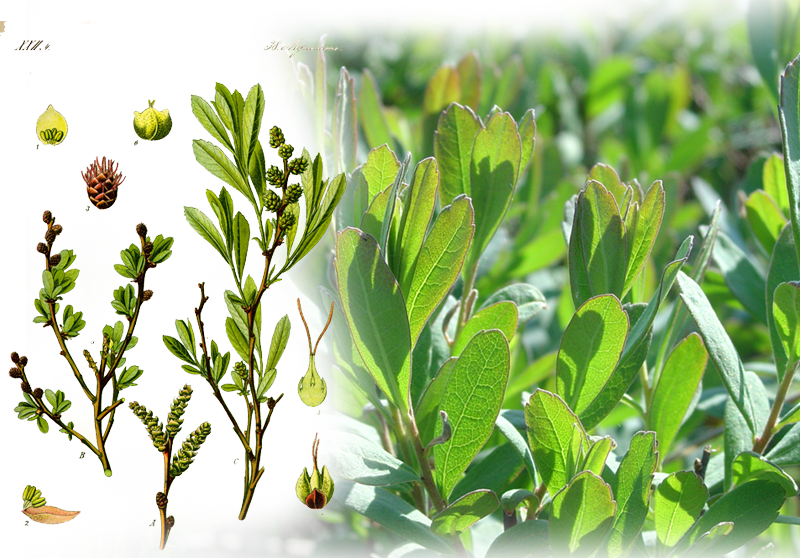
Bog myrtle
 4
4 5
5 8
8Will it grow where I live?
Bog myrtle is hardy to zone 2 – that covers all of Central Europe and the British Isles, and every USDA zone from 2 upwards.
Or check it for your location right here:
Profile
- Family
- Myricaceae
- Habit
- Shrub
- Height
- 1.8 m
- Spread
- 3.5 m
- Growth
- slow
- Lifespan
- 40 years
- First yield
- after 5 years
- Hardiness
- zone 2–7
- Shade tolerance
- partial shade
- Soil
- Sand, Silt, Loam
- Soil moisture
- semi-dry – near water
- pH
- 5 – 7.5
Flowering & harvest
| J | F | M | A | M | J | J | A | S | O | N | D | |
|---|---|---|---|---|---|---|---|---|---|---|---|---|
| Flowering | ||||||||||||
| Fruit harvest |
Uses
Edible: The aromatic fruits and leaves are used fresh or dried to season soups, stews, and other dishes. Occasionally added to beer and ale to enhance flavor and increase foam formation, the fruit, about 3 mm in diameter, holds a large seed. Dried leaves can be used to prepare a delicate and flavorful tea.
Medicinal: The leaves are abortive, aromatic, astringent, emmenagogic, and stomachic. They are typically used as tea but contain a toxic aromatic oil, so caution is advised when using them.
Other uses: A wax layer on the fruits and leaves is removed by scalding the fruits with boiling water and soaking them for a few minutes. The wax floats to the surface and is then skimmed off. The fruit is then boiled in water to extract the wax from the pulp. The wax is skimmed off again and strained through a muslin cloth. It can be used to make scented candles that emit a delightful fragrance when burned. Unfortunately, this method does not produce enough wax to be commercially viable. A yellow dye can be obtained from the tips of the stems and seeds of the plant. The bark contains tannin and can be harvested in autumn and used as a yellow dye. The plant repels moths and insects in general. The fragrant leaves are also utilized. A strong decoction of the leaves can be used as a parasiticide to kill external body parasites. A fragrant essential oil is extracted from the fruits.
Growing
There are varying opinions on the requirements of this plant. Most reports suggest that it prefers moist soil and thrives in an open position with well-draining soil, in either sunny or lightly shaded areas. It is commonly believed to prefer or even require a lime-free loamy or peaty soil, although one report suggests it can grow in any regular garden soil. In the wild, it is typically found in soils with a pH between 3.5 and 6, occasionally in marshes with a pH of up to 7.5. A spreading shrub that can form thickets in favorable conditions. This species has a symbiotic relationship with specific soil microorganisms that form nodules on the plant's roots and fix atmospheric nitrogen. While some of this nitrogen is utilized by the plant itself, a portion can also be accessed by nearby plants. This characteristic enables the plant to thrive in waterlogged soils. Dioecious. Male and female plants need to be grown together for seed production. Occasionally, this plant can be monoecious and may change gender from year to year. Flowers mainly develop on one-year-old wood. All parts of the plant have a pleasant aroma. A valuable food source for the caterpillars of many butterfly species. Plants of this genus exhibit notable resistance to honey fungus.
Notable
Specialties: prefers acidic soil in coastal, moor/wetland areas. This plant is occasionally monoecious and can change sex from year to year; listed on the Red List; flowers on one-year-old wood; M. pensylvanica is better fruiting+growing and significantly better M. cerifera, which is frost-hardy only from Zone 7 onwards.
Origin & habitat
Western Europe, from Scandinavia to Portugal in the west, extending to northwestern Russia in the east. North America.
Hedgerows and copses.
⚠️ Hazards
This plant is an abortifacient and should not be consumed by pregnant women. It is recommended to avoid eating it if you are pregnant.
Frequently asked questions
Bog myrtle: how big does it get?
Bog myrtle (Myrica gale) grows as a Shrub and reaches roughly 1.8 m in height when mature, with a spread of about 3.5 m. Growth is slow.
Bog myrtle: what site does it need?
Bog myrtle tolerates partial shade. Suitable soils are Sand, Silt, Loam. Soil moisture should be in the range semi-dry – near water. The pH may lie between 5 and 7.5.
Bog myrtle: is it hardy?
Bog myrtle is listed as hardy in zone 2–7 and survives normal winters outdoors there.
Bog myrtle: will it grow in Central Europe?
Bog myrtle is hardy to zone 2 – that covers all of Central Europe and the British Isles, and every USDA zone from 2 upwards.
Bog myrtle: when does it flower?
In a temperate northern-hemisphere climate it flowers in April.
Bog myrtle: when is it harvested?
In a temperate northern-hemisphere climate the fruit ripens in September.
Bog myrtle: is it poisonous?
Individual parts of Bog myrtle are noted as mildly problematic — the plant does not count as poisonous. With wild plants, never rely on a database alone, only on a confident identification.
Bog myrtle: what is it used for?
Rated on a scale up to 10: Edible 4/10, Medicinal 5/10, Other uses 8/10.
Plan this plant into your own garden
Permaplans plans your garden to scale on the map — with a site check, harvest calendar and over 1,000 plants. Free for iPhone, Android, Mac, Windows & Linux.
Will this plant grow where you live? → Check your site
Community experience
No first-hand reports for this plant yet.
Growing it? Write in the app what works for you – your post will show up here.
💬 Get the app and join in