
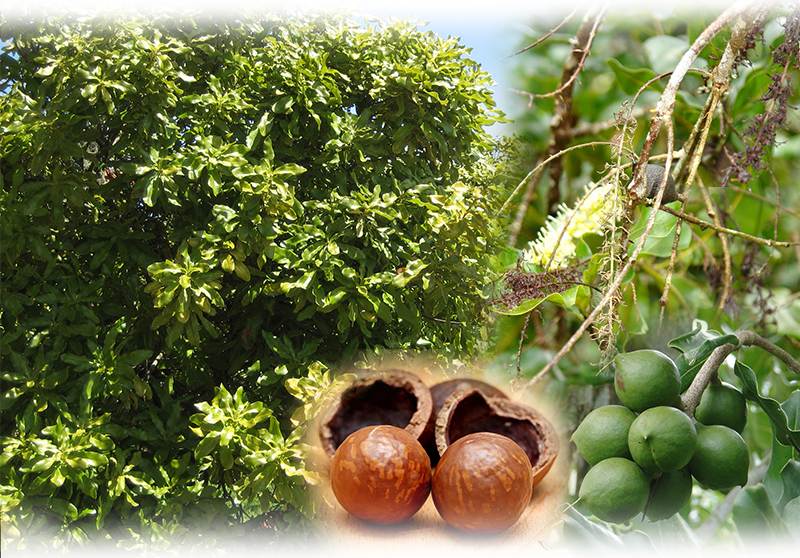
Macadamia
 8
8 2
2 2
2Will it grow where I live?
Macadamia is not winter-hardy in Central Europe (zone 9): outdoors from spring to autumn only, otherwise a container plant overwintered frost-free. It also needs warm summers – in Central Europe that means wine-growing regions, cities or a sheltered south-facing wall.
Or check it for your location right here:
Profile
- Family
- Proteaceae
- Habit
- Tree
- Height
- 10 m
- Spread
- 10 m
- Growth
- slow
- Lifespan
- 120 years
- First yield
- after 8 years
- Full yield
- after 14 years
- Productive years
- 40 years
- Yield per plant
- up to 50 kg a year
- Yield in cultivation
- up to 5 t/ha
- Energy yield
- 800 kcal per m² a year
- Hardiness
- zone 9–12
- Shade tolerance
- full sun
- Soil
- Sand, Silt, Loam
- Soil moisture
- semi-dry – very wet
- pH
- 4.5 – 6.5
- Synonyms
- Maiden.&Betche.
Flowering & harvest
| J | F | M | A | M | J | J | A | S | O | N | D | |
|---|---|---|---|---|---|---|---|---|---|---|---|---|
| Flowering | ||||||||||||
| Fruit harvest |
Varieties (13)
13 varieties of Macadamia are listed in the Permaplans variety finder — each with its own page: taste, ripening time, disease resistance, parentage and use.
- 246 Historic Hawaiian foundation variety, one of the first named cultivars of commercial production.
- 344 High-yielding Hawaiian variety for windy sites, dominant in commercial orchards.
- 660 Compact, high-yielding Hawaiian variety with very high kernel recovery.
- 741 Hawaiian upland variety for cooler sites with late maturity.
- 800 High-yielding Hawaiian variety for lower, warmer sites.
- 816 Internationally popular Hawaiian variety with even ripening - often used as a pollenizer.
- 849 Proven 'Own Choice' selection, valued as a reliable pollenizer and bearer.
- A16 Robust Australian selection, widely planted as pollenizer and main bearing variety.
- A38 Compact high-performance variety for dense plantings with very high kernel recovery.
- A4 Compact, high-yielding elite variety with excellent kernel quality - a leader in Australia and South Africa.
- Beaumont High-yielding, hardy hybrid with pink flowers - the go-to variety for home gardens and new orchards.
- Daddow Large-nutted Australian variety with high kernel quality and good wind tolerance.
- Nelmac II South African hybrid with very large nuts - a leader on the fresh market.
Uses
Edible: Seeds (raw, cooked) (cakes, cookies, ice cream) (flour, grains) (oil)
Growing
Pflanzen gedeihen am besten in nährstoffreichen, feuchten Böden und benötigen in der Anfangsphase im Sommer reichlich Wasser. Etablierte Pflanzen sind jedoch sehr trockenheitsresistent. Bäume benötigen einen geschützten Standort und werden durch starken Wind leicht beschädigt. Pflanzen können in kühleren Klimazonen als ihrem natürlichen Lebensraum angebaut werden, sind in Großbritannien aber nicht sehr winterhart. Sie überstehen jedoch leichten Frost und sind auf den Scilly-Inseln im Freien erfolgreich gewachsen. Optimales Wachstum findet bei Temperaturen zwischen 20 und 25 °C statt; das Wachstum kommt zum Erliegen, wenn die Temperaturen unter 10 °C oder über 30 °C steigen. Kaltes Wetter kann zum Totalausfall der Ernte führen. Die Macadamianuss wird in vielen tropischen und subtropischen Gebieten wegen ihrer essbaren Samen angebaut; es gibt einige Sorten. Die Pflanzen wachsen langsam; Sämlinge benötigen 6–7 Jahre, um die ersten Früchte zu tragen. Die Bäume liefern dann etwa 40–50 Jahre lang kommerziell nutzbare Früchte und können bis zu 100 Jahre lang Früchte tragen. Ein Rückschnitt ist normalerweise nicht notwendig, wird aber im Herbst toleriert. Diese Art wurde früher als Teil von M. ternifolia betrachtet.
Origin & habitat
Australia - New South Wales, Queensland.
Trockene Regenwälder des östlichen Küstenbuschs.
⚠️ Hazards
Nuts are toxic to dogs and cats.
Frequently asked questions
Macadamia: how big does it get?
Macadamia (Macadamia integrifolia) grows as a Tree and reaches roughly 10 m in height when mature, with a spread of about 10 m. Growth is slow.
Macadamia: what site does it need?
Macadamia tolerates full sun. Suitable soils are Sand, Silt, Loam. Soil moisture should be in the range semi-dry – very wet. The pH may lie between 4.5 and 6.5.
Macadamia: is it hardy?
Macadamia is listed as hardy in zone 9–12 and survives normal winters outdoors there.
Macadamia: will it grow in Central Europe?
Macadamia is not winter-hardy in Central Europe (zone 9): outdoors from spring to autumn only, otherwise a container plant overwintered frost-free. It also needs warm summers – in Central Europe that means wine-growing regions, cities or a sheltered south-facing wall.
Macadamia: when does it flower?
In a temperate northern-hemisphere climate it flowers from March to April.
Macadamia: when is it harvested?
In a temperate northern-hemisphere climate the fruit ripens from August to November.
Macadamia: when does it start cropping, and how much?
Macadamia first crops after 8 years. Full yield comes after 14 years. A mature plant gives up to 50 kg a year, in cultivation up to 5 t per hectare. The productive period lasts about 40 years, within a lifespan of around 120 years. Figures assume a good site; variety, soil and climate shift them considerably.
Macadamia: is it poisonous?
No toxicity is recorded for Macadamia. With wild plants, never rely on a database alone — only on a confident identification.
Macadamia: what is it used for?
Rated on a scale up to 10: Edible 8/10, Medicinal 2/10, Other uses 2/10.
Which Macadamia varieties are there?
The Permaplans variety finder lists 13 varieties of Macadamia, including 246, 344, 660, 741, 800, 816, 849, A16, A38, A4, Beaumont, Daddow and 1 more. Each variety has its own page with taste, ripening time, disease resistance and parentage.
Plan this plant into your own garden
Permaplans plans your garden to scale on the map — with a site check, harvest calendar and over 1,000 plants. Free for iPhone, Android, Mac, Windows & Linux.
Will this plant grow where you live? → Check your site
Community experience
No first-hand reports for this plant yet.
Growing it? Write in the app what works for you – your post will show up here.
💬 Get the app and join in