
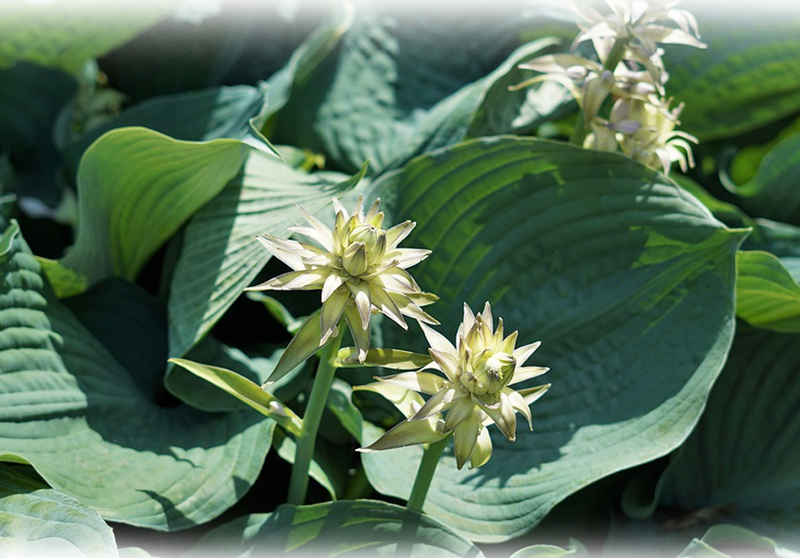
Blue-leaf hosta
 6
6 5
5Will it grow where I live?
Blue-leaf hosta is hardy to zone 4 – that covers all of Central Europe and the British Isles, and every USDA zone from 4 upwards.
Or check it for your location right here:
Profile
- Family
- Asparagaceae
- Habit
- perennial
- Height
- 0.9 m
- Spread
- 0.8 m
- Growth
- medium
- Lifespan
- 15 years
- First yield
- after 2 years
- Hardiness
- zone 4–8
- Shade tolerance
- full shade
- Soil
- Sand, Silt, Loam, Clay
- Soil moisture
- semi-dry – very moist
- pH
- 6 – 7.5
- Synonyms
- Hosta
- Planned in gardens
- 3×
Flowering & harvest
| J | F | M | A | M | J | J | A | S | O | N | D | |
|---|---|---|---|---|---|---|---|---|---|---|---|---|
| Flowering | ||||||||||||
| Leaf harvest |
Uses
Edible: Only the young spring shoots are eaten, before the leaves unfurl. In Japan they are a prized spring vegetable known as urui and are grown commercially, partly blanched. In flavour they sit between lettuce and leek, with a slightly mucilaginous texture of the kind familiar from asparagus or okra, and without bitterness. The shoots are briefly blanched and dressed with sesame or miso, added to soups and stews, or fried in tempura batter; the peeled flower stems can be steamed like asparagus. Timing is what matters: the plant produces new leaves only in spring and early summer, and a second cutting in the same year will not reshoot and permanently weakens the clump.
Other uses: The chief practical use of the blue-leaved hosta is ground cover: its large, horizontally held and densely overlapping leaves close the surface completely, suppress weeds reliably and keep the soil moist — planted about 60 centimetres apart, a stand closes within three or four years. That makes it the standard answer for difficult shaded areas beneath trees, on north sides and along paths where grass no longer grows. As cut foliage the blue-green, strongly veined leaves are sought after by florists and last well in the vase. The blue waxy bloom rubs off and does not return — so avoid handling the upper leaf surfaces when moving or working around the plant.
Growing
Site: The blue-leaved hosta is a shade perennial, and in this species that is more than mere tolerance: the waxy blue bloom on the leaves, which is its whole appeal, breaks down in full sun, the foliage turns green and scorches at the margins. Light shade beneath trees, the north side of a wall or the eastern edge of an open area suits it best. The soil must be humus-rich, deep and evenly moist and must never dry out; strongly calcareous ground slows growth but can be offset with plenty of humus. It emerges late, only once the spring geophytes have finished — combining it with winter aconite, squill or corydalis uses the same ground twice. Clumps reach 80 to 100 centimetres across in time, so allow the room. Do not place it under a roof drip line, where the large leaves break under falling water. Care: Slugs and snails are the real adversary. On damp nights they eat inward from the leaf margins and can ruin a plant within days; the thick-leaved, strongly blue-green sieboldiana forms are far less affected than thin-leaved cultivars and are therefore the easier choice. Check in the evening; an open, quickly drying soil surface around the clump prevents more than a damp mulch does. Deer are equally fond of the leaves and will strip whole clumps. Feed with compost in spring and, in dry spells, water thoroughly rather than often. Leave the foliage standing until frost and clear it afterwards. Divide the crown every three to four years or flowering declines. Harvest only the spring shoots, and those only once — cut later and the plant will not flush again that year.
Propagation
Division is the norm with hostas and the only method that stays true to type. Early spring is best, as soon as the shoot tips push through as cones, with early autumn as the alternative. Lift the clump, cut it with a spade or a stout knife into pieces carrying two or three growth buds each, and replant immediately; smaller divisions establish reliably but take two to three years to reach full size. Seed is possible but gives no true-to-type plants: the thousands of garden forms segregate, and the blue leaves of sieboldiana seedlings usually come out greener than the mother plant's. To try anyway, sow fresh seed shallowly in pots in spring, keep it evenly moist and stand it in shade; germination is spread over several weeks, and a flowering plant takes three to four years.
Value for wildlife
The blue-leaved hosta flowers in July and August, when little else in shade is in bloom, and its pale violet to whitish bell-shaped flowers are built for bumblebees: the long corolla tube releases nectar only deep inside, and short-tongued bees can barely reach it. Buff-tailed and common carder bumblebees are accordingly the main visitors, joined in late summer by hummingbird hawk-moths. NaturaDB gives no species counts for the plant, as is to be expected of a Japanese newcomer, and no caterpillars or beetles are tied to it in Central Europe. Its contribution lies elsewhere: the broad, densely overlapping leaves shade the ground completely, hold moisture and give ground beetles, amphibians and hedgehogs a daytime refuge — that slugs appreciate the same refuge is the other side of it. Anyone aiming specifically at wild bees should add native shade perennials such as goat's beard or hedge woundwort.
Notable
Special features: Grown commercially in Japan; new leaves are only produced in spring to early summer, so harvest/cut only then, otherwise no more plants will grow; thousands of different cultivars; propagation every 3 years by dividing the rootstock.
Origin & habitat
East Asia: Japan, chiefly the main island of Honshu. The blue-leaved hosta grows there in the montane zone, above all in the snowy uplands facing the Sea of Japan. It reached Europe around 1830 through Philipp Franz von Siebold, whose name it carries, and quickly became the standard perennial for shaded garden ground. It and a few related species have given rise to one of the largest cultivar groups in perennial horticulture — several thousand named garden forms derive wholly or partly from it. As an escape it appears in Central Europe at most near old gardens and does not spread.
Moist, humus-rich mountain forest, woodland margins, stream valleys and seepage slopes in the Japanese uplands, mostly in the light shade of broadleaved trees. The species is adapted to a climate of high humidity, plentiful summer rainfall and a long winter dormancy under snow — the closed snow cover protects the shallow rhizomes from bare frost, which explains why plants here sometimes emerge later and weaker after a frosty, snowless winter. The soils are deep, humus-rich, evenly moist and acid to neutral. In that niche it competes well, because its large, densely overlapping leaves shade the ground completely and suppress companion growth.
⚠️ Hazards
Although the details are unclear, I question our ability to easily digest larger quantities in their raw form.
Frequently asked questions
Blue-leaf hosta: how big does it get?
Blue-leaf hosta (Hosta sieboldiana) grows as a perennial and reaches roughly 0.9 m in height when mature, with a spread of about 0.8 m. Growth is medium.
Blue-leaf hosta: what site does it need?
Blue-leaf hosta tolerates full shade. Suitable soils are Sand, Silt, Loam, Clay. Soil moisture should be in the range semi-dry – very moist. The pH may lie between 6 and 7.5.
Blue-leaf hosta: is it hardy?
Blue-leaf hosta is listed as hardy in zone 4–8 and survives normal winters outdoors there.
Blue-leaf hosta: will it grow in Central Europe?
Blue-leaf hosta is hardy to zone 4 – that covers all of Central Europe and the British Isles, and every USDA zone from 4 upwards.
Blue-leaf hosta: when does it flower?
In a temperate northern-hemisphere climate it flowers from May to September.
Blue-leaf hosta: is it poisonous?
Individual parts of Blue-leaf hosta are noted as mildly problematic — the plant does not count as poisonous. With wild plants, never rely on a database alone, only on a confident identification.
Blue-leaf hosta: what is it used for?
Rated on a scale up to 10: Edible 6/10, Other uses 5/10.
Plan this plant into your own garden
Permaplans plans your garden to scale on the map — with a site check, harvest calendar and over 1,000 plants. Free for iPhone, Android, Mac, Windows & Linux.
Will this plant grow where you live? → Check your site
Community experience
No first-hand reports for this plant yet.
Growing it? Write in the app what works for you – your post will show up here.
💬 Get the app and join in