
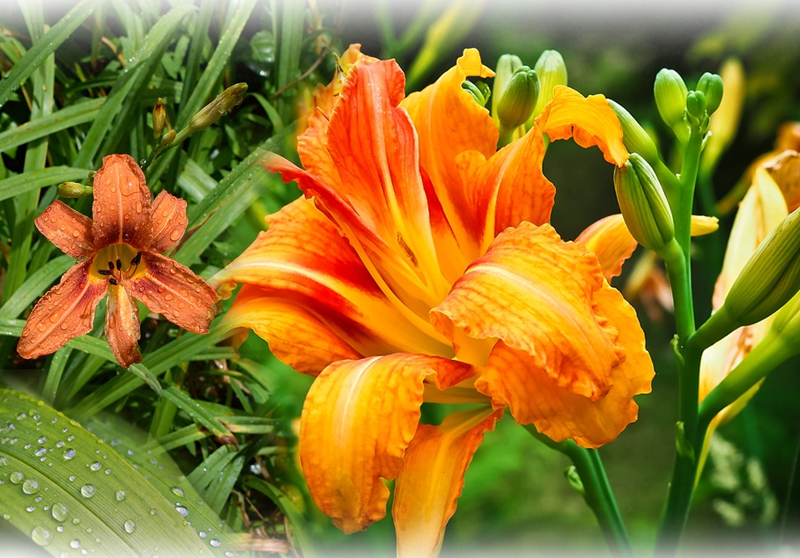
Daylily
 5
5 4
4 7
7Will it grow where I live?
Daylily is hardy to zone 3 – that covers all of Central Europe and the British Isles, and every USDA zone from 3 upwards.
Or check it for your location right here:
Profile
- Family
- Xanthorrhoeaceae
- Habit
- perennial
- Height
- 1.2 m
- Spread
- 0.5 m
- Growth
- medium
- Lifespan
- 5 years
- First yield
- after 1 year
- Hardiness
- zone 3–10
- Shade tolerance
- partial shade
- Soil
- Sand, Silt, Loam, Clay
- Soil moisture
- dry – very wet
- pH
- 6 – 7.5
Flowering & harvest
| J | F | M | A | M | J | J | A | S | O | N | D | |
|---|---|---|---|---|---|---|---|---|---|---|---|---|
| Flowering |
Uses
Edible: Leaves and young shoots can be cooked as a replacement for asparagus or celery, offering a sweet flavor. However, caution is needed to prevent the leaves from becoming stringy. The flowers, with thick and crisp petals, have a pleasant sweetness and can be consumed raw or cooked. Additionally, the flowers can be dried and utilized as a soup thickener, being a good source of iron. The flower buds taste similar to peas and are suitable for raw or cooked consumption, with the option of being dried for relish. Dried flowers have approximately 9.3% protein, 25% fat, 60% carbohydrates (sugar-rich), and 0.9% ash, along with a high vitamin A content. Tubers, with a nutty taste, can be eaten raw or cooked, with young tubers being preferable, although the inner part of older tubers remains tasty.
Other uses: The sturdy, desiccated leaves are twisted into twine for crafting footwear. These plants create an expansive cluster and work well as a low-lying vegetation when planted with a 90 cm gap in all directions. It is recommended to leave the withered leaves on the soil in winter for optimal coverage. The variety 'Kwanso Flore Pleno' was notably acknowledged.
Growing
The daylily is about as undemanding as perennials get. It thrives on sandy-loamy, nutrient-rich soil in full sun; in partial shade it still grows but flowers noticeably less. Fresh to moderately dry conditions suit it best, waterlogging does not. Hardiness is a non-issue under Central European conditions. After planting it needs a year or two before it really gets going. The real point to plan for is its spread: the fleshy rhizomes push steadily outwards, the clumps broaden, and every root fragment left in the ground grows into a new plant. Vigorous cultivars such as Europa push through closed turf. To keep it within a bed, give it generous spacing or contain it. After about ten years flowering falls off — that is the moment to divide and move it. Young spring shoots are popular with slugs.
Propagation
The triploid clone common in Europe is sterile and sets barely any viable seed; sowing gets you nowhere with it, and where seed does form, the seedlings come out uneven. Propagation is therefore by division, and that could hardly be simpler: in spring, or after flowering in late summer, lift the clump with a spade and break it apart; every piece of rhizome carrying an eye will take. Larger divisions go straight to their new position, smaller ones root more reliably potted up first. Plantlets occasionally form on the flowering stems, detach and root by themselves — these too can be taken off and potted. That every fragment reshoots is also why an established stand is so hard to remove again.
Value for wildlife
For native insects the daylily is of limited value. Nectar and pollen are both rated at just one level out of four, and no specialist wild bee or butterfly species are known for it — as an East Asian neophyte it has no established feeding relationships in Central Europe. Reliable visitor counts do not exist; NaturaDB notes explicitly for this species that no precise data on its value for bees and butterflies are available. On top of that, each flower is open for a single day, and the triploid clone widespread in Europe stays sterile, so it offers neither seed nor fruit for birds. Its ecological contribution in the garden lies elsewhere: the dense clumps give ground-dwelling animals cover and stabilise banks.
Notable
Special features: each flower opens for one day only, but the plant keeps pushing out new ones over roughly 6 weeks; after about 10 years flowering declines -> divide and move to a fresh position; the clone widespread in Europe is triploid+sterile and reproduces only by rhizomes, every root fragment becoming a new plant -> quick to spread and hard to undo; the dried flower buds sold in China as "golden needles" come, on current understanding, from H. citrina, H. lilioasphodelus or H. altissima, not from H. fulva; propagation by rhizome division at any time
Origin & habitat
East Asia: Korea, China, Japan. The natural range of the wild varieties covers the temperate and subtropical regions of Korea, China and Japan, with one subspecies reaching into India. The species came to Europe early: Conrad Gessner described it as far back as 1561, the cultivar Europa escaped in England during the 17th century and spread across the continent, and North America followed towards the end of the 19th century. The clone common in Europe is triploid and therefore largely sterile — it sets almost no viable seed and spreads instead by vigorous rhizomes. That purely vegetative increase is exactly what has made it a persistent neophyte on both continents, naturalising along verges and embankments.
As a naturalised neophyte in Europe, the daylily occupies mainly ruderal ground: roadsides, railway embankments, banks, abandoned gardens and woodland margins. In its East Asian homeland it grows in meadows and open woodland. It ranges from the lowlands up to about 1,000 metres and copes with soils between pH 6 and 8, but avoids waterlogging. It wants a sunny to lightly shaded position on sandy-loamy, nutrient-rich ground, fresh to moderately dry. Its persistence is striking: once established, clumps hold on for decades in places long since abandoned to maintenance, surviving there without setting any seed at all, purely through their fleshy rhizomes.
⚠️ Hazards
I can only speak from my experience of eating countless different daylilies: some flowers were enormously irritating in the mouth, so much so that I was still spitting afterwards to get rid of it. Taste the flowers first, therefore, before they go into a salad and get mixed in. The traditional heated preparation of the buds is the best and safest route. Raw consumption of the flowers of the clone widespread in Europe is generally advised against as well; larger amounts of root tissue can act as a laxative. For cats the plant is severely nephrotoxic and can cause kidney failure — worth taking seriously in a household with cats.
Frequently asked questions
Daylily: how big does it get?
Daylily (Hemerocallis fulva) grows as a perennial and reaches roughly 1.2 m in height when mature, with a spread of about 0.5 m. Growth is medium.
Daylily: what site does it need?
Daylily tolerates partial shade. Suitable soils are Sand, Silt, Loam, Clay. Soil moisture should be in the range dry – very wet. The pH may lie between 6 and 7.5.
Daylily: is it hardy?
Daylily is listed as hardy in zone 3–10 and survives normal winters outdoors there.
Daylily: will it grow in Central Europe?
Daylily is hardy to zone 3 – that covers all of Central Europe and the British Isles, and every USDA zone from 3 upwards.
Daylily: when does it flower?
In a temperate northern-hemisphere climate it flowers from June to July.
Daylily: is it poisonous?
Individual parts of Daylily are noted as mildly problematic — the plant does not count as poisonous. With wild plants, never rely on a database alone, only on a confident identification.
Daylily: what is it used for?
Rated on a scale up to 10: Edible 5/10, Medicinal 4/10, Other uses 7/10.
Plan this plant into your own garden
Permaplans plans your garden to scale on the map — with a site check, harvest calendar and over 1,000 plants. Free for iPhone, Android, Mac, Windows & Linux.
Will this plant grow where you live? → Check your site
Community experience
No first-hand reports for this plant yet.
Growing it? Write in the app what works for you – your post will show up here.
💬 Get the app and join in