
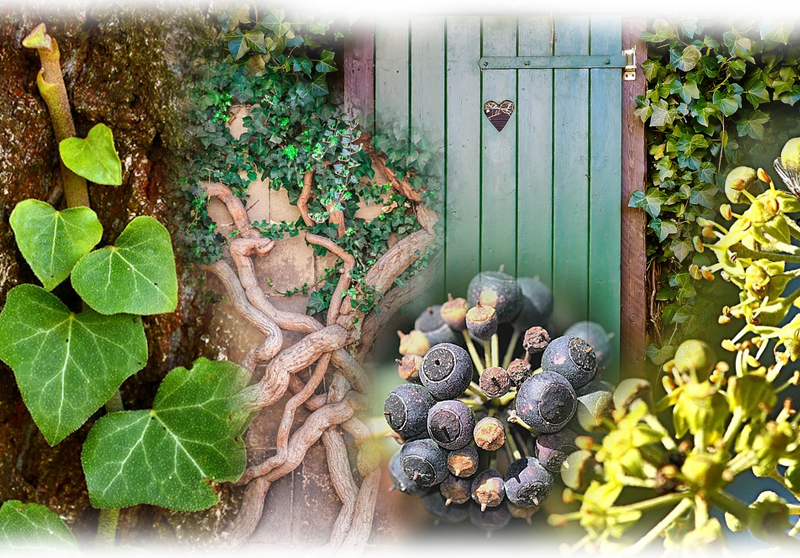
Ivy
 5
5 9
9Will it grow where I live?
Ivy is hardy to zone 5 – that covers all of Central Europe and the British Isles, and every USDA zone from 5 upwards.
Or check it for your location right here:
Profile
- Family
- Araliaceae
- Habit
- Climber
- Height
- 18.5 m
- Spread
- 10 m
- Growth
- medium
- Lifespan
- 450 years
- First yield
- after 9 years
- Hardiness
- zone 5–10
- Shade tolerance
- full shade
- Soil
- Sand, Silt, Loam, Clay
- Soil moisture
- very dry – very wet
- pH
- 5.5 – 8
- Planned in gardens
- 3×
Flowering & harvest
| J | F | M | A | M | J | J | A | S | O | N | D | |
|---|---|---|---|---|---|---|---|---|---|---|---|---|
| Flowering |
Uses
Edible: Ivy is not a food plant. All parts contain triterpene saponins, chiefly hederasaponin C and its breakdown product alpha-hederin, together with falcarinol. The blue-black berries taste markedly bitter, which makes eating any quantity unlikely; even two or three berries can cause burning in the throat, vomiting, diarrhoea, headache and a raised pulse in children. The figures quoted for the seed of around 16 per cent protein and 35 per cent fat come from a constituent analysis and are no indication of edibility. Historically leaves were fed to sheep and goats in times of need, as those animals tolerate them better than cattle and horses; for human cooking there is no documented use.
Other uses: Boiled ivy leaves yield a saponin-rich liquor that once served as a detergent for dark textiles: it cleans without drawing out the colour and refreshes black fabrics; the same decoction was used as a darkening hair rinse. The twigs give yellow and brown dye tones. The wood of old stems that have grown tree-like is fine and tough and was worked into walking-stick handles, turnery and inlay; long runners are classic binding material for wreaths. The greatest practical use today lies in facade greening: a closed cover of ivy acts as an insulating layer, buffers summer heat build-up, keeps driving rain off the wall and binds dust. As an evergreen ground cover, ivy clothes ground beneath trees where grass will not grow.
Growing
Site: Ivy is a decision for decades, because it can hardly be removed later. It does no harm to sound masonry and even shields it from driving rain and temperature swings; into damaged joints, under roof tiles and behind timber cladding it grows in and forces them apart. It can overgrow the crown of young or weakened trees, while old healthy ones carry it without harm. It climbs with adhesive roots and needs no trellis. Anyone wanting the late flowers for insects and the winter berries for birds must give it a surface where the upper part is allowed to mature. On a fully sunny south wall the evergreen foliage suffers from frost drought. Care: Pruning is possible almost any time, best in spring before growth starts. Cut back once a year at gutters, window frames and roof tiles, or it works its way in unnoticed. To rejuvenate, cut hard down near the base; it reshoots reliably. Feeding is unnecessary. Water in the first two years and on dry sunny sites; after that it is markedly drought-tolerant. Do not throw clippings into animal enclosures. Wear gloves when working with it, as the sap causes contact eczema in sensitive people.
Propagation
Ivy is most easily propagated from cuttings, and the growth form matters. Cuttings of the creeping juvenile form root almost without fail: semi-ripe shoots from July to September, or hardwood shoots in winter, ten to fifteen centimetres long, pushed into sandy substrate in a shaded spot, root within a few weeks. Anyone wanting an upright bush ivy must take the cuttings expressly from the flowering adult form; they keep that form permanently and no longer climb. Layering happens by itself, because creeping shoots root at the nodes, and a rooted section can be severed almost all year round. Sowing is only worthwhile for raising the wild form: the pulp of the berries, which ripen in spring, must be washed off, after which the seed germinates following about four weeks of cold.
Value for wildlife
Ivy matters to wildlife above all because it flowers at the wrong time of year. From September into November, when almost everything else has finished, its globular umbels carry nectar and pollen and draw honeybees, bumblebees, wasps, hornets and hoverflies; red admiral, peacock and comma butterflies feed there before overwintering. The ivy bee collects ivy pollen exclusively for its brood and cannot live without the plant. The second value comes in winter: the berries only ripen between January and April and are then emergency food for blackbird, song, mistle and fieldfare thrush, starling, blackcap, robin and woodpigeon, with at least twelve bird species documented. The dense evergreen growth on trunk and wall provides nesting and roosting places and overwintering shelter for insects at the same time. As a caterpillar food plant, by contrast, ivy is insignificant with six species.
Notable
Features: Drought and dirt tolerant; protects undamaged masonry from rain and temperature fluctuations while providing habitat for insects, birds, etc.; Ivy purifies the air from benzene, formaldehyde, xylenes, and toluene (hence also good as a houseplant); Plants form hedges along fences; Many decorative varieties for various purposes, some only >2m tall; Non-parasitic: obtains all nutrients from the sun and soil.
Origin & habitat
Europe and the Near East: from Ireland and the Iberian Peninsula to the Caucasus and northern Iran. The range follows the Atlantic to sub-Mediterranean climate. Northwards ivy reaches southern Scandinavia and the Baltic coastal belt; eastwards it thins out as winters grow colder and is absent from the continental interior. In the south it extends across North Africa, Asia Minor and the Caucasus. In Central Europe it is widespread in the lowlands and the uplands and climbs to about 1000 metres in the Alps. It was introduced to North America, Australia and New Zealand as an ornamental and is regionally invasive there, blanketing whole forest floors and smothering young trees in the absence of its native herbivores.
Ivy grows in deciduous and mixed woodland, floodplain forest, hedgerows, ravines and on shaded rock, frequently in beech and oak-hornbeam forest. It is the only native liana of any importance and climbs trees, walls and rock with adhesive roots without drawing water or nutrients from them; where there is nothing to climb it forms flat carpets across the woodland floor. The species is markedly shade-tolerant and stays for decades in its non-flowering juvenile form in deep shade; only in light does it form the upright adult growth with unlobed leaves, flowers and fruit. It prefers moist, nutrient-rich, freely drained soils and readily accepts lime. It avoids waterlogging, strongly acid raw humus layers and distinctly dry sandy heath.
⚠️ Hazards
Toxicity: highly toxic
The plant is said to be highly toxic in large quantities, although the leaves are consumed by various mammals without apparent harmful effects. The leaves and fruits contain the saponin-containing glycoside Hederagenin, which can cause respiratory distress and coma if ingested. The sap can cause dermatitis with blistering and inflammation, possibly due to the presence of polyacetylene compounds.
Frequently asked questions
Ivy: how big does it get?
Ivy (Hedera helix) grows as a Climber and reaches roughly 18.5 m in height when mature, with a spread of about 10 m. Growth is medium.
Ivy: what site does it need?
Ivy tolerates full shade. Suitable soils are Sand, Silt, Loam, Clay. Soil moisture should be in the range very dry – very wet. The pH may lie between 5.5 and 8.
Ivy: is it hardy?
Ivy is listed as hardy in zone 5–10 and survives normal winters outdoors there.
Ivy: will it grow in Central Europe?
Ivy is hardy to zone 5 – that covers all of Central Europe and the British Isles, and every USDA zone from 5 upwards.
Ivy: when does it flower?
In a temperate northern-hemisphere climate it flowers from September to October.
Ivy: is it poisonous?
Ivy is classified as highly toxic. With wild plants, never rely on a database alone — only on a confident identification.
Ivy: what is it used for?
Rated on a scale up to 10: Medicinal 5/10, Other uses 9/10.
Plan this plant into your own garden
Permaplans plans your garden to scale on the map — with a site check, harvest calendar and over 1,000 plants. Free for iPhone, Android, Mac, Windows & Linux.
Will this plant grow where you live? → Check your site
Community experience
No first-hand reports for this plant yet.
Growing it? Write in the app what works for you – your post will show up here.
💬 Get the app and join in