
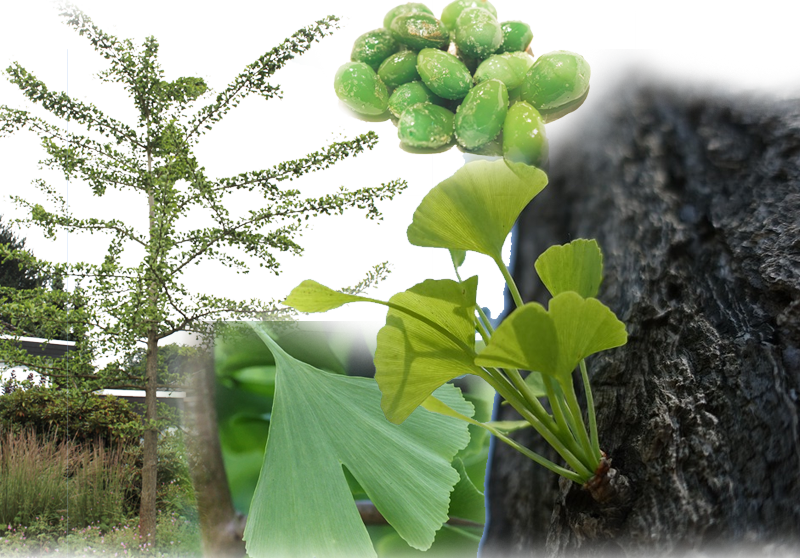
Ginkgo tree
 6
6 7
7 5
5Will it grow where I live?
Ginkgo tree is hardy to zone 4 – that covers all of Central Europe and the British Isles, and every USDA zone from 4 upwards.
Or check it for your location right here:
Profile
- Family
- Ginkgoaceae
- Habit
- Tree
- Height
- 35 m
- Spread
- 10 m
- Growth
- very slow
- Lifespan
- 1000 years
- First yield
- after 35 years
- Yield per plant
- up to 50 kg a year
- Yield in cultivation
- up to 7 t/ha
- Energy yield
- 1300 kcal per m² a year
- Hardiness
- zone 4–10
- Shade tolerance
- light shade
- Soil
- Sand, Silt, Loam
- Soil moisture
- very dry – very moist
- pH
- 5.5 – 9
- Synonyms
- Ginkgo, Gingko
Flowering & harvest
| J | F | M | A | M | J | J | A | S | O | N | D | |
|---|---|---|---|---|---|---|---|---|---|---|---|---|
| Flowering | ||||||||||||
| Fruit harvest | ||||||||||||
| Leaf harvest |
Uses
Edible: The seed can be consumed either raw or cooked in small amounts, offering a soft, oily texture and a sweet taste similar to large pine nuts. When cooked, it has a flavor resembling a mix of potato and sweet chestnut. It is versatile in various dishes like soups and porridge but should be cooked beforehand to eliminate its slightly sharp taste. While some sources suggest raw consumption is possible, others caution against excessive intake due to potential toxicity. Rich in niacin, the seed provides a good source of starch and protein with low fat content, primarily unsaturated or monounsaturated. Additionally, the seed is used for extracting cooking oil.
Medicinal: Ginkgo has a rich history in traditional Chinese medicine, with its seeds being the primary focus. The plant's leaves contain active compounds that can enhance blood flow, boost cognitive function, and enhance memory. Additionally, they can improve peripheral circulation and potentially alleviate conditions like tinnitus. Ginkgolides, unique components in the leaves, have anti-allergic properties that may benefit individuals with asthma. The ginkgo fruit possesses antibacterial, antifungal, and calming qualities. Traditionally, the boiled seeds have been utilized to address asthma, coughs, and urinary issues, although caution is necessary due to reported cases of toxicity.
Other uses: The leaves are economically the most important part today: their extract underpins a worldwide pharmaceutical and supplement industry. Ginkgo is grown in plantations for this purpose — the largest lies at Sumter, South Carolina, where millions of closely spaced trees are cut back to ground level every five years and harvested mechanically; China has some 5,000 hectares, mainly in Jiangsu and Shandong. Harvesting begins in mid-July while the leaves are still green, and they must be dried within twelve hours. The wood is light, soft and splits well, and is used in East Asia for shrines, temple buildings and furniture. In the garden the narrow habit and light shade are valued, making the tree a living support for grape or kiwi.
Growing
Site: Ginkgo is undemanding but needs space and time — it reaches 25 to 40 metres and lives for centuries. It avoids very wet and very dry soils; otherwise it grows on acid and calcareous ground alike, takes frost to around minus 30 degrees, and shrugs off road salt, exhaust and compacted urban soil like almost no other tree. Sex is the decisive question: the fleshy seed coat of female trees smells strongly of butyric acid as it rots and makes paths, terraces and parking spaces unpleasant for weeks — so set female trees well away from seating, or deliberately choose a male clone if you do not want to harvest seed. Its narrow crown casts little shade, which makes it a usable living support for grape or kiwi. It poses no risk to fruit plantings, sharing no diseases with them. Care: Pruning is unnecessary but tolerated without complaint; in China cropping trees are kept to about five metres by regular cutting back. Fertilise sparingly, shelter young trees through their first winters, and after that the tree is practically indestructible — no significant pests or diseases are known. The foliage falls late and drops completely within a few days, which makes raking simple. Seeds ripen in October and November; wear gloves when removing the flesh, as the ginkgolic acids it contains irritate the skin. Seedlings need two to three decades to bear, and until then you do not know whether you have raised a male; grafted female cultivars fruit after three to five years, though markedly biennially.
Propagation
Sowing is the usual route. The soft flesh must be removed completely before stratification — best done with gloves, as it irritates the skin. The cleaned seeds are stratified cool and moist over winter and sown in spring; germination is reliable. The drawback lies in the outcome: ginkgo is dioecious, and whether a seedling turns out male or female only becomes apparent after many years. Literature puts the time to first fruiting of seed-raised trees at twenty to thirty-five years, in practice usually considerably less. Anyone aiming for a harvest therefore grafts onto seedling rootstocks: grafted female cultivars bear after three to five years. Propagation from softwood cuttings in a warm greenhouse is possible but less common.
Value for wildlife
Ginkgo is of little value to wildlife, and there is no sugar-coating it: a relict more than 200 million years old with no relatives in the central European flora, wind-pollinated, offering neither nectar nor usable pollen, and no native caterpillar or wild bee has adapted to it. Its proverbial freedom from pests is precisely the flip side of that isolation. What it can contribute is structure: as a large, very long-lived tree it provides perching and nesting opportunities for decades, later cavities and deadwood, and it persists where urban climate, road salt and compacted soil defeat native species. Anyone whose main aim is to support insects will achieve many times as much with field maple, hornbeam or large-leaved lime.
Notable
Special features: The only surviving species of Ginkgo that grew on Earth 200 million years ago and survived the Hiroshima atomic bomb at a distance of only 800m (all life within a 2km radius was destroyed); the variety "Dafushon" produces 5-10kg at 15 years; 50-100kg at 50 years; requires very little shade + trellis for vines, kiwi and others; very rarely also monoecious,
Origin & habitat
East Asia: south-western China. Natural wild stands are documented only from a small area in south-western China — the southern slopes of the Jinfo Shan near Chongqing, where genetic diversity is highest, and a few small populations in neighbouring Guizhou. The original range lay in mesophytic mixed forest along the Yangtze. The well-known population on Tianmu Shan in Zhejiang, by contrast, probably goes back to plantings by Buddhist monks. From China the ginkgo reached Japan by way of Korea and Europe in 1730; today it is planted worldwide in temperate regions as a park, street and temple tree, without naturalising anywhere.
In the few stands regarded as natural, ginkgo grows in species-rich deciduous mixed forest in the hill country of south-western China, mostly on steep rocky slopes and in ravines between 300 and 1,100 metres, alongside oak, maple, hickory and magnolia. It tolerates acid and alkaline soils alike and grows better on the latter, but avoids both permanently wet and markedly dry substrates. As the relict of a plant group widespread some 200 million years ago it no longer has a coherent natural ecosystem; its effective habitat today is the planted park, temple and street site.
⚠️ Hazards
The seed should be cooked before eating to eliminate a potentially harmful acidic compound, likely 4'-methoxypyridoxine, which can degrade vitamin B6. This compound is more harmful to children, but regular consumption of raw nuts over an extended period would be needed for any negative effects to show.
Frequently asked questions
Ginkgo tree: how big does it get?
Ginkgo tree (Ginkgo biloba) grows as a Tree and reaches roughly 35 m in height when mature, with a spread of about 10 m. Growth is very slow.
Ginkgo tree: what site does it need?
Ginkgo tree tolerates light shade. Suitable soils are Sand, Silt, Loam. Soil moisture should be in the range very dry – very moist. The pH may lie between 5.5 and 9.
Ginkgo tree: is it hardy?
Ginkgo tree is listed as hardy in zone 4–10 and survives normal winters outdoors there.
Ginkgo tree: will it grow in Central Europe?
Ginkgo tree is hardy to zone 4 – that covers all of Central Europe and the British Isles, and every USDA zone from 4 upwards.
Ginkgo tree: when does it flower?
In a temperate northern-hemisphere climate it flowers in May.
Ginkgo tree: when is it harvested?
In a temperate northern-hemisphere climate the fruit ripens in October.
Ginkgo tree: when does it start cropping, and how much?
Ginkgo tree first crops after 35 years. A mature plant gives up to 50 kg a year, in cultivation up to 7 t per hectare. Figures assume a good site; variety, soil and climate shift them considerably.
Ginkgo tree: is it poisonous?
Individual parts of Ginkgo tree are noted as mildly problematic — the plant does not count as poisonous. With wild plants, never rely on a database alone, only on a confident identification.
Ginkgo tree: what is it used for?
Rated on a scale up to 10: Edible 6/10, Medicinal 7/10, Other uses 5/10.
Plan this plant into your own garden
Permaplans plans your garden to scale on the map — with a site check, harvest calendar and over 1,000 plants. Free for iPhone, Android, Mac, Windows & Linux.
Will this plant grow where you live? → Check your site
Community experience
No first-hand reports for this plant yet.
Growing it? Write in the app what works for you – your post will show up here.
💬 Get the app and join in