
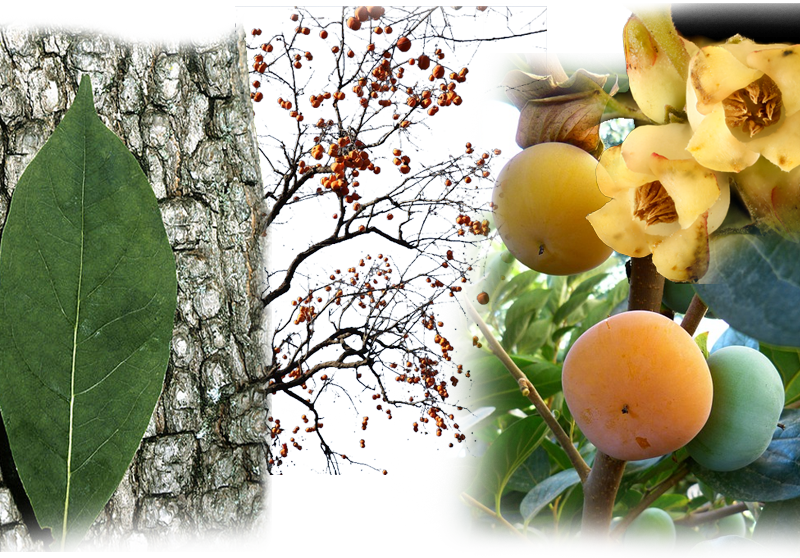
Persimmon
 8
8 4
4 5
5Will it grow where I live?
Persimmon is hardy to zone 5 – that covers all of Central Europe and the British Isles, and every USDA zone from 5 upwards. It also needs warm summers – in Central Europe that means wine-growing regions, cities or a sheltered south-facing wall.
Or check it for your location right here:
Profile
- Family
- Ebenaceae
- Habit
- Tree
- Height
- 17.5 m
- Spread
- 8 m
- Growth
- slow
- Lifespan
- 300 years
- First yield
- after 5 years
- Full yield
- after 25–50 years
- Productive years
- 20–300 years
- Yield per plant
- up to 40 kg a year
- Yield in cultivation
- up to 2 t/ha
- Energy yield
- 140 kcal per m² a year
- Hardiness
- zone 5–10
- Shade tolerance
- partial shade
- Soil
- Sand, Silt, Loam
- Soil moisture
- dry – moist
- pH
- 5.5 – 8
- Synonyms
- Amerikanische Kaki
Flowering & harvest
| J | F | M | A | M | J | J | A | S | O | N | D | |
|---|---|---|---|---|---|---|---|---|---|---|---|---|
| Flowering | ||||||||||||
| Fruit harvest |
Varieties (11)
11 varieties of Persimmon are listed in the Permaplans variety finder — each with its own page: taste, ripening time, disease resistance, parentage and use.
- Early Golden Historic foundational variety, parent of many modern cultivars.
- Garretson Early-ripening, aromatic heirloom and important breeding parent.
- H-118 Very large-fruited Jerry Lehman selection of top quality.
- John Rick Large-fruited quality variety with especially rich flavour.
- Lena Large-fruited, productive variety with good sweet flavour.
- Meader The classic self-fertile, ultra-hardy variety for short northern summers.
- Morris Burton Small fruit, but praised by many as the best-tasting American persimmon.
- Prok Large-fruited, self-fertile go-to variety for the home garden.
- Szukis Self-fertile, cold-hardy variety with early, heavy yields.
- WS8-10 Very late-ripening variety, ideal for wildlife and an extended harvest.
- Yates Productive Indiana variety with large, high-quality fruit.
Uses
Edible: Fruit can be consumed raw, cooked, or dried and incorporated into various baked goods. It is typically plum-sized with a rich flavor when fully ripe, though it can be very tart and astringent before reaching full ripeness. In cooler summers, the fruit may not ripen well, but a frost can enhance its aroma. Harvesting after a frost in autumn is ideal. Despite a warm summer in 1996, some fruit on sun-exposed trees remained underripe. The fruit, measuring up to 4.5 cm in diameter, can also be dried for culinary use. The pulp can be used to make molasses, while the seeds yield an oil resembling peanut oil. Dried leaves can be brewed into a tea rich in vitamin C, with a pleasant sassafras-like flavor. Roasted seeds are sometimes used as a coffee alternative.
Medicinal: The leaves have cardiotonic, stimulating, and tonic properties. They are often used to treat heart conditions.
Other uses: Can be used as a base for D. kaki. The wood is strong, hard, heavy, fine-grained, elastic, and wear-resistant. It is used for making wooden goods, turnings, and especially golf club handles.
Growing
Requires good, deep loamy soil in sunny or lightly shaded areas for optimal growth. When cultivated for its fruit, it thrives in warm, sunny, and sheltered locations, preferring to avoid very acidic or excessively moist soils. While young plants are somewhat delicate, mature dormant trees can withstand temperatures as low as -35°C. Spring growth, especially in young plants, is vulnerable to frost, making it advisable to plant them in areas shielded from morning sunlight. Fruiting can commence within a few years, as evidenced by a 1.5-meter-tall plant at Kew Botanic Gardens in autumn 1996, bearing a significant yield. This species is sometimes grown for its edible fruit, with various named cultivars available. 'Dooley' and 'Geneva Red' are successful near the northern boundaries of persimmon cultivation, producing medium to large fruits. 'Meader' is suitable for cooler climates and is self-pollinating. Due to their long taproot, these plants are challenging to transplant, emphasizing the importance of planting them in their permanent positions promptly and providing winter protection during the initial years. The subspecies D. virginiana platycarpa, known for its sweet, juicy flesh, grows naturally from Missouri to Arkansas.
Propagation
Samen – am besten im Frühbeetkasten aussäen, sobald sie reif sind. Gelagerte Samen benötigen eine Kältebehandlung und sollten so früh wie möglich im Jahr ausgesät werden. Sie keimen in der Regel innerhalb von 1–6 Monaten bei 15 °C. Sobald die jungen Sämlinge groß genug sind, in ausreichend tiefe Töpfe umpflanzen und im Frühsommer auspflanzen. Die Pflanzen benötigen in den ersten ein bis zwei Wintern im Freien einen gewissen Schutz vor Frost. Stecklinge von halbverholzten Trieben, Juli/August im Frühbeetkasten. Absenker im Frühjahr.
Notable
Special features: heat-loving, young leaf shoots are susceptible to frost; unripe fruit is very astringent; store with apples (ethylene-emitting) until ripe; there are self-fertile varieties (e.g., Meader); D. kaki and D. lotus are similar, for which D. viriginiana can serve as a rootstock (perhaps also for D. nigra?)
Origin & habitat
Dry woodlands, former fields, and open areas on sandy soils that are well-drained. Can be located on various soil types ranging from sand to shale and mudflats.
Woodlands and scrub, typically found on limestone, occasionally forming pure stands in sheltered areas on chalk in the southeast and limestone in the northwest. A resilient plant, it thrives in diverse habitats.
Frequently asked questions
Persimmon: how big does it get?
Persimmon (Diospyros virginiana) grows as a Tree and reaches roughly 17.5 m in height when mature, with a spread of about 8 m. Growth is slow.
Persimmon: what site does it need?
Persimmon tolerates partial shade. Suitable soils are Sand, Silt, Loam. Soil moisture should be in the range dry – moist. The pH may lie between 5.5 and 8.
Persimmon: is it hardy?
Persimmon is listed as hardy in zone 5–10 and survives normal winters outdoors there.
Persimmon: will it grow in Central Europe?
Persimmon is hardy to zone 5 – that covers all of Central Europe and the British Isles, and every USDA zone from 5 upwards. It also needs warm summers – in Central Europe that means wine-growing regions, cities or a sheltered south-facing wall.
Persimmon: when does it flower?
In a temperate northern-hemisphere climate it flowers in June.
Persimmon: when is it harvested?
In a temperate northern-hemisphere climate the fruit ripens in November.
Persimmon: when does it start cropping, and how much?
Persimmon first crops after 5 years. Full yield comes after 25–50 years. A mature plant gives up to 40 kg a year, in cultivation up to 2 t per hectare. The productive period lasts about 20–300 years. Figures assume a good site; variety, soil and climate shift them considerably.
Persimmon: is it poisonous?
No toxicity is recorded for Persimmon. With wild plants, never rely on a database alone — only on a confident identification.
Persimmon: what is it used for?
Rated on a scale up to 10: Edible 8/10, Medicinal 4/10, Other uses 5/10.
Which Persimmon varieties are there?
The Permaplans variety finder lists 11 varieties of Persimmon, including Early Golden, Garretson, H-118, John Rick, Lena, Meader, Morris Burton, Prok, Szukis, WS8-10, Yates. Each variety has its own page with taste, ripening time, disease resistance and parentage.
Plan this plant into your own garden
Permaplans plans your garden to scale on the map — with a site check, harvest calendar and over 1,000 plants. Free for iPhone, Android, Mac, Windows & Linux.
Will this plant grow where you live? → Check your site
Community experience
No first-hand reports for this plant yet.
Growing it? Write in the app what works for you – your post will show up here.
💬 Get the app and join in