
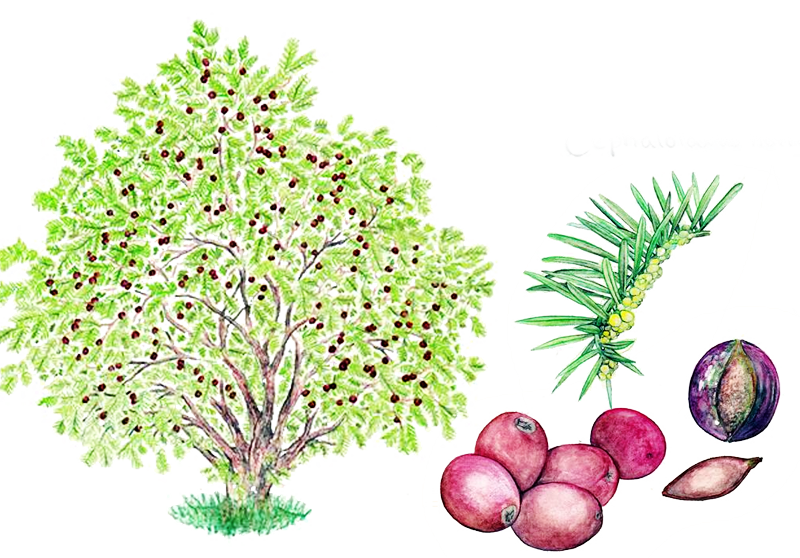
Japanese plum yew
 4
4 1
1 8
8Will it grow where I live?
Japanese plum yew is hardy to zone 7: lowlands, river valleys and cities across Central Europe are fine, harsher continental or upland sites need winter protection or a container.
Or check it for your location right here:
Profile
- Family
- Cephalotaxaceae
- Habit
- Shrub
- Height
- 5 m
- Spread
- 4 m
- Growth
- very slow
- Lifespan
- 150 years
- First yield
- after 7 years
- Yield per plant
- up to 4 kg a year
- Yield in cultivation
- up to 2 t/ha
- Energy yield
- 800 kcal per m² a year
- Hardiness
- zone 7–9
- Shade tolerance
- full shade
- Soil
- Sand, Silt, Loam
- Soil moisture
- semi-dry – very wet
- pH
- 5 – 7
- Synonyms
- Taxus harringtonia, Pflaumeneibe
Flowering & harvest
| J | F | M | A | M | J | J | A | S | O | N | D | |
|---|---|---|---|---|---|---|---|---|---|---|---|---|
| Flowering | ||||||||||||
| Fruit harvest |
Uses
Edible: Fruit + seeds (raw) 2t/ha correspond to about 800 kcal/m² and have a sweet pine nut flavor with a hint of pine resin.
Medicinal: The leaves contain homoharringtonine, a compound utilized in cancer treatment due to its anticancer properties.
Other uses: Seeds, oil, bulbs, wood, hedges Bulbs crafted from seed oil are highly resilient and perfect for illumination. Wood is solid, tough, and long-lasting. Hedges thrive in shade, respond well to pruning, and stay green throughout the year.
Growing
Thrives in moist, well-drained sandy soil but can adapt to various soil types, except for dry, gravelly, or calcareous soils. Prefers partial shade but can tolerate full shade and does not do well in full sun. Flourishes in mild, humid coastal regions, needing a sheltered, moist location and avoiding very exposed positions. While the dormant plant is extremely resilient, the young spring growth, even in mature plants, is sensitive to frost. It is advisable to grow the plants in a spot shielded from the morning sun. The Japanese Plum Yewen Tree is a slow-growing tree with high potential as a food crop. It typically yields abundant fruit and seeds, commonly consumed in Japan. Moreover, the seeds seem to be impervious to squirrel predation. There has been some confusion regarding the classification of this species. Some botanists have classified C. drupacea as a distinct species, although most now consider it a subspecies of this plant. In cultivation, it is often referred to as the cultivar 'Fastigiata'. Another subspecies, C. harringtonia nana, is a small, spreading shrub reaching up to 2 meters in height, spreading through runners. This variety is reputed to bear the best fruit in this genus and is highly resilient, thriving as far south as southern Sweden and Nova Scotia. The plants are dioecious, with female plants occasionally producing fruit and sterile seeds even without male plants. However, it is recommended to have at least one male plant for every five female plants when cultivating for fruit and seeds. Plants can also change gender, with male cones developing in the axils of the previous year's leaves and female cones at the base of the branch tips.
Propagation
Seeds should be planted right after they mature in a cool environment to sprout in the following spring. A tough seed coat might slow down germination, particularly if the seed isn't planted promptly. Preserved seeds need to undergo cold stratification and be planted in the spring in a cool setting. Germination may require 18 months or longer. Once seedlings reach a suitable size, transfer them and nurture them indoors for at least their initial winter. When the last frosts are over, move them outdoors in late spring. Semi-woody cuttings from the tips of shoots can be taken in August or September in a damp, cool environment, but this process is challenging.
Notable
Special features: Requires one male to fertilize five females. However, females sometimes produce fruit with infertile seeds without a male. They can also change sex. Best placed in a position protected from morning sun. There is also the Chinese plum yew (C. fortunei).
Origin & habitat
An understory tree species for forests in deep, fertile, moist soil in river valleys and depressions, often found in thickets.
⚠️ Hazards
The fruit, including the seeds, is edible, but my friend vomited after eating them. I consumed the seeds without any adverse effects. Given its relation to the yew, I would approach it cautiously like the common yew, concentrating on consuming the fruit pulp and avoiding the seeds.
Frequently asked questions
Japanese plum yew: how big does it get?
Japanese plum yew (Cephalotaxus harringtonia drupacea) grows as a Shrub and reaches roughly 5 m in height when mature, with a spread of about 4 m. Growth is very slow.
Japanese plum yew: what site does it need?
Japanese plum yew tolerates full shade. Suitable soils are Sand, Silt, Loam. Soil moisture should be in the range semi-dry – very wet. The pH may lie between 5 and 7.
Japanese plum yew: is it hardy?
Japanese plum yew is listed as hardy in zone 7–9 and survives normal winters outdoors there.
Japanese plum yew: will it grow in Central Europe?
Japanese plum yew is hardy to zone 7: lowlands, river valleys and cities across Central Europe are fine, harsher continental or upland sites need winter protection or a container.
Japanese plum yew: when does it flower?
In a temperate northern-hemisphere climate it flowers in May.
Japanese plum yew: when is it harvested?
In a temperate northern-hemisphere climate the fruit ripens in November.
Japanese plum yew: when does it start cropping, and how much?
Japanese plum yew first crops after 7 years. A mature plant gives up to 4 kg a year, in cultivation up to 2 t per hectare. Figures assume a good site; variety, soil and climate shift them considerably.
Japanese plum yew: is it poisonous?
Individual parts of Japanese plum yew are noted as mildly problematic — the plant does not count as poisonous. With wild plants, never rely on a database alone, only on a confident identification.
Japanese plum yew: what is it used for?
Rated on a scale up to 10: Edible 4/10, Medicinal 1/10, Other uses 8/10.
Plan this plant into your own garden
Permaplans plans your garden to scale on the map — with a site check, harvest calendar and over 1,000 plants. Free for iPhone, Android, Mac, Windows & Linux.
Will this plant grow where you live? → Check your site
Community experience
No first-hand reports for this plant yet.
Growing it? Write in the app what works for you – your post will show up here.
💬 Get the app and join in