
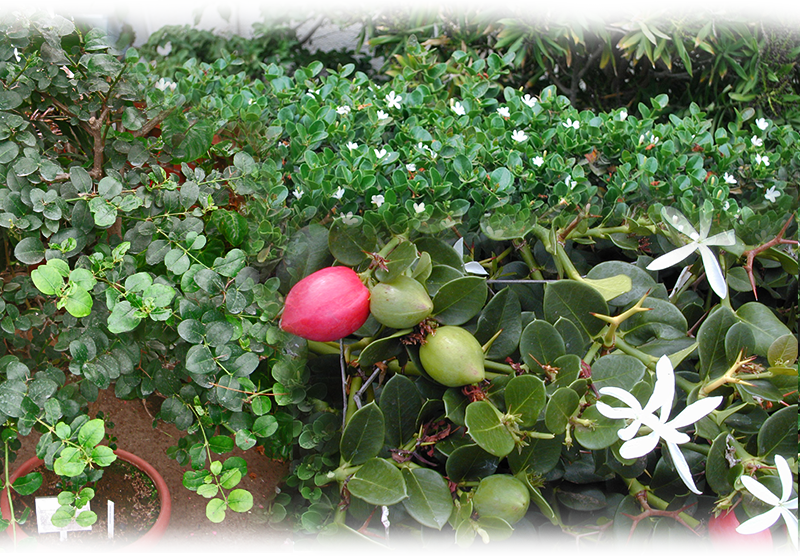
Natal plum
 8
8 4
4 4
4Will it grow where I live?
Natal plum is not winter-hardy in Central Europe (zone 9): outdoors from spring to autumn only, otherwise a container plant overwintered frost-free. It also needs warm summers – in Central Europe that means wine-growing regions, cities or a sheltered south-facing wall.
Or check it for your location right here:
Profile
- Family
- Apocynaceae
- Habit
- Shrub
- Height
- 3 m
- Spread
- 3 m
- Growth
- medium
- Lifespan
- 25 years
- First yield
- after 3 years
- Hardiness
- zone 9–12
- Shade tolerance
- partial shade
- Soil
- Sand, Silt, Loam
- Soil moisture
- very dry – very moist
- pH
- 6 – 7.5
Uses
Medicinal: Fruit (boosts the immune system); other parts except the fruit are considered toxic; roots (strong antimicrobial) decoction (sexually transmitted diseases, restoring potency, may induce miscarriages); leaves (anti-cancer) poultice (toothaches, inflammations, pains, chest pains, malaria); branches (against worm infestations).
Other uses: Plant: Bonsai, ornamental plant, hedge plant for demarcation, erosion control; A non-toxic, milky sap oozes from all parts of the plant when cut.
Origin & habitat
Influencing rocks up to 3600 meters in the Himalayas, it is found on rocks affecting the hottest regions. In the Mediterranean region, it is located on ancient walls, cliffs, and rocky slopes.
⚠️ Hazards
The Natal plum is mildly toxic, causing gastrointestinal issues, vomiting, and allergic reactions in both humans and animals when consumed in its unripe state or when exposed to the plant's sap. Cats and dogs are particularly at risk.
Frequently asked questions
Natal plum: how big does it get?
Natal plum (Carissa macrocarpa) grows as a Shrub and reaches roughly 3 m in height when mature, with a spread of about 3 m. Growth is medium.
Natal plum: what site does it need?
Natal plum tolerates partial shade. Suitable soils are Sand, Silt, Loam. Soil moisture should be in the range very dry – very moist. The pH may lie between 6 and 7.5.
Natal plum: is it hardy?
Natal plum is listed as hardy in zone 9–12 and survives normal winters outdoors there.
Natal plum: will it grow in Central Europe?
Natal plum is not winter-hardy in Central Europe (zone 9): outdoors from spring to autumn only, otherwise a container plant overwintered frost-free. It also needs warm summers – in Central Europe that means wine-growing regions, cities or a sheltered south-facing wall.
Natal plum: is it poisonous?
Individual parts of Natal plum are noted as mildly problematic — the plant does not count as poisonous. With wild plants, never rely on a database alone, only on a confident identification.
Natal plum: what is it used for?
Rated on a scale up to 10: Edible 8/10, Medicinal 4/10, Other uses 4/10.
Plan this plant into your own garden
Permaplans plans your garden to scale on the map — with a site check, harvest calendar and over 1,000 plants. Free for iPhone, Android, Mac, Windows & Linux.
Will this plant grow where you live? → Check your site
Community experience
No first-hand reports for this plant yet.
Growing it? Write in the app what works for you – your post will show up here.
💬 Get the app and join in