
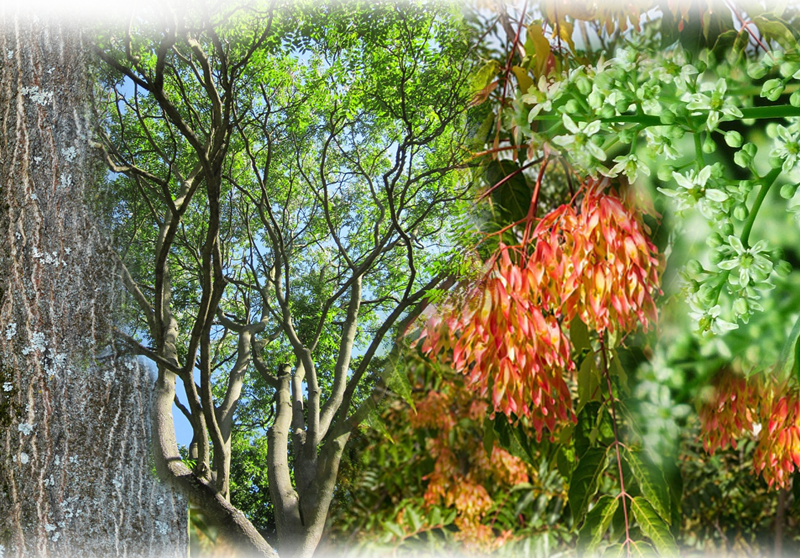
Tree of heaven
 1
1 6
6 6
6Will it grow where I live?
Tree of heaven is hardy to zone 6, which covers nearly all of Central Europe and the British Isles; only harsh upland sites (Alps, high ridges) call for winter protection.
Or check it for your location right here:
Profile
- Family
- Simaroubaceae
- Habit
- Tree
- Height
- 22.5 m
- Spread
- 15 m
- Growth
- very fast
- Lifespan
- 125 years
- First yield
- after 4 years
- Hardiness
- zone 6–9
- Shade tolerance
- partial shade
- Soil
- Sand, Silt, Loam
- Soil moisture
- very dry – near water
- pH
- 4.1 – 8
Flowering & harvest
| J | F | M | A | M | J | J | A | S | O | N | D | |
|---|---|---|---|---|---|---|---|---|---|---|---|---|
| Flowering | ||||||||||||
| Fruit harvest |
Uses
Edible: The tree of heaven is not a food plant. The leaves are toxic, as are the bark and sap; nothing on this tree is eaten. Two indirect uses are documented. The first is honey: the flowers yield abundant nectar, and in south-eastern Europe and Hungary tree-of-heaven honey counts as a monofloral speciality with a strong, musky aroma. The second concerns silk production, though differently from what is often claimed: for the classic silkworm Bombyx mori the leaves proved unusable. They are eaten by the ailanthus silkmoth (Samia cynthia), whose cocoon yields a coarser but more durable and cheaper silk; that is precisely why the moth was brought to Vienna and to several cities in the eastern USA in 1856. No silk industry came of it, and the moth remained behind as an alien species.
Medicinal: The plant's root and stem bark possess astringent, bitter, and antispasmodic qualities. However, when taken in doses of 4-9g, it can be harmful. Traditionally, it is used to address malaria, fever, dysentery, intestinal issues, and worm infestations. A root tincture may alleviate palpitations, asthma, epilepsy, and gastrointestinal problems. The plant's fruit is utilized for bloody stools or urine, venereal diseases like metrorrhagia, dysmenorrhea, leukorrhea, gonorrhea, and spermatorrhea, as well as eye ailments. The leaves, bark, and roots of the plant can assist with parasitic ulcers, itching, and rashes. The leaves exhibit anthelmintic, astringent, and purgative properties.
Other uses: Leaves are yellow. Combining leaves with wood creates paper. A mixture of leaves and flowers, mashed and mixed with water, serves as an insect repellent. Wood is hard, heavy, splits easily, is easy to work, is not durable, and has a coarse grain. Carpentry uses wood. Charcoal and firewood are other products made from wood.
Growing
Site: Since 25 July 2019 the tree of heaven has been on the list of invasive alien species of Union concern. Trade in it is therefore banned across the EU and it may not be newly planted — so the question of where to site it no longer arises for new plantings; in Switzerland sale has been prohibited since September 2024 under Annex 2.2 of the Release Ordinance. In practice only the handling of existing trees remains, and that is demanding. Where it stands it quickly forms thickets through aggressive root suckers, suppresses the germination of other species and soil life with the allelopathic compound ailanthone, and damages drainage pipes, walls and path surfaces. The wood is brittle and branches break in wind — critical above paths, seating areas and buildings. Male flowers smell unpleasant, and the bark and sap are toxic and irritate the skin, which matters near small-animal enclosures and play areas. Care: With existing trees the aim is containment, not encouragement, and the commonest mistake is cutting it down: the tree answers with massive stump regrowth and root suckers and so becomes more, not less. Girdling over two growing seasons is more effective, as is consistently removing suckers year after year; pull seedlings out at once while they are still single-rooted. In Austria and the USA host-specific Verticillium strains (V. nonalfalfae) are used as a mycoherbicide, and Switzerland is considering it. Wear gloves and long sleeves for all work, since the sap irritates the skin. Feeding and watering are pointless: the tree tolerates drought, heat, road salt, high and low pH and air pollutants, is hardy to at least minus 15 degrees and grows even on rubble. Verticillium wilt also occurs spontaneously and can kill trees suddenly.
Propagation
Seeds should be planted outside immediately after they are fully developed. If you have a limited quantity of seeds, it's advisable to plant them in a cool greenhouse. Germination rates may be low, typically averaging 56%, but one kilogram of seeds typically yields about 6,500 viable plants. For optimal germination, seeds should undergo a brief cold stratification period of 8 weeks. Root pruning should be done in December, while planting the runners is recommended in late winter. Once the seedlings are large enough to handle, transfer them to individual pots, keep them in a cool greenhouse during the first winter, and then plant them outdoors in late spring.
Value for wildlife
The wildlife balance of the tree of heaven is split. On the credit side stands the nectar: the flowers are remarkably productive, and in south-eastern Europe and Hungary tree-of-heaven honey is a monofloral speciality in its own right — which explains the high nectar value in the database. Almost everything else is on the debit side. From its native range in China, 46 arthropod species, 16 plant-pathogenic fungi and one virus are known to attack it; in its introduced range, by contrast, very few herbivores accept it, which was originally even treated as an argument for planting it. The only herbivore in Europe to have switched to it is the fall webworm (Hyphantria cunea) — itself an alien. The ailanthus silkmoth (Samia cynthia) feeds on the leaves but was brought to Vienna in 1856 for silk production and remains tied to warm urban areas. On top of that, ailanthone suppresses germination and soil life nearby. In dry grassland and open woodland it displaces native flora and raises nitrogen levels through easily decomposed litter — on balance a loss that the nectar does not offset.
Notable
Special features: highly drought/salt/pollution tolerant with a wide, shallow root system: good for soil stabilization and reclaiming (mines and ruins); breaks through concrete and water pipes!; min. 9°C Øyear; 1-2m growth/year; in swampy areas, for soil drainage → mosquitoes; reappeared in Germany in 1780 (Ice Age), banned from trade since 2019.
Origin & habitat
East Asia: China and northern Vietnam. From there the tree of heaven was taken from the mid-18th century onwards to other parts of Asia, to Europe and America and later to Africa and Australia — first as an urban and ornamental tree, and in Vienna also for an experiment in silk production. Today it grows wild in every region with a temperate or Mediterranean climate and counts among the hundred worst invasive species in Europe. In Germany it is still largely tied to urban heat islands: in Berlin its presence falls from 92 per cent of grid squares in the centre to 3 per cent at the city edge. Outside towns it follows railway lines and motorways conspicuously, already measurably spreading from Berlin into the surrounding countryside. With rising mean annual temperatures further spread is to be expected.
Native to temperate to subtropical regions with moist, often calcareous soils. Prefers open habitats such as forest edges, disturbed sites, roadsides, and wastelands. Thrives in full sun but can also grow in partial shade. Found from lowlands to moderate elevations. Commonly colonizes disturbed areas and tolerates dry to moderately moist soils, showing adaptability to a wide range of soil types and pH levels.
⚠️ Hazards
Toxicity: toxic
Toxic, skin irritation on contact, toxic to dogs and cats Bark, flowers and sap contain the bitter compound quassin; ingestion can cause severe poisoning, and the sap irritates the skin — wear gloves when pruning. In mammals quassin lowers the heart rate and in larger amounts can cause paralysis and death. Cats, which use the bark to sharpen their claws, and rodents are particularly at risk. Horses avoid the tree of their own accord.
Frequently asked questions
Tree of heaven: how big does it get?
Tree of heaven (Ailanthus altissima) grows as a Tree and reaches roughly 22.5 m in height when mature, with a spread of about 15 m. Growth is very fast.
Tree of heaven: what site does it need?
Tree of heaven tolerates partial shade. Suitable soils are Sand, Silt, Loam. Soil moisture should be in the range very dry – near water. The pH may lie between 4.1 and 8.
Tree of heaven: is it hardy?
Tree of heaven is listed as hardy in zone 6–9 and survives normal winters outdoors there.
Tree of heaven: will it grow in Central Europe?
Tree of heaven is hardy to zone 6, which covers nearly all of Central Europe and the British Isles; only harsh upland sites (Alps, high ridges) call for winter protection.
Tree of heaven: when does it flower?
In a temperate northern-hemisphere climate it flowers from June to July.
Tree of heaven: when is it harvested?
In a temperate northern-hemisphere climate the fruit ripens in October.
Tree of heaven: is it poisonous?
Tree of heaven is classified as toxic. With wild plants, never rely on a database alone — only on a confident identification.
Tree of heaven: what is it used for?
Rated on a scale up to 10: Edible 1/10, Medicinal 6/10, Other uses 6/10.
Plan this plant into your own garden
Permaplans plans your garden to scale on the map — with a site check, harvest calendar and over 1,000 plants. Free for iPhone, Android, Mac, Windows & Linux.
Will this plant grow where you live? → Check your site
Community experience
No first-hand reports for this plant yet.
Growing it? Write in the app what works for you – your post will show up here.
💬 Get the app and join in