
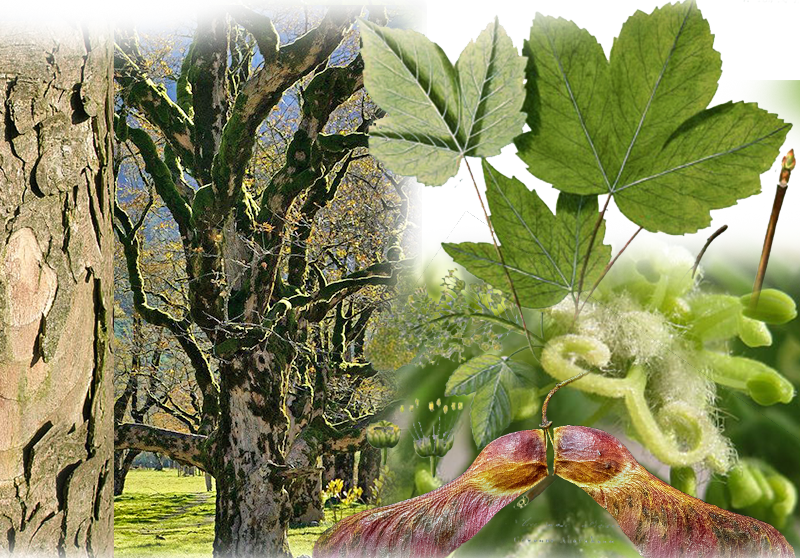
Sycamore maple
 4
4 2
2 9
9Will it grow where I live?
Sycamore maple is hardy to zone 5 – that covers all of Central Europe and the British Isles, and every USDA zone from 5 upwards.
Or check it for your location right here:
Profile
- Family
- Aceraceae
- Habit
- Tree
- Height
- 31.5 m
- Spread
- 16 m
- Growth
- very fast
- Lifespan
- 500 years
- First yield
- after 20 years
- Full yield
- after 80 years
- Yield in cultivation
- up to 12 t/ha
- Energy yield
- 75 kcal per m² a year
- Hardiness
- zone 5–7
- Shade tolerance
- partial shade
- Soil
- Sand, Silt, Loam, Clay
- Soil moisture
- semi-dry – very moist
- pH
- 5 – 8
- Synonyms
- Bergahorn
Flowering & harvest
| J | F | M | A | M | J | J | A | S | O | N | D | |
|---|---|---|---|---|---|---|---|---|---|---|---|---|
| Flowering | ||||||||||||
| Fruit harvest | ||||||||||||
| Leaf harvest |
Uses
Edible: What is used is essentially the spring sap. Before the leaves break, usually between February and early April, the tree stands under root pressure; drill the trunk and a clear, faintly sweet sap runs, drunk fresh or boiled down to syrup as with sugar maple. The sugar content is well below that of Acer saccharum, so a great deal must be evaporated for one litre of syrup. Seal the tap holes after harvest, and only tap strong, healthy trunks. The leaves were formerly used as wrapping to keep bread dough, butter and cheese fresh. Seeds and seedlings are emphatically not food: they contain hypoglycin A, the same substance that causes severe poisoning in grazing animals.
Medicinal: No medicinal use of sycamore maple is documented. Tradition records that maple leaves were applied externally as a poultice on wounds in folk medicine and that the spring sap was regarded in the Alps as a strengthening spring drink — both historically attested, without evidence of efficacy.
Other uses: Sycamore timber ranks among the fine hardwoods: pale to almost white, fine-pored, even and odourless. It goes into furniture, parquet, staircases and turnery, and because it gives off no smell of its own, traditionally into kitchen utensils, dough troughs and butchers' blocks. Trunks with wavy grain — fiddleback sycamore — are the classic wood for the backs and ribs of violins and guitars and fetch top prices. In the Alps sycamores were left standing as pasture trees on the high meadows, where they give shade and shelter to stock; individual trees are several hundred years old. The foliage was pollarded for winter fodder, and the leaves served as wrapping and lining material in food storage.
Growing
Site: Sycamore maple reaches 25 to 30 metres and almost the same in width with age — a tree for large grounds, pasture and avenues, not for the home garden. What matters most is distance from horse pasture and small-livestock runs: the seeds and seedlings contain hypoglycin A and cause atypical myopathy in horses, which is usually fatal. The winged fruits travel far, so a buffer of at least fifty metres to grazing land is sensible. Self-seeding is heavy; the following year seedlings stand in beds, paving joints and hedges. As a heart-rooter it occupies the soil deeply and makes underplanting laborious, and the coarse leaf litter breaks down slowly and does not belong in ponds. For bees it is one of the richest nectar sources of May. Care: Young trees need a three-stake support for three to four years plus protection against deer browsing and hares gnawing the bark. Prune in summer or late summer — in late winter and early spring the tree bleeds heavily from every cut. Do not feed it; it already benefits from airborne nitrogen. Tar spot draws black blotches on the leaves in late summer and is purely cosmetic. What does matter is verticillium wilt, for which no treatment exists, and sooty bark disease, which follows drought years: its spores can trigger allergic alveolitis in humans, so affected trees must be felled damp and with respiratory protection.
Propagation
Sycamore maple all but propagates itself — natural regeneration is abundant, and anyone needing young plants simply lifts seedlings in spring. For deliberate raising, collect the winged fruits in September and October and sow them at once outdoors or in seed trays left outside over winter; the seed needs cold to germinate and comes up the following spring. Badly dried seed loses viability fast; if it must be stored, give it two to four months of stratification at one to five degrees before sowing. Protect seedbeds from mice. Cuttings root poorly, so named cultivars are whip-grafted onto seedling rootstocks in winter or budded in summer. Trees cut to the stump resprout reliably, which makes pollarding and coppice management possible.
Value for wildlife
Sycamore maple is one of the most productive nectar sources of spring. Its inconspicuous greenish flowers open in May together with the leaves and yield nectar and pollen in quantity; honeybees, mining and mason bees, hoverflies and beetles work them, and pollination is by insects with wind as a supplement. Moth caterpillars, longhorn beetles and gall mites live on the leaves, wood and bark — the red pustules the mites raise on the foliage are harmless. Old trees with cavities and coarse bark are breeding and hunting ground for woodpeckers, nuthatches and bats, while bullfinches, hawfinches and mice take the winged fruits. In Central Europe the sycamore is native and a load-bearing species of its mountain forests; outside Europe, in New Zealand for instance, it counts as invasive.
Notable
Special features: Super chop & drop mulch & soil builder; syrup min. 60% sugar; sugar maple (Acer saccharum) needs a more continental climate, grows slowly, is 3x richer in sugar, has more culinary and medicinal uses; field maple (Acer campestre) leaves + leaf stalks + sauerkraut; sycamore is popular as a deer grazing material, but poisonous to horses;
Origin & habitat
Europe and western Asia. The continuous range runs from the Pyrenees across the Alps, the Apennines and the Carpathians to the Caucasus and Asia Minor; in Central Europe it is the commonest maple of the mountains. Its centre of distribution lies between 900 and 1,300 metres, reaching about 850 m in the Harz, 1,300 m in the Bavarian Forest, 1,400 m in the Black Forest and over 1,600 m in the Alps. North of the low mountain ranges it occurs naturally only on the more base-rich glacial soils of the plain; elsewhere it is largely planted and naturalised from plantings. Introduced as a forestry and park tree to North America, New Zealand, Australia and Argentina, where it spreads invasively in places.
Sycamore maple is a tree of cool, moist mountain country with a humid, sub-Atlantic climate. Its strongholds are ravine forests shared with ash and wych elm, goatsbeard-sycamore woodland, high-montane sycamore-beech forest and subalpine spruce-fir forest; it also appears in carbonate spruce-fir-beech and oak-ash woodland. It demands soils that stay fresh, well supplied with nutrients and rich in bases — limestone slope scree, loess loam, weathered basalt, mild clays — and coarse block scree is a characteristic special habitat. It avoids strongly alternating wet-dry ground, very acid and dry sites, base-poor groundwater soils, glacial sands and the more strongly pseudogleyed soils of the uplands. High airborne nitrogen inputs favour it, so it is currently expanding onto sites where it was formerly absent.
⚠️ Hazards
Toxic to grazing animals The seeds and seedlings contain hypoglycin A and cause atypical myopathy in horses, which is usually fatal. The dangerous periods are autumn, when the winged fruits blow onto pasture, and spring, when the seedlings come up; the substance also passes into water, so troughs beneath the tree are a risk in their own right. Felling trees affected by sooty bark disease requires respiratory protection, as the spores can trigger allergic alveolitis.
Frequently asked questions
Sycamore maple: how big does it get?
Sycamore maple (Acer pseudoplatanus) grows as a Tree and reaches roughly 31.5 m in height when mature, with a spread of about 16 m. Growth is very fast.
Sycamore maple: what site does it need?
Sycamore maple tolerates partial shade. Suitable soils are Sand, Silt, Loam, Clay. Soil moisture should be in the range semi-dry – very moist. The pH may lie between 5 and 8.
Sycamore maple: is it hardy?
Sycamore maple is listed as hardy in zone 5–7 and survives normal winters outdoors there.
Sycamore maple: will it grow in Central Europe?
Sycamore maple is hardy to zone 5 – that covers all of Central Europe and the British Isles, and every USDA zone from 5 upwards.
Sycamore maple: when does it flower?
In a temperate northern-hemisphere climate it flowers in May.
Sycamore maple: when is it harvested?
In a temperate northern-hemisphere climate the fruit ripens from September to October.
Sycamore maple: when does it start cropping, and how much?
Sycamore maple first crops after 20 years. Full yield comes after 80 years. In cultivation, up to 12 t per hectare is typical. Figures assume a good site; variety, soil and climate shift them considerably.
Sycamore maple: is it poisonous?
No toxicity is recorded for Sycamore maple. With wild plants, never rely on a database alone — only on a confident identification.
Sycamore maple: what is it used for?
Rated on a scale up to 10: Edible 4/10, Medicinal 2/10, Other uses 9/10.
Plan this plant into your own garden
Permaplans plans your garden to scale on the map — with a site check, harvest calendar and over 1,000 plants. Free for iPhone, Android, Mac, Windows & Linux.
Will this plant grow where you live? → Check your site
Community experience
No first-hand reports for this plant yet.
Growing it? Write in the app what works for you – your post will show up here.
💬 Get the app and join in