
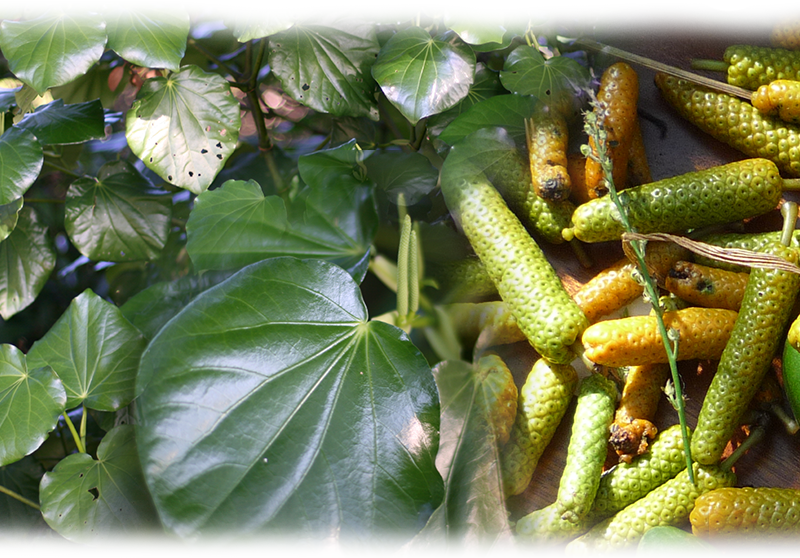
Kawakawa
 6
6 6
6 4
4Will it grow where I live?
Kawakawa is not winter-hardy in Central Europe (zone 9): outdoors from spring to autumn only, otherwise a container plant overwintered frost-free. It also needs warm summers – in Central Europe that means wine-growing regions, cities or a sheltered south-facing wall.
Or check it for your location right here:
Profile
- Family
- Piperaceae
- Habit
- Shrub
- Height
- 6 m
- Spread
- 6 m
- Growth
- medium
- Lifespan
- 30 years
- First yield
- after 3 years
- Hardiness
- zone 9–11
- Shade tolerance
- full shade
- Soil
- Sand, Silt, Loam, Clay
- Soil moisture
- moist – near water
- pH
- 6 – 7
- Synonyms
- Tahiti Pfeffer
Flowering & harvest
| J | F | M | A | M | J | J | A | S | O | N | D | |
|---|---|---|---|---|---|---|---|---|---|---|---|---|
| Flowering | ||||||||||||
| Fruit harvest |
Uses
Edible: Fruit+seeds (raw – like a spicy strawberry, seeds as a spice); leaves (aromatic) (beer, tea, flavor, seasoning in salt);
Medicinal: The fruit of the plant has diuretic properties and can help with toothaches as well as neuralgic/rheumatic joint pain. The leaves possess antiseptic, numbing, aphrodisiac, stimulating, and toning properties. An infusion of the leaves can act as a blood purifier, for kidney and bladder issues, stomach ailments, gonorrhea, and intestinal parasites. An infusion of the leaves can also aid in treating scabies when used in a bath. A poultice made from the leaves can help with skin problems such as bruises, abscesses, cuts, wounds, and swelling, as well as toothaches and rheumatism. The root can be used for toothaches and dysentery.
Other uses: Dry and burnt leaves (as insect repellent), signs of the morning; windbreak strips.
Origin & habitat
In the dry regions of the Andes, it is found as a shrub in arid areas, but it reaches tree size in dry riverbeds with accessible groundwater.
⚠️ Hazards
Although I have regularly consumed large amounts of tea without any issues, there are voices that advise against its consumption.
Frequently asked questions
Kawakawa: how big does it get?
Kawakawa (Piper excelsum) grows as a Shrub and reaches roughly 6 m in height when mature, with a spread of about 6 m. Growth is medium.
Kawakawa: what site does it need?
Kawakawa tolerates full shade. Suitable soils are Sand, Silt, Loam, Clay. Soil moisture should be in the range moist – near water. The pH may lie between 6 and 7.
Kawakawa: is it hardy?
Kawakawa is listed as hardy in zone 9–11 and survives normal winters outdoors there.
Kawakawa: will it grow in Central Europe?
Kawakawa is not winter-hardy in Central Europe (zone 9): outdoors from spring to autumn only, otherwise a container plant overwintered frost-free. It also needs warm summers – in Central Europe that means wine-growing regions, cities or a sheltered south-facing wall.
Kawakawa: when does it flower?
In a temperate northern-hemisphere climate it flowers from March to April.
Kawakawa: when is it harvested?
In a temperate northern-hemisphere climate the fruit ripens from June to November.
Kawakawa: is it poisonous?
Individual parts of Kawakawa are noted as mildly problematic — the plant does not count as poisonous. With wild plants, never rely on a database alone, only on a confident identification.
Kawakawa: what is it used for?
Rated on a scale up to 10: Edible 6/10, Medicinal 6/10, Other uses 4/10.
Plan this plant into your own garden
Permaplans plans your garden to scale on the map — with a site check, harvest calendar and over 1,000 plants. Free for iPhone, Android, Mac, Windows & Linux.
Will this plant grow where you live? → Check your site
Community experience
No first-hand reports for this plant yet.
Growing it? Write in the app what works for you – your post will show up here.
💬 Get the app and join in