
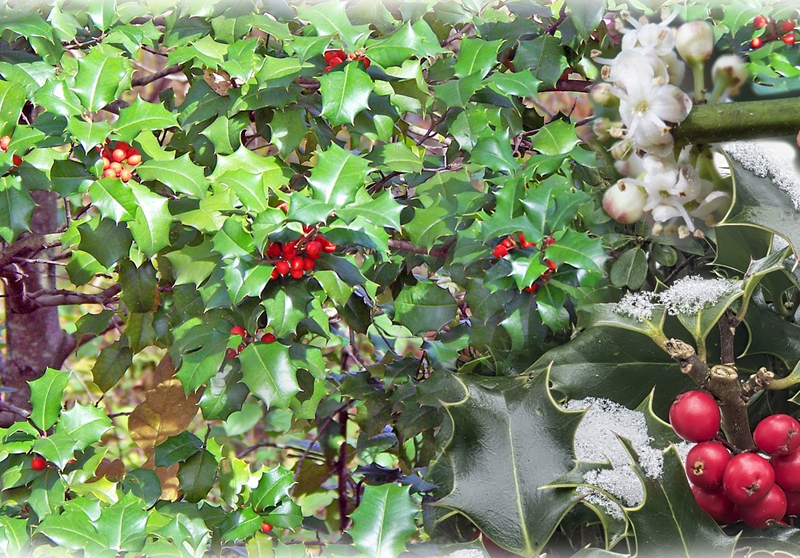
Holly
 3
3 4
4 5
5Will it grow where I live?
Holly is hardy to zone 6, which covers nearly all of Central Europe and the British Isles; only harsh upland sites (Alps, high ridges) call for winter protection.
Or check it for your location right here:
Profile
- Family
- Aquifoliaceae
- Habit
- Shrub
- Height
- 9 m
- Spread
- 5 m
- Growth
- very slow
- Lifespan
- 200 years
- First yield
- after 8 years
- Hardiness
- zone 6–9
- Shade tolerance
- full shade
- Soil
- Sand, Silt, Loam, Clay
- Soil moisture
- semi-dry – very wet
- pH
- 3 – 7.5
- Synonyms
- Ilex
Flowering & harvest
| J | F | M | A | M | J | J | A | S | O | N | D | |
|---|---|---|---|---|---|---|---|---|---|---|---|---|
| Flowering | ||||||||||||
| Fruit harvest |
Uses
Edible: Holly is not a food plant. The red berries are poisonous: they contain saponins and bitter compounds that cause vomiting and diarrhoea even in small quantity, and their colour means children eat them regularly. The only usable part is the roasted seed, historically ground as a coffee substitute; the effort bears no relation to the result. One correction is needed on leaf tea: the infusion drunk as maté comes from the South American relative Ilex paraguariensis, which contains caffeine. European holly contains virtually none; its leaves were indeed used as an infusion in western Europe, but in stronger doses they act as an emetic and purgative. The comparison with maté is therefore misleading and should not be read as a recommendation for use.
Medicinal: The leaves, tea, juice, Bach flower, fruit, and powder possess different healing qualities such as diaphoretic, expectorant, antipyretic, tonic, and antiseptic. They are utilized for treating influenza, rheumatism, catarrh, pleurisy, jaundice, dropsy, and to halt bleeding. The Bach flower promotes love in the heart. The fruit may lead to intense nausea and diarrhea.
Other uses: Holly wood is very hard, dense, fine-pored and almost white — the palest timber in Europe. Turned and carved it becomes chess pieces, inlay, handles, tool and whip stocks; stained black it served as a substitute for ebony. As fuel it can even be burnt green. Historically the bark mattered most: steeped for weeks and pounded, it yielded birdlime, with which songbirds were caught across Europe — a practice now banned that gave the tree its economic value for centuries. Bundled shoots served as chimney brushes and rodent deterrents, and the spineless upper leaves as winter fodder. In the garden the main practical use is the shear-tolerant, evergreen, defensive hedge that provides screening, shelter and boundary in one.
Growing
Site: With holly, legal protection comes before the question of site. In Germany it is specially protected under the federal species protection ordinance — wild plants may neither be dug up nor cut for Christmas greenery; nursery-grown plants are not affected. In the garden it wants a half-shaded to shaded spot sheltered from winter sun and sharp east wind, on lime-poor, humus-rich, loose soil. Two things belong in the planning: the lower leaves are hard-spined and have no place beside narrow paths, seating or play areas, and the red berries are poisonous, so distance from children's areas is sensible. Because the species is dioecious, only female plants fruit — and only with a male pollinator within reach. Over time root suckers build impenetrable thicket, welcome as cover but a nuisance on a boundary. Care: It grows slowly and needs patience, but takes clipping excellently and can be trained into dense evergreen hedges and topiary; cut in late June or in August, never in frost. The most important and most often forgotten point is winter watering: as an evergreen it transpires even in frost, and the commonest cause of damage is not cold but winter desiccation — water on frost-free winter days and mulch the root zone. Do not lime. The holly leaf miner draws yellowish blotches on the leaves, which is purely cosmetic; picking off affected leaves is enough. Shade young plants in their first winter and protect them from browsing. It transplants badly, so move it only with a rootball and as young as possible.
Propagation
Holly can be raised from seed, but it demands exceptional patience. The stones have a deep, double dormancy and lie in the ground for 18 months to 3 years depending on the batch before they come up; in nature passage through a bird's gut does part of the pre-treatment, while in cultivation a warm-cold stratification over at least one warm summer and one cold winter helps. On top of that, the sex of a seedling only shows with the first flowering many years later — anyone wanting berries buys named cultivars. Cuttings are therefore the practical route: half-ripe shoots with a heel taken in August and September, rooted under a cover with gentle bottom heat, need two to three months and give plants true to type and of known sex. Low branches can also be layered and root suckers of older plants severed.
Value for wildlife
Holly is not a mass forage plant but a winter refuge. Its small white flowers open from May to early June and are pollinated by bees; because the species is dioecious, fruit sets only on female plants with a pollinator nearby. The red drupes ripen from October and hang all winter — though only twelve bird species are known to eat them in Central Europe, chiefly thrushes, robin and blackcap, which disperse the seed through the gut. Its real value lies in the evergreen structure: a holly thicket is a roost, a nest site and an overwintering quarter for birds and insects at a time when the deciduous wood stands bare. Two organisms are bound to it: the holly leaf miner, whose larvae mine only in holly leaves, and the holly speckle, an ascomycete fungus found nowhere else.
Notable
Special features: Salt (with wind) tolerant; Needs a mild, cool location (e.g. coast, forest, backyard, etc.); Moderate warmth/nitrogen indicator; +hedge. Even the Celts hung the branches around the house/yard in winter/Christmas time to protect against evil: This led to the Christmas tree; H. Potter's magic wand was made of holly; holly was said to be full of nature spirits.
Origin & habitat
Atlantic Europe, North Africa and the Caucasus region: the range runs from the Iberian peninsula and north-west Africa across France, Britain and Ireland and western and northern Germany to southern Scandinavia, and eastwards over the Caucasus into northern Iran. Its northern limit follows the zero-degree January isotherm: it needs mild winters and summers that are not too dry. Over recent decades the range has expanded northwards with the warming climate, and the species is now recorded on the Norwegian coast up to 63 degrees north. In Central Europe its stronghold is the north-west German lowland, the Lower Rhine and the western uplands; eastwards and into more continental districts it quickly becomes rare. In mountains it climbs to about 1,800 metres.
Holly is a shade-tolerant understorey shrub of deciduous woodland and one of only four native tall-growing evergreen woody plants — alongside ivy, box and yew. It grows above all in beech, beech-fir, oak-hornbeam and oak-birch woods on nutrient-rich, lime-poor, loose to stony loams. Half-shade and shade are its optimum, and because it suckers from the roots it often forms large continuous stands there. Its leaves show heterophylly: in the lower zone reachable by game they are wavy and strongly spined, higher up increasingly flat and spineless — a browsing defence that stops exactly where it is no longer needed. What limits it is winter, not shade: severe bare frost and continental cold rule it out.
⚠️ Hazards
Toxicity: toxic
Poisonous, poisonous to dogs and cats The red berries contain saponins and bitter compounds and cause vomiting, diarrhoea and drowsiness. Their colour means children eat them regularly, so distance from play and sitting areas matters. Dogs and cats also react to the berries.
Frequently asked questions
Holly: how big does it get?
Holly (Ilex aquifolium) grows as a Shrub and reaches roughly 9 m in height when mature, with a spread of about 5 m. Growth is very slow.
Holly: what site does it need?
Holly tolerates full shade. Suitable soils are Sand, Silt, Loam, Clay. Soil moisture should be in the range semi-dry – very wet. The pH may lie between 3 and 7.5.
Holly: is it hardy?
Holly is listed as hardy in zone 6–9 and survives normal winters outdoors there.
Holly: will it grow in Central Europe?
Holly is hardy to zone 6, which covers nearly all of Central Europe and the British Isles; only harsh upland sites (Alps, high ridges) call for winter protection.
Holly: when does it flower?
In a temperate northern-hemisphere climate it flowers from May to June.
Holly: when is it harvested?
In a temperate northern-hemisphere climate the fruit ripens in October.
Holly: is it poisonous?
Holly is classified as toxic. With wild plants, never rely on a database alone — only on a confident identification.
Holly: what is it used for?
Rated on a scale up to 10: Edible 3/10, Medicinal 4/10, Other uses 5/10.
Plan this plant into your own garden
Permaplans plans your garden to scale on the map — with a site check, harvest calendar and over 1,000 plants. Free for iPhone, Android, Mac, Windows & Linux.
Will this plant grow where you live? → Check your site
Community experience
No first-hand reports for this plant yet.
Growing it? Write in the app what works for you – your post will show up here.
💬 Get the app and join in