
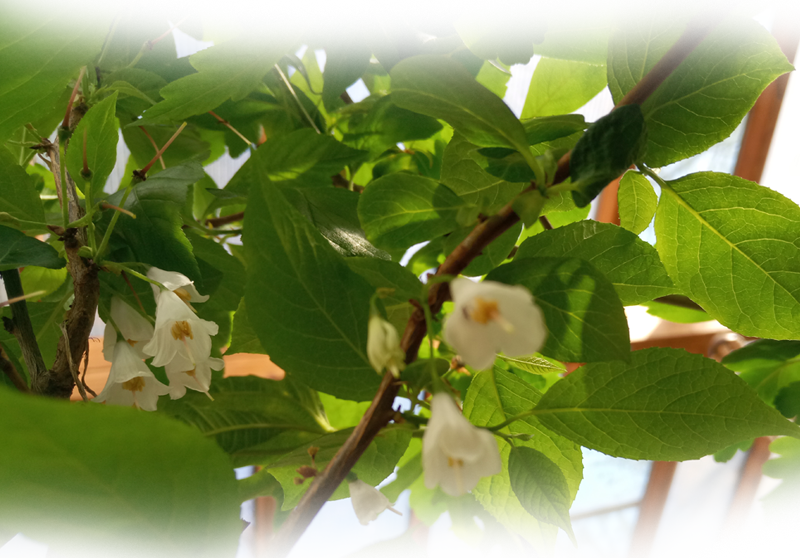
Snowdrop tree
 5
5 3
3Will it grow where I live?
Snowdrop tree is hardy to zone 5 – that covers all of Central Europe and the British Isles, and every USDA zone from 5 upwards.
Or check it for your location right here:
Profile
- Family
- Styracaceae
- Habit
- Shrub
- Height
- 6.5 m
- Spread
- 5 m
- Growth
- slow
- Lifespan
- 100 years
- First yield
- after 5 years
- Hardiness
- zone 5–8
- Shade tolerance
- light shade
- Soil
- Sand, Silt
- Soil moisture
- semi-dry – very wet
- pH
- 5 – 7
Flowering & harvest
| J | F | M | A | M | J | J | A | S | O | N | D | |
|---|---|---|---|---|---|---|---|---|---|---|---|---|
| Flowering | ||||||||||||
| Fruit harvest |
Uses
Edible: Unripe summer fruit has a tangy flavor similar to peas or cucumbers.
Other uses: Wood is soft, lightweight, and has a fine texture, commonly utilized in furniture making. It emits a pleasant floral fragrance and acts as a food source for various animals. Additionally, it is a decorative element in outdoor spaces.
Propagation
Seeds should be planted right after they ripen in a cool environment. It takes 18 months for them to sprout. To speed up germination, the seeds can undergo warm stratification at 14-25°C for 2-3 months, followed by cold stratification at 0-5°C for another 2-3 months. Once the seedlings are sufficiently grown, they need to be moved to individual pots and kept in the greenhouse for at least the first winter. Afterward, they can be transferred to their permanent spot in late spring or early summer, once the risk of frost has passed. Green wood cuttings, 5-8 cm in length with a heel, can be taken in May/June in a frame. Roots will develop within 28 days, with a relatively high success rate. Layering in early spring, as the buds start to grow, takes about 12 months to show results, with a high success rate.
Notable
Special features: Needs a sheltered, moist, humus-rich location; Cultivation as a small tree/shrub: Solitary. Dislikes neither heat nor drought. Origin: Appalachian Mountains (mountain region) in the southeastern USA in stream valleys. Blooms on previous year's wood. Synonym H. tetraptera is sometimes differentiated as a tree up to 10m with more soil and shade tolerance.
Origin & habitat
Southeastern region of North America - from Virginia to Florida, extending westward to Oklahoma.
Humid forests and thickets up to 1600 meters. Mixed forests and shrubs on mountain slopes, as well as humid areas in ravines at altitudes ranging from 900 to 3600 meters.
Frequently asked questions
Snowdrop tree: how big does it get?
Snowdrop tree (Halesia carolina) grows as a Shrub and reaches roughly 6.5 m in height when mature, with a spread of about 5 m. Growth is slow.
Snowdrop tree: what site does it need?
Snowdrop tree tolerates light shade. Suitable soils are Sand, Silt. Soil moisture should be in the range semi-dry – very wet. The pH may lie between 5 and 7.
Snowdrop tree: is it hardy?
Snowdrop tree is listed as hardy in zone 5–8 and survives normal winters outdoors there.
Snowdrop tree: will it grow in Central Europe?
Snowdrop tree is hardy to zone 5 – that covers all of Central Europe and the British Isles, and every USDA zone from 5 upwards.
Snowdrop tree: when does it flower?
In a temperate northern-hemisphere climate it flowers from April to May.
Snowdrop tree: when is it harvested?
In a temperate northern-hemisphere climate the fruit ripens in July.
Snowdrop tree: is it poisonous?
No toxicity is recorded for Snowdrop tree. With wild plants, never rely on a database alone — only on a confident identification.
Snowdrop tree: what is it used for?
Rated on a scale up to 10: Edible 5/10, Other uses 3/10.
Plan this plant into your own garden
Permaplans plans your garden to scale on the map — with a site check, harvest calendar and over 1,000 plants. Free for iPhone, Android, Mac, Windows & Linux.
Will this plant grow where you live? → Check your site
Community experience
No first-hand reports for this plant yet.
Growing it? Write in the app what works for you – your post will show up here.
💬 Get the app and join in