
 4
4 9
9Will it grow where I live?
Butterfly bush is hardy to zone 5 – that covers all of Central Europe and the British Isles, and every USDA zone from 5 upwards.
Or check it for your location right here:
Profile
- Family
- Buddleiaceae
- Habit
- Shrub
- Height
- 3 m
- Spread
- 4 m
- Growth
- very fast
- Lifespan
- 35 years
- First yield
- after 3 years
- Hardiness
- zone 5–8
- Shade tolerance
- full sun
- Soil
- Sand, Silt, Loam
- Soil moisture
- very dry – very moist
- pH
- 5.5 – 8.5
- Synonyms
- B. variabilis.
Flowering & harvest
| J | F | M | A | M | J | J | A | S | O | N | D | |
|---|---|---|---|---|---|---|---|---|---|---|---|---|
| Flowering | ||||||||||||
| Fruit harvest |
Uses
Medicinal: A plant with mild toxicity is utilized in traditional Chinese medicine to treat liver and bronchial ailments and aid in wound healing. Its flowers possess antioxidant and anti-inflammatory qualities. Extracts from the flowers produce essential oil and cream that offer anti-aging benefits, promote skin repair, and safeguard against collagen breakdown and UVA harm. Bach flower remedies derived from this plant may alleviate listlessness and irritability while enhancing joy and dignity. Smoking the plant can help restore balance. The leaves are appropriate for ointment dressings, and extracts are incorporated into skin creams.
Other uses: Shades from black to green can be obtained from the flowers, leaves and stems, and orange-gold to brown from the flowers alone. The most practical asset is the dense, deep root system, with which the shrub binds loose banks and gravel surfaces — the same trait that makes it so successful on railway embankments. Its strong honey scent and months-long flowering have made it a widely planted ornamental. The panicles are of limited use as cut flowers, since they wilt quickly. With any use the pressure to spread remains to be considered: without consistent removal of the seed heads, every planting contributes to further naturalisation.
Growing
Site: Full sun, free-draining and rather lean — on rich ground it grows luxuriantly and flowers less well; it accepts drought, urban climate and air pollution without complaint. Before the question of where comes the question of whether at all: it is an invasive neophyte, no longer legal to sell in Switzerland since September 2024, and seeds itself from any position over long distances onto railway ballast and wasteland. It draws butterflies in numbers but offers their caterpillars nothing. Anyone who genuinely wants to help them plants dogwood, privet, bird cherry or elder. Care: It flowers on the current year's wood and is cut back hard in late winter to two or three buds of the previous year's shoots; without this it becomes senescent and flowers sparsely. In harsh locations it dies back and reshoots from the base, which does no harm. Do not feed it. The second and decisive task is consistently cutting out the spent panicles before the seed ripens — this prolongs flowering and prevents seeding into the surroundings. Given its spreading behaviour this is not optional but obligatory.
Propagation
Propagation is trivial, and that is precisely the problem. A single shrub can produce around 20 million seeds a year — minute wind-borne seeds carried over long distances that germinate reliably on open mineral ground. This is the basis of its spread across railway ballast and wasteland. Anyone keeping it in a garden should cut off the seed heads before they ripen. Horticulturally it is propagated from cuttings: semi-ripe tip cuttings in summer or hardwood cuttings in winter root without special measures and come true to type. When planting anew it is worth asking whether a native shrub would not serve better: dogwood, privet, bird cherry and elder offer butterflies larval food as well.
Value for wildlife
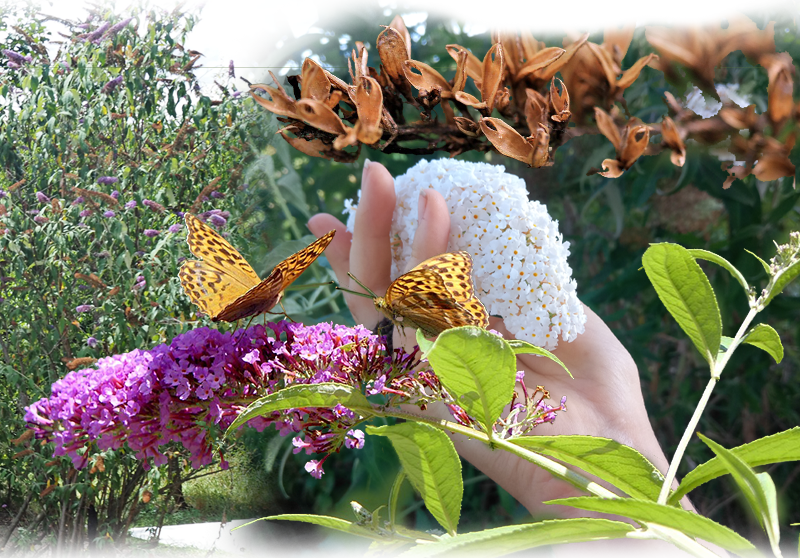
The butterfly bush bears its name rightly and misleadingly at once. Its honey-scented panicles open from June and supply abundant nectar into the autumn; butterflies and the hummingbird hawk-moth visit in numbers, making it a conspicuous late-summer nectar source. As a larval food plant, however, it offers practically nothing — the butterflies it attracts cannot breed on it. It thus serves the highly visible end of the life cycle and omits the decisive one. Reliable figures for wild bees, beetles or birds are not available. On balance the harm outweighs the benefit: where it spreads across railway ballast and wasteland it displaces precisely the sparse pioneer vegetation on which native butterflies raise their caterpillars.
Notable
Special features: Thrives in dry, nutrient-poor soils; highly resilient to limescale, sea wind, air pollution, and pests. Easily hybridizes with other Buddleja species, producing blooms in various colors such as white, purple, pink, rose, and blue. It serves as a significant nectar source in late summer. The flowering panicles, when soaked in olive oil for a month, can be turned into a ready-made cream that can be applied to the skin daily before bedtime, resulting in increased elasticity and a velvety soft texture.
Origin & habitat
China and Tibet; naturalised in Europe as a neophyte. The natural range of the butterfly bush lies in the mountains of central and western China and in Tibet, where it grows on rocky river banks at altitudes between roughly 1,300 and 2,600 m. It reached Europe towards the end of the nineteenth century as an ornamental. In Germany it has been recorded in the wild since 1928 and has since established firmly from garden escapes; today it is naturalised across much of central and western Europe. In the United Kingdom and Switzerland it is listed as invasive — in Switzerland its sale has been banned since September 2024.
In its native range the butterfly bush occupies rocky river banks and gravel flats in the Chinese mountains — open, stony, repeatedly disturbed mineral ground. It finds exactly this pattern again in the European cultural landscape: railway ballast and track beds, gravel bars and stream banks, industrial wasteland, demolition sites and wall tops. It is a pioneer of warm dry raw ground, demands full sun and prefers free-draining, neutral to basic, moderately nutrient-poor soils. It scarcely penetrates closed vegetation; its spread follows disturbance. On railway land and wasteland, however, it forms dense pure stands and displaces the sparse pioneer vegetation there.
⚠️ Hazards
Plant material can be touched without any issue, but should not be consumed or given to animals as it has slight toxicity.
Frequently asked questions
Butterfly bush: how big does it get?
Butterfly bush (Buddleja davidii) grows as a Shrub and reaches roughly 3 m in height when mature, with a spread of about 4 m. Growth is very fast.
Butterfly bush: what site does it need?
Butterfly bush tolerates full sun. Suitable soils are Sand, Silt, Loam. Soil moisture should be in the range very dry – very moist. The pH may lie between 5.5 and 8.5.
Butterfly bush: is it hardy?
Butterfly bush is listed as hardy in zone 5–8 and survives normal winters outdoors there.
Butterfly bush: will it grow in Central Europe?
Butterfly bush is hardy to zone 5 – that covers all of Central Europe and the British Isles, and every USDA zone from 5 upwards.
Butterfly bush: when does it flower?
In a temperate northern-hemisphere climate it flowers from July to October.
Butterfly bush: when is it harvested?
In a temperate northern-hemisphere climate the fruit ripens from September to October.
Butterfly bush: is it poisonous?
Individual parts of Butterfly bush are noted as mildly problematic — the plant does not count as poisonous. With wild plants, never rely on a database alone, only on a confident identification.
Butterfly bush: what is it used for?
Rated on a scale up to 10: Medicinal 4/10, Other uses 9/10.
Plan this plant into your own garden
Permaplans plans your garden to scale on the map — with a site check, harvest calendar and over 1,000 plants. Free for iPhone, Android, Mac, Windows & Linux.
Will this plant grow where you live? → Check your site
Community experience
What Permaplans users wrote about this plant – taken from the app as is. 2 posts.
These are so pretty! There are many of them in my town and I admire them when I drive by. it's definitely on my list to plant in the future.
Es gibt auch weiß blühende Sorten
Growing it? Write in the app what works for you – your post will show up here.
💬 Get the app and join in